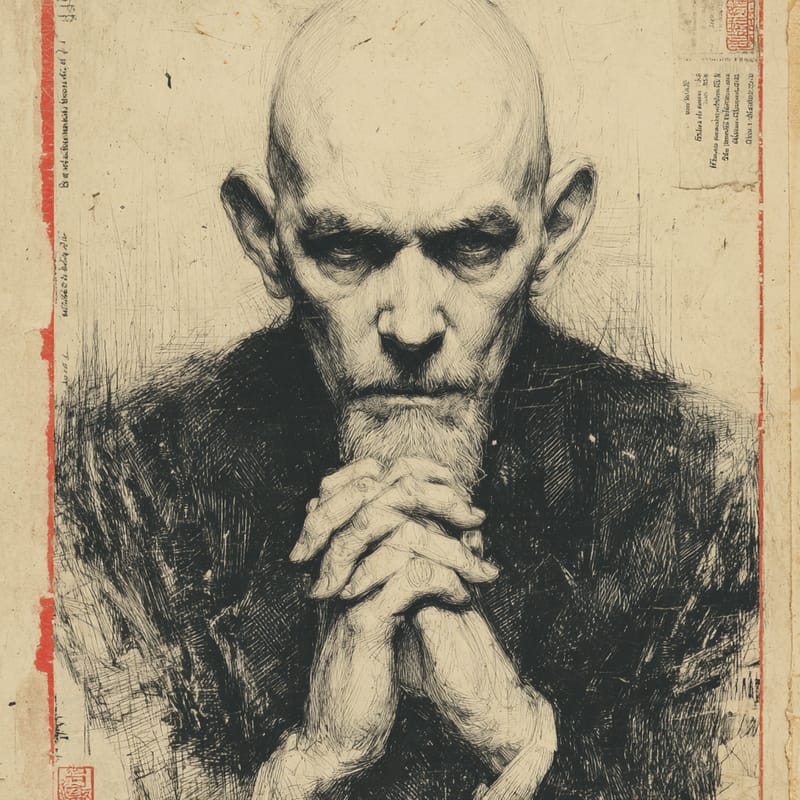
C. Montgomery Burns
Excellent.
Capital and control, gleefully fused.
Traditional Conservative CapitalistOne of 729 ideologies · enter the Conservative Capitalist hall →- Role
- Plutocrat (fiction)
- From
- The Simpsons
- Region
- United States
- Social band
- Traditional
- Placement
- +96 · +30 · −60
§ Where C. Montgomery Burns stands
3 axesBurns sits near the absolute market pole: he privately owns Springfield's power plant and treats its workers as costs to be minimised. In 'Last Exit to Springfield' (1993) he tries to scrap the union's dental plan and break its strike, and in 'Who Shot Mr. Burns?' (1995) he blocks out the sun so the town must buy more electricity. Profit, monopoly and private wealth are his only economic values.
Burns treats public institutions as instruments of private power. In 'Two Cars in Every Garage and Three Eyes on Every Fish' (1990) he runs for governor to escape safety regulators, spending lavishly on a slick media campaign, and he habitually treats officials as obstacles to be bought or bullied. His rule is plutocratic rather than formally dictatorial: he buys influence instead of abolishing elections.
Burns is reactionary to the point of parody. A relic of the nineteenth century, he clings to outdated customs, slang and technology and shows open contempt for the poor and for anyone outside the old moneyed elite, while 'Rosebud' (1993) has him pining for the teddy bear of his gilded childhood. The show treats his traditionalism as decrepitude rather than wisdom.
How close are you to C. Montgomery Burns?
Three statements, one per axis. Answer them and we’ll drop you on the compass next to them.
§ The story
FictionCharles Montgomery Burns is the elderly, fabulously rich owner of the Springfield Nuclear Power Plant in The Simpsons, the animated sitcom created by Matt Groening that began as a series on Fox in 1989. Voiced mainly by Harry Shearer, he employs Homer Simpson, whose name he can never remember, and is served by his devoted assistant Waylon Smithers. Frail, ancient and cartoonishly villainous, he steeples his fingers, murmurs 'Excellent' and sets his hounds on unwanted visitors.
Burns is television's most enduring caricature of the plutocrat: a monopolist who cuts safety corners, breaks strikes, pollutes the town and treats democracy as one more thing to buy. Writers have used him to satirise corporate power, from his run for governor after a three-eyed fish is found near his plant to his scheme to block out the sun, and the episode 'Rosebud' (1993) recasts his life as a parody of Citizen Kane. His name has become shorthand in political commentary for heartless bosses and billionaires.
Notable for
- 01Owns the nuclear plant
- 02'Release the hounds'
- 03Archetype of the plutocrat
Key works & moments
- 1989The Simpsons premieres as a series on Fox; Burns becomes a fixture as Homer's tyrannical boss.
- 1990Runs for governor in 'Two Cars in Every Garage and Three Eyes on Every Fish'.
- 1993Fights a union strike in 'Last Exit to Springfield' and searches for his lost bear in 'Rosebud'.
- 1994Appears among Springfield's Republican power brokers in 'Sideshow Bob Roberts'.
- 1995Blocks out the sun and is shot in the two-part 'Who Shot Mr. Burns?'.
In C. Montgomery Burns's words
“Excellent.”
“Since the beginning of time, man has yearned to destroy the sun.”
§ Minds closest to C. Montgomery Burns
All minds →



§ Also in the Conservative Capitalist hall
Enter the hall →§ Common questions
4 answersWhat is Mr Burns's political ideology?
Mr Burns is a caricature of the plutocratic capitalist: on the 99ideologies three-axis compass, a Traditional Conservative Capitalist. Economically he sits at the extreme market end (+96), a monopolist devoted to private profit and hostile to unions and regulation. On governance he leans authoritarian (+30), buying elections and officials rather than abolishing them, and socially he is deeply traditional (−60), an aristocratic reactionary contemptuous of the poor and of modern life.
Is Mr Burns left-wing or right-wing?
As a caricature, right-wing: he embodies what the left criticises about unchecked capitalism, from union-busting and pollution to buying political power, and 'Sideshow Bob Roberts' (1994) places him among Springfield's Republican power brokers. But he is not a model conservative or libertarian either. Burns cares nothing for free competition, family values or limited government, only for his own wealth and control, and he cheats markets as readily as voters. The writers aim him at plutocracy as such.
Why did Mr Burns run for governor?
To save his nuclear plant from the regulators. In 'Two Cars in Every Garage and Three Eyes on Every Fish' (1990), Bart catches a three-eyed fish near the plant and safety inspectors threaten to close it, so Burns runs for governor in order to change the rules himself. His spin doctors run a slick campaign recasting the mutant fish, Blinky, as nothing to fear, and he surges in the polls against Governor Mary Bailey. The bid collapses when Marge serves him Blinky at a staged family dinner and he spits it out on camera.
Which minds are closest to C. Montgomery Burns?
On the 99ideologies three-axis compass, the minds closest to C. Montgomery Burns are Chiang Ching-kuo (96% alike), Guizot (Doctrinaire archetype) (96% alike) and The Chicago-School technocrat (archetype) (95% alike). The furthest is Emma Goldman (0% alike).