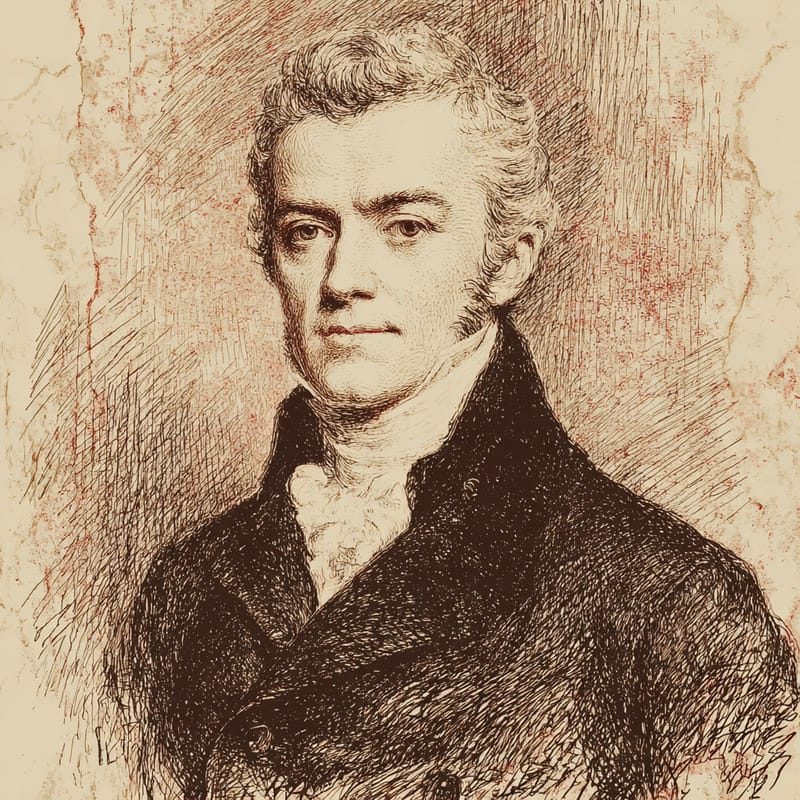
Alexander Hamilton
The financial founder
Capital, credit, and a strong union.
Traditional Conservative CapitalistOne of 729 ideologies · enter the Conservative Capitalist hall →- Role
- Treasury Secretary
- Era
- 1755–1804
- Region
- United States
- Social band
- Traditional
- Placement
- +88 · +28 · −38
§ Where Alexander Hamilton stands
3 axesHamilton was the architect of American capitalism. His 1790 Report on Public Credit had the federal government assume the states' war debts and fund them at face value, the First Bank of the United States was chartered in 1791, and his 1791 Report on Manufactures urged tariffs and subsidies to build industry. He wanted the state to create and protect markets, not to replace them.
Hamilton wanted an energetic central government and a strong executive. At the Constitutional Convention in 1787 he proposed a president and senate serving for life during good behaviour, Federalist No. 70 argued for vigour in the executive, and in 1794 he rode with the militia force that suppressed the Whiskey Rebellion against his excise tax. Yet he defended written constitutional limits and judicial review, notably in Federalist No. 78.
Hamilton distrusted popular passions and favoured government by a propertied, educated elite, which made him the target of Jeffersonian attacks as a would-be aristocrat. He was also an immigrant who rose by merit and a founding member of the New York Manumission Society, formed in 1785 to promote the gradual abolition of slavery, which complicates his order-minded conservatism.
How close are you to Alexander Hamilton?
Three statements, one per axis. Answer them and we’ll drop you on the compass next to them.
§ The story
HistoricalAlexander Hamilton (c. 1755–1804) was a founding father of the United States and its first secretary of the treasury. Born illegitimate on the Caribbean island of Nevis and orphaned young, he was sent to New York by sponsors impressed with his talent, studied at King's College and served as George Washington's aide-de-camp during the Revolutionary War. As a New York lawyer he pressed for a stronger national government, attended the 1787 Constitutional Convention and wrote most of The Federalist essays defending the new Constitution.
As treasury secretary from 1789 to 1795 Hamilton had the federal government assume the states' war debts, founded the First Bank of the United States and the Mint, and set out a programme for manufacturing that made him the architect of American finance. His vision of a commercial, centralised republic made him leader of the Federalists and a bitter rival of Thomas Jefferson and James Madison, whose opposition helped create the first party system. He was mortally wounded in a duel with Vice President Aaron Burr in 1804; the 2015 musical Hamilton revived his fame.
Notable for
- 01Founded the national financial system
- 02First Treasury Secretary
- 03The Federalist Papers
Key works & moments
- 1777Becomes aide-de-camp to General George Washington.
- 1787–88Writes 51 of the 85 Federalist essays with James Madison and John Jay.
- 1789Appointed the first secretary of the treasury.
- 1790Issues the Report on Public Credit; Congress approves federal assumption of state debts.
- 1791Secures the charter of the First Bank of the United States and presents the Report on Manufactures.
- 1804Mortally wounded by Aaron Burr in a duel at Weehawken, New Jersey.
In their own words
“Energy in the executive is a leading character in the definition of good government.”
§ Minds closest to Alexander Hamilton
All minds →


§ Also in the Conservative Capitalist hall
Enter the hall →§ Common questions
4 answersWhat was Alexander Hamilton's political ideology?
Hamilton was a Federalist who championed commerce, public credit and a strong national government: on the 99ideologies three-axis compass, a Traditional Conservative Capitalist. Economically he sat far to the market side (+88), building the banks, credit and industrial policy of American capitalism. On governance he favoured an energetic central state (+28) within a written constitution, and socially he was traditional (−38), trusting order and a propertied elite over popular passions.
Was Alexander Hamilton left-wing or right-wing?
By the standards of his time, right-wing. Hamilton stood for finance, manufacturing, central authority and an elite-led republic against Jefferson's agrarian, states'-rights democracy, which later Americans saw as the more popular cause. Yet his use of federal power to shape the economy has appealed to modern progressives as well as conservatives, and his membership of an anti-slavery society set him apart from slaveholding rivals such as Jefferson. Left and right fit early American politics only loosely.
Did Alexander Hamilton want a monarchy?
No, though his opponents accused him of it. In a long speech to the Constitutional Convention on 18 June 1787 Hamilton praised the British system of government and proposed an elected chief executive and senate serving for life during good behaviour, which Jefferson and his allies later cited as proof of monarchism. But Hamilton accepted the republican Constitution that emerged, defended it at length in The Federalist, and argued that an elected executive bound by law was not a king.
Which minds are closest to Alexander Hamilton?
On the 99ideologies three-axis compass, the minds closest to Alexander Hamilton are William McKinley (97% alike), Carlos Slim (96% alike) and The Chicago-School technocrat (archetype) (95% alike). The furthest is Emma Goldman (0% alike).