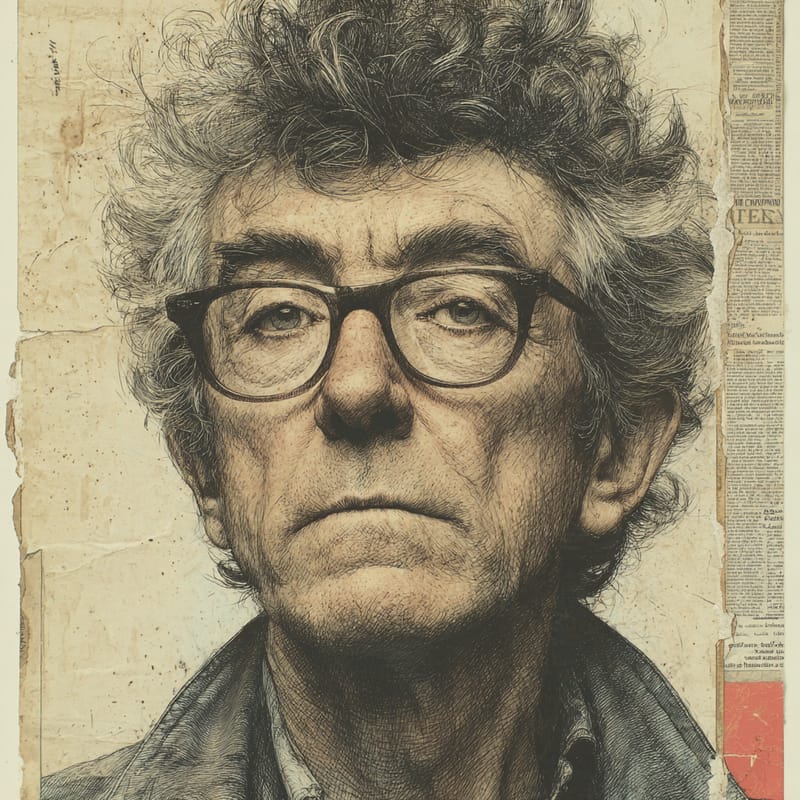
Ernest Mandel
Late capitalism
The economist of the Fourth International.
Progressive TrotskyistOne of 729 ideologies · enter the Trotskyist hall →- Role
- Economist & theorist
- Era
- 1923–1995
- Region
- Belgium
- Social band
- Progressive
- Placement
- −96 · +48 · +65
§ Where Ernest Mandel stands
3 axesMandel stood at the far socialist pole, seeking the abolition of private ownership of the means of production and its replacement by democratically planned production. In 'In Defence of Socialist Planning' (New Left Review, 1986) he rejected Alec Nove's case for market socialism, arguing that producers and consumers should set priorities through self-managed councils rather than through markets or bureaucrats.
As a Leninist, Mandel believed capitalism would fall to a revolution led by a vanguard party, and he defended the dictatorship of the proletariat in its Marxist sense. Yet he was fiercely anti-bureaucratic: the Fourth International's resolution Socialist Democracy and the Dictatorship of the Proletariat, closely associated with him, endorsed multi-party pluralism and free trade unions under workers' rule.
Mandel embraced the new left. He spoke at the International Vietnam Congress in West Berlin in February 1968 and championed that year's student revolts, treating students, anti-colonial movements and the women's movement as allies of the working class. His internationalism rejected nationalism of every kind as a barrier to the unity of workers across borders.
How close are you to Ernest Mandel?
Three statements, one per axis. Answer them and we’ll drop you on the compass next to them.
§ The story
HistoricalErnest Ezra Mandel (1923–1995) was a Belgian Marxist economist and for four decades the best-known leader of the Trotskyist Fourth International. Born in Frankfurt to a Jewish family that settled in Antwerp, he joined the Trotskyist movement as a teenager, fought in the Belgian Resistance and survived arrest and deportation to camps in Germany. After the war he rose to the International's leadership, writing under pen names such as Ernest Germain, and later taught at the Free University of Brussels.
Mandel gave Trotskyism a serious body of economic theory. Marxist Economic Theory (1962) and Late Capitalism (1972) analysed the post-war boom and predicted its end, and his work on long waves revived interest in the cycles charted by Nikolai Kondratiev. A leader of the reunified International from 1963 and a mentor to the radicals of 1968, he upheld Trotsky's view of the Soviet Union as a degenerated workers' state. Several governments barred him; in Kleindienst v. Mandel (1972) the US Supreme Court upheld his exclusion, a case still cited in free-speech law.
Notable for
- 01'Late Capitalism'
- 02Led the Fourth International
- 03Marxist economic theory
Key works & moments
- 1940sFights in the Belgian Resistance; arrested and deported to Germany, he survives the camps.
- 1962Publishes Traité d'économie marxiste, translated into English as Marxist Economic Theory.
- 1963Helps reunify the Fourth International and becomes a leader of its United Secretariat.
- 1972Publishes Der Spätkapitalismus, translated in 1975 as Late Capitalism.
- 1972The US Supreme Court upholds his exclusion from the country in Kleindienst v. Mandel.
- 1986Defends democratic socialist planning against Alec Nove's market socialism in New Left Review.
§ Minds closest to Ernest Mandel
All minds →

§ Also in the Trotskyist hall
Enter the hall →§ Common questions
4 answersWhat was Ernest Mandel's political ideology?
Ernest Mandel was a Trotskyist Marxist: on the 99ideologies three-axis compass, a Progressive Trotskyist. He sat at the far socialist end economically (−96), demanding social ownership and democratic planning. On governance he leaned authoritarian (+48) as a Leninist who expected revolution led by a vanguard party, though he opposed bureaucratic one-party rule. Socially he was clearly progressive (+65), allied with the student, anti-colonial and women's movements that rose around 1968.
Was Ernest Mandel left-wing or right-wing?
Far left, without ambiguity. Mandel wanted to abolish capitalism, not reform it, and spent his life building a revolutionary international. He rejected social democracy as the management of capitalism and Stalinism as a bureaucratic dictatorship, placing himself on the anti-Stalinist revolutionary left. His only authoritarian lean comes from his Leninist belief in revolution and a vanguard party; within that tradition he was among the most committed to socialist democracy and civil liberties.
What did Ernest Mandel mean by late capitalism?
He meant the phase of capitalism that began after the Second World War. In Late Capitalism (1972) Mandel argued that the post-war boom was not a new, crisis-free system but a long wave of expansion within monopoly capitalism, driven by a third technological revolution in electronics and automation, permanent arms spending, multinational corporations and heavy state intervention. He predicted it would give way to stagnation, as it did in the 1970s. The phrase predated him, but Fredric Jameson's 1991 book on postmodernism made Mandel's usage famous.
Which minds are closest to Ernest Mandel?
On the 99ideologies three-axis compass, the minds closest to Ernest Mandel are Raya Dunayevskaya (98% alike), Emmanuel Goldstein (97% alike) and Leon Trotsky (97% alike). The furthest is Hans-Hermann Hoppe (0% alike).