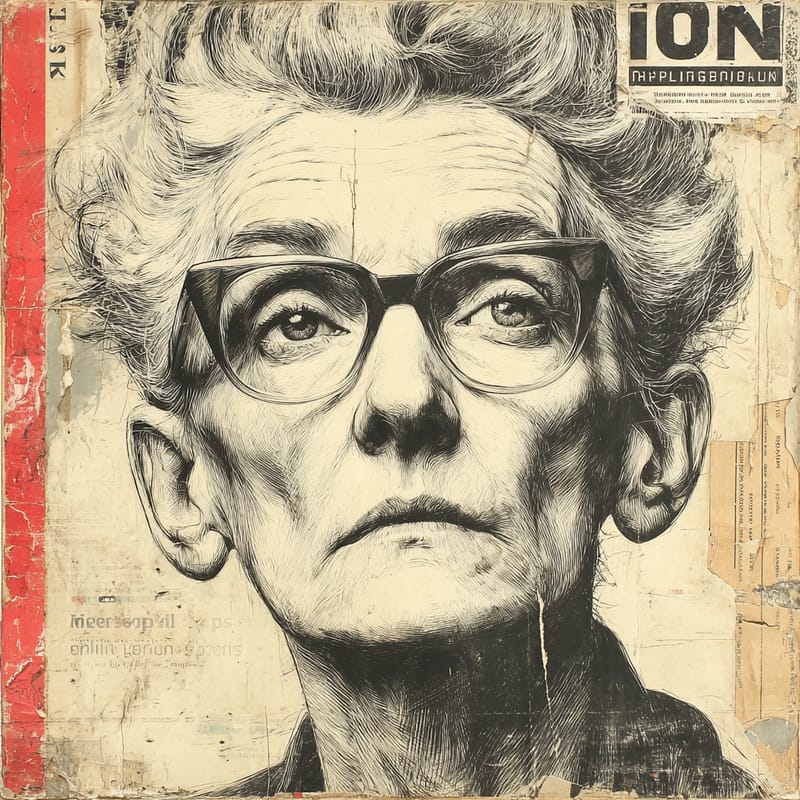
Raya Dunayevskaya
Marxist-Humanism
Hegel, Marx, and human freedom.
Progressive TrotskyistOne of 729 ideologies · enter the Trotskyist hall →- Role
- Philosopher
- Era
- 1910–1987
- Region
- Russia / US
- Social band
- Progressive
- Placement
- −93 · +45 · +68
§ Where Raya Dunayevskaya stands
3 axesDunayevskaya stood near the socialist pole, seeking the abolition of capitalism through workers' control of production. Her study of the Soviet five-year plans in the early 1940s led her to conclude that the USSR was a state-capitalist society exploiting labour like any other, and Marxism and Freedom (1958), which included her translations from Marx's 1844 manuscripts, presented Marx's thought as a philosophy of freed labour.
Her governance reading reflects a revolutionary who never renounced the overthrow of capitalism or the Russian Revolution of 1917 as a beginning. Within that framework she rejected the vanguard party that claims to lead the masses, and in Philosophy and Revolution (1973) she argued that freedom must come from the self-activity of workers, women, Black Americans and youth, not from a party-state.
Dunayevskaya was a strongly progressive humanist who saw women's liberation and Black liberation as integral to revolution. Her American Civilization on Trial (1963) cast Black Americans as the vanguard of American freedom, her 1982 book on Rosa Luxemburg linked Marx's late writings to the women's movement, and she backed anti-colonial revolutions in Africa while condemning the Soviet crushing of Hungary in 1956.
How close are you to Raya Dunayevskaya?
Three statements, one per axis. Answer them and we’ll drop you on the compass next to them.
§ The story
HistoricalRaya Dunayevskaya (1910–1987) was a Ukrainian-born American Marxist philosopher and the founder of Marxist-Humanism. Born in the Russian Empire, in what is now Ukraine, she emigrated with her family to Chicago in the early 1920s and joined the communist youth movement, from which she was expelled as a teenager for wanting to hear Trotsky's side of the party dispute. In 1937–38 she worked as Leon Trotsky's Russian-language secretary in Mexico, but broke with him after the Hitler–Stalin pact of 1939.
With C. L. R. James she led the Johnson–Forest Tendency in the 1940s, developing the theory that the Soviet Union was state capitalist, and her 1944 article in the American Economic Review exposed a Soviet revision of Marx's law of value. In 1955 she founded the News and Letters Committees and their newspaper. Her books Marxism and Freedom (1958), Philosophy and Revolution (1973) and Rosa Luxemburg, Women's Liberation, and Marx's Philosophy of Revolution (1982) recast Marx as a philosopher of human freedom rooted in Hegel's dialectic.
Notable for
- 01Founded Marxist-Humanism
- 02'Marxism and Freedom'
- 03State-capitalism theory of the USSR
Key works & moments
- 1937–38Works as Leon Trotsky's Russian-language secretary in Coyoacán, Mexico.
- 1940sLeads the Johnson–Forest Tendency with C. L. R. James, arguing the USSR is state capitalist.
- 1944Her American Economic Review article exposes a Soviet revision of Marx's law of value.
- 1955Founds the News and Letters Committees and their newspaper, News & Letters.
- 1958Publishes Marxism and Freedom, the founding text of Marxist-Humanism.
- 1973Publishes Philosophy and Revolution: From Hegel to Sartre, and from Marx to Mao.
§ Minds closest to Raya Dunayevskaya
All minds →

§ Also in the Trotskyist hall
Enter the hall →§ Common questions
4 answersWhat was Raya Dunayevskaya's political ideology?
Dunayevskaya was a revolutionary socialist who founded Marxist-Humanism, a reading of Marx centred on human freedom and self-activity: on the 99ideologies three-axis compass, a Progressive Trotskyist. Economically she sat near the socialist pole (−93), opposing both Western capitalism and Soviet state capitalism. On governance she leaned moderately authoritarian (+45), as a committed revolutionary, though she rejected vanguard parties, and socially she was strongly progressive (+68), linking revolution to women's and Black liberation.
Was Raya Dunayevskaya left-wing or right-wing?
Unambiguously left-wing. She spent her life in revolutionary Marxist organisations, from the communist youth movement of the 1920s and Trotsky's circle to the News and Letters Committees she founded in 1955. She was, however, a fierce critic of the Soviet Union, China and the Communist parties, which she regarded as state-capitalist betrayals of Marx, so she belongs to the anti-Stalinist, humanist wing of the far left rather than to any ruling communist tradition.
What is Marxist-Humanism?
Marxist-Humanism is the philosophy Dunayevskaya developed from the 1950s, holding that Marx's thought is above all a theory of human liberation rooted in Hegel's dialectic. Drawing on Marx's 1844 manuscripts, it treats freedom and the self-activity of workers, women, minorities and youth as the measure of socialism, and rejects both capitalist markets and the state planning of the Soviet bloc. Her Marxism and Freedom (1958) is its founding text; other thinkers, such as Erich Fromm, developed related humanist readings of Marx.
Which minds are closest to Raya Dunayevskaya?
On the 99ideologies three-axis compass, the minds closest to Raya Dunayevskaya are C. L. R. James (99% alike), Ernest Mandel (98% alike) and Natalia Sedova (97% alike). The furthest is Hans-Hermann Hoppe (0% alike).