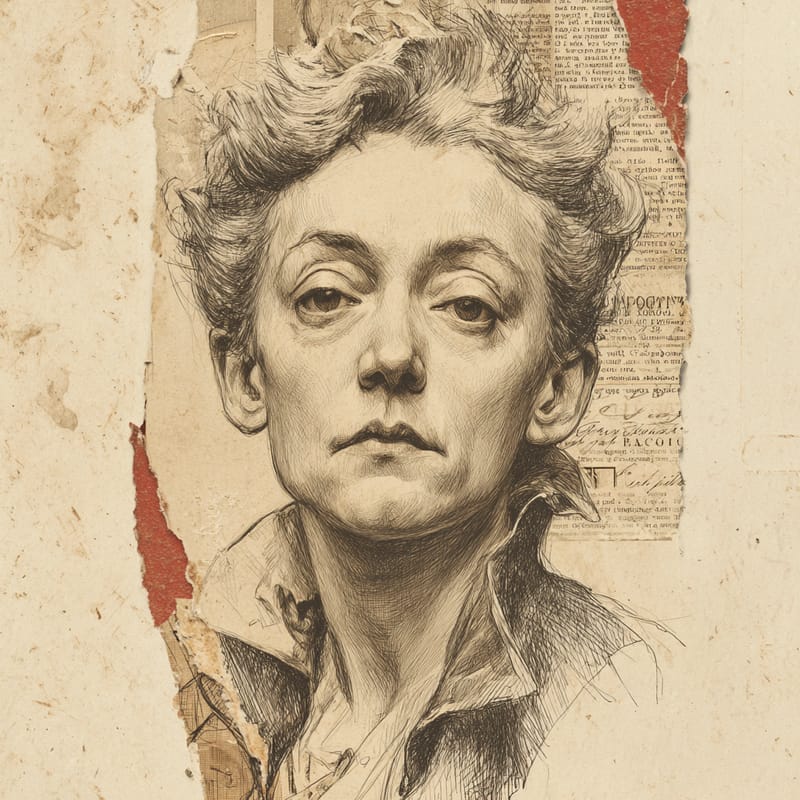
Natalia Sedova
The exile's companion
Carried the cause after the assassination.
Reformist TrotskyistOne of 729 ideologies · enter the Trotskyist hall →- Role
- Revolutionary
- Era
- 1882–1962
- Region
- Russia
- Social band
- Reformist
- Placement
- −90 · +44 · +62
§ Where Natalia Sedova stands
3 axesSedova shared the Bolshevik goal of abolishing capitalism and placing the economy under collective ownership and planning, and she served the Soviet state that nationalised industry after 1917. In exile she backed the Left Opposition's programme, and her 1951 break with the Fourth International came from the left: she argued that Stalin's Soviet Union had destroyed the conquests of October and could no longer be called a workers' state.
Sedova accepted the revolutionary dictatorship the Bolsheviks established in 1917 and served in its government for a decade. After Stalin's victory she became an unyielding anti-Stalinist, campaigning against the Moscow show trials of 1936–38 and supporting the Dewey Commission that examined the charges against Trotsky in Coyoacán in 1937. Like him, she remained a Leninist rather than a liberal democrat.
One of the many women of the revolutionary generation who lived as professional militants, Sedova embodied the emancipated, secular outlook of early Bolshevism. Her work at the Commissariat for Education under Anatoly Lunacharsky aimed to open Russia's palaces, estates and collections to the people as public museums, and she remained a committed internationalist through exile on three continents.
How close are you to Natalia Sedova?
Three statements, one per axis. Answer them and we’ll drop you on the compass next to them.
§ The story
HistoricalNatalia Ivanovna Sedova (1882–1962) was a Russian revolutionary and the lifelong companion of Leon Trotsky. Born in Romny in Ukraine, she was drawn into radical circles as a schoolgirl in Kharkiv and continued her studies in Geneva and Paris, where in 1902 she met Trotsky through the Iskra group of Russian Marxists. After the October Revolution she headed the museums department of the People's Commissariat for Education from 1918 to 1928, working to preserve Russia's art and historic monuments.
When Stalin defeated the Left Opposition, Sedova followed Trotsky into exile in Alma-Ata, Turkey, France, Norway and Mexico, acting as his secretary, organiser and confidante. Both their sons died: Sergei was shot in the Soviet Union in 1937, and Lev died in suspicious circumstances in a Paris clinic in 1938. In Coyoacán she survived the armed raid of May 1940 before Trotsky was murdered that August. She guarded his archive and memory, co-wrote a life of him with Victor Serge and in 1951 broke with the Fourth International.
Notable for
- 01Co-exile and collaborator
- 02Preserved Trotsky's legacy
- 03Lifelong revolutionary
Key works & moments
- 1902Meets Leon Trotsky in Paris through the Iskra circle of Russian Marxist exiles.
- 1918–28Heads the museums department of the People's Commissariat for Education.
- 1929Deported from the Soviet Union with Trotsky, beginning more than a decade of exile abroad.
- 1938Her son Lev Sedov, Trotsky's chief organiser in Europe, dies suspiciously in a Paris clinic.
- 1940Survives the May raid on the Coyoacán house; Trotsky is assassinated in August.
- 1951Breaks with the Fourth International, rejecting its view of Stalin's USSR as a workers' state.
§ Minds closest to Natalia Sedova
All minds →

§ Also in the Trotskyist hall
Enter the hall →§ Common questions
4 answersWhat was Natalia Sedova's political ideology?
Natalia Sedova was a revolutionary Marxist of the Trotskyist tradition: on the 99ideologies three-axis compass, a Reformist Trotskyist, where the first word describes her social outlook rather than any preference for gradual change. She sat at the far socialist end economically (−90), committed to collective ownership and planning; she leaned authoritarian on governance (+44) as a Leninist who served the early Soviet state; and she was clearly progressive socially (+62), an emancipated internationalist of the revolutionary generation.
Was Natalia Sedova left-wing or right-wing?
Far left. Sedova devoted her life to socialist revolution, served the early Bolshevik government and shared Trotsky's exile and struggle against Stalin. Her final break with the Fourth International in 1951 moved her further from any accommodation with the Soviet state, not closer to the centre: she rejected the International's continued defence of the USSR as a workers' state. The nuance lies in governance, where her Leninism accepted revolutionary dictatorship while condemning Stalin's bureaucratic tyranny.
Why did Natalia Sedova break with the Fourth International?
Because she could no longer accept its view of the Soviet Union. In a 1951 letter to the International's leadership she argued that Stalin's regime had destroyed the gains of the 1917 revolution, and that continuing to call it a workers' state, and to defend it, was a mistake; she also objected to the International's stance on the Korean War. Her position brought her close to those Trotskyists and former Trotskyists who regarded the Soviet Union as a new form of class society rather than a workers' state.
Which minds are closest to Natalia Sedova?
On the 99ideologies three-axis compass, the minds closest to Natalia Sedova are Emmanuel Goldstein (99% alike), Tony Cliff (97% alike) and Raya Dunayevskaya (97% alike). The furthest is Hans-Hermann Hoppe (0% alike).