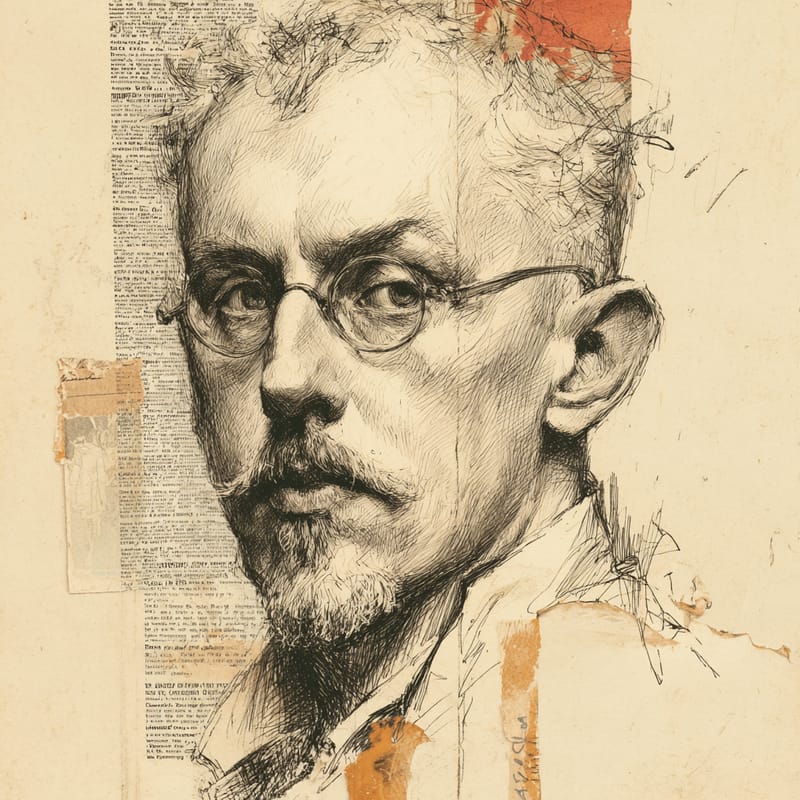
Emmanuel Goldstein
The eternal heretic
Orwell's shadow of the purged revolutionary.
Reformist TrotskyistOne of 729 ideologies · enter the Trotskyist hall →- Role
- Revolutionary enemy (fiction)
- From
- Nineteen Eighty-Four
- Region
- Oceania
- Social band
- Reformist
- Placement
- −92 · +46 · +60
§ Where Emmanuel Goldstein stands
3 axesIn Party mythology Goldstein is the original revolutionary who cries that the revolution has been betrayed, a Trotsky-like voice for the socialist ideals Ingsoc abandoned. His book exposes how the Party keeps the population poor: continuous war deliberately destroys the surplus of industry so that rising wealth never erodes hierarchy, an argument that presupposes the egalitarian economy the revolution promised.
Goldstein is presented as the arch-dissident: in the Two Minutes Hate he denounces the Party's dictatorship and demands freedom of speech, of the press, of assembly and of thought. Yet he heads the Brotherhood, a conspiratorial underground whose recruits, as O'Brien swears in Winston and Julia in Part Two, must be ready to commit murder and sabotage, the methods of a revolutionary vanguard rather than a liberal.
Goldstein stands for the free, critical intellect that Ingsoc most fears. His book argues that machine production had made human equality technically possible and that the Party's hierarchy survives only by suppressing that possibility and rewriting the past, a fundamentally progressive premise that treats history and class as things people can understand and change.
How close are you to Emmanuel Goldstein?
Three statements, one per axis. Answer them and we’ll drop you on the compass next to them.
§ The story
FictionEmmanuel Goldstein is the Party's arch-enemy in George Orwell's novel Nineteen Eighty-Four, published in 1949. Once a leading figure of the revolution, almost on a level with Big Brother himself, he is said to have turned to counter-revolution, been condemned to death and mysteriously escaped. Every day his face fills the telescreens during the Two Minutes Hate, and he is named as the leader of the Brotherhood and the author of the book, The Theory and Practice of Oligarchical Collectivism.
Orwell modelled Goldstein on Leon Trotsky, the exiled revolutionary whom Stalin's propaganda blamed for every failure, giving him a goatee, a lean Jewish face and a name that echoes Trotsky's birth name, Bronstein. The book's analysis of a self-perpetuating ruling class borrows from James Burnham's The Managerial Revolution. O'Brien later claims to have helped write it, leaving it unclear whether Goldstein or the Brotherhood exist at all. Goldstein has become shorthand for the manufactured enemy a regime needs to channel public hatred.
Notable for
- 01The Party's designated enemy (in-story)
- 02Author of 'the Book'
- 03Trotsky allegory
Key works & moments
- 1949George Orwell publishes Nineteen Eighty-Four, with Goldstein as the Party's eternal enemy.
- Part OneGoldstein's face on the telescreen triggers the Two Minutes Hate at the Ministry of Truth.
- Part TwoO'Brien enlists Winston and Julia in the Brotherhood and supplies Goldstein's forbidden book.
- Part TwoWinston reads The Theory and Practice of Oligarchical Collectivism in the room above Mr Charrington's shop.
- Part ThreeO'Brien claims he co-wrote the book, casting doubt on whether Goldstein exists.
In Emmanuel Goldstein's words
“Throughout recorded time, and probably since the end of the Neolithic Age, there have been three kinds of people in the world, the High, the Middle, and the Low.”
§ Minds closest to Emmanuel Goldstein
All minds →

§ Also in the Trotskyist hall
Enter the hall →§ Common questions
4 answersWhat is Emmanuel Goldstein's political ideology?
Emmanuel Goldstein is the betrayed revolutionary of Orwell's Nineteen Eighty-Four: on the 99ideologies three-axis compass, a Reformist Trotskyist, the first word describing his social outlook rather than any taste for gradual change. Economically he sits at the far socialist end (−92) as the voice of the revolution's original egalitarian aims; on governance he leans authoritarian (+46) as head of a conspiratorial underground ready to use violence; and socially he is clearly progressive (+60), standing for freedom of thought against the Party.
Is Emmanuel Goldstein left-wing or right-wing?
Left-wing. Goldstein is the revolutionary who, in Party propaganda, cries that the revolution has been betrayed, the very charge Trotsky levelled at Stalin, and his book analyses class and power in recognisably Marxist terms. He is the left-opposition figure set against the Party's ruling oligarchy. The twist is that Orwell never lets the reader be sure he exists: the Party may simply need an enemy, and its use of him shows how a regime can turn even its critics into propaganda.
Was Emmanuel Goldstein based on Trotsky?
Yes, closely. Like Trotsky, Goldstein was once a revolutionary leader second only to the supreme leader, fell from grace, escaped and was then blamed by the regime for every sabotage and conspiracy, just as Stalin's show trials of 1936–38 blamed Trotskyists. Orwell even gives him a goatee and a lean Jewish face. His book's portrait of a bureaucratic ruling class owes something to Trotsky's critique of Stalinism and to James Burnham's The Managerial Revolution (1941), which Orwell criticised in a 1946 essay.
Which minds are closest to Emmanuel Goldstein?
On the 99ideologies three-axis compass, the minds closest to Emmanuel Goldstein are Natalia Sedova (99% alike), Tony Cliff (98% alike) and Leon Trotsky (97% alike). The furthest is Hans-Hermann Hoppe (0% alike).