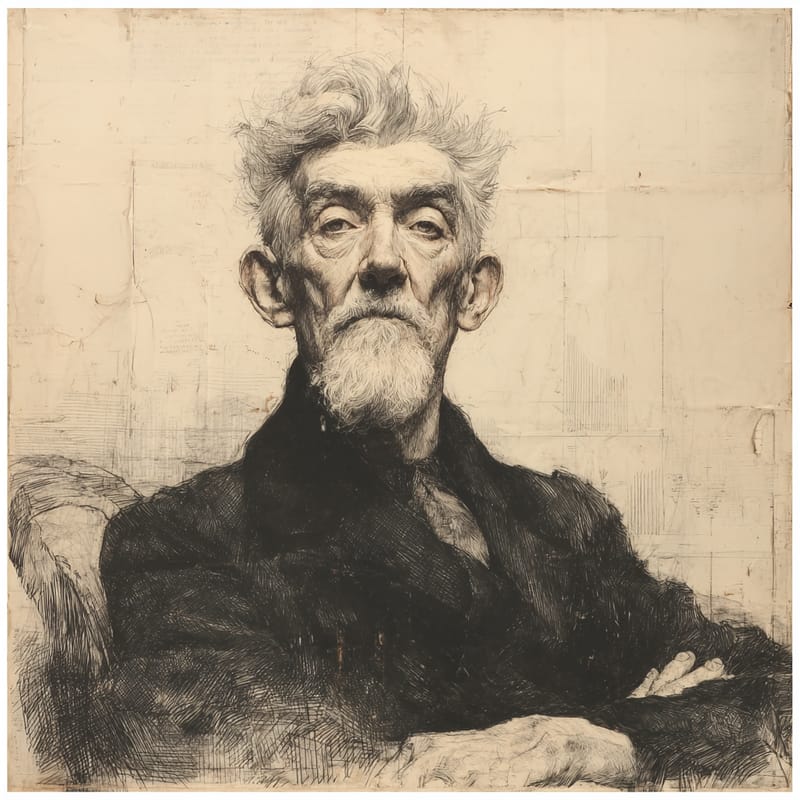
C. L. R. James
The Black Jacobins
Revolution, anti-colonialism, cricket.
Progressive TrotskyistOne of 729 ideologies · enter the Trotskyist hall →- Role
- Historian & theorist
- Era
- 1901–1989
- Region
- Trinidad / UK
- Social band
- Progressive
- Placement
- −90 · +46 · +70
§ Where C. L. R. James stands
3 axesJames was a revolutionary socialist who wanted capitalism abolished and production run by the workers themselves. With the Johnson–Forest Tendency he argued in State Capitalism and World Revolution (1950) that the Soviet Union was not socialist but a state-capitalist system exploiting its workers, and in Facing Reality (1958) he hailed the workers' councils of the 1956 Hungarian revolution as a model of self-management.
James's governance reading reflects a revolutionary who accepted the overthrow of the capitalist state by force; his World Revolution 1917–1936 (1937) defended the Bolshevik revolution while condemning Stalin. In later years he grew hostile to vanguard parties, and in Every Cook Can Govern (1956) he celebrated the direct democracy of ancient Athens, but he never abandoned revolution itself.
James was a pan-Africanist and anti-colonialist who placed Black and colonised peoples at the centre of world history. The Black Jacobins (1938) told the Haitian Revolution as the story of enslaved people winning their own freedom, he co-founded the International African Service Bureau with George Padmore in 1937, and in 1948 he argued that Black struggles in America had their own independent revolutionary validity.
How close are you to C. L. R. James?
Three statements, one per axis. Answer them and we’ll drop you on the compass next to them.
§ The story
HistoricalCyril Lionel Robert James (1901–1989) was a Trinidadian historian, journalist, novelist and Marxist theorist. A teacher in Port of Spain whose pupils included the future prime minister Eric Williams, he moved to England in 1932, lived with the cricketer Learie Constantine in Lancashire and reported on cricket for the Manchester Guardian. In London he joined the Trotskyist movement and campaigned with George Padmore against colonial rule, publishing The Black Jacobins (1938), his history of the Haitian Revolution.
In the United States from 1938, James met Trotsky in Mexico in 1939 and led the Johnson–Forest Tendency with Raya Dunayevskaya and Grace Lee, which broke with orthodox Trotskyism by calling the Soviet Union state capitalist. Detained on Ellis Island and expelled in 1953, he returned to Trinidad in 1958 to edit the governing nationalist party's newspaper before breaking with Williams. His Beyond a Boundary (1963) made cricket a lens on colonialism, and he became a revered elder of pan-African and Caribbean thought, dying in London in 1989.
Notable for
- 01'The Black Jacobins'
- 02Pan-African Trotskyism
- 03'Beyond a Boundary'
Key works & moments
- 1932Moves to England, where he writes on cricket and Caribbean self-government.
- 1938Publishes The Black Jacobins, a history of the Haitian Revolution.
- 1939Meets Leon Trotsky in Mexico to discuss Black liberation in the United States.
- 1950Co-authors State Capitalism and World Revolution, defining the Johnson–Forest Tendency.
- 1953Expelled from the United States after detention on Ellis Island.
- 1963Publishes Beyond a Boundary, his study of cricket and colonialism.
In their own words
“What do they know of cricket who only cricket know?”
“In 1789 the French West Indian colony of San Domingo supplied two-thirds of the overseas trade of France and was the greatest individual market for the European slave-trade.”
§ Minds closest to C. L. R. James
All minds →

§ Also in the Trotskyist hall
Enter the hall →§ Common questions
4 answersWhat was C. L. R. James's political ideology?
James was a revolutionary Marxist and pan-Africanist who moved from Trotskyism to his own theory of workers' self-emancipation: on the 99ideologies three-axis compass, a Progressive Trotskyist. Economically he sat near the socialist pole (−90), seeking the abolition of capitalism and of Soviet-style state capitalism alike. On governance he leaned moderately authoritarian (+46), as a believer in revolutionary overthrow, and socially he was strongly progressive (+70), championing anti-colonial and Black liberation.
Was C. L. R. James left-wing or right-wing?
Firmly left-wing. James spent his life on the revolutionary left, from the Trotskyist movement of the 1930s to the independent Marxist groups he led in the United States and Britain, and he supported independence movements across Africa and the Caribbean. He was also a critic of the Soviet Union and of authoritarian post-colonial rulers, including his former pupil Eric Williams, so his leftism was anti-Stalinist and democratic in spirit rather than loyal to any state.
What is The Black Jacobins about?
The Black Jacobins (1938) is James's history of the Haitian Revolution of 1791–1804, in which enslaved Africans in the French colony of Saint-Domingue overthrew slavery and colonial rule and founded Haiti. Centred on Toussaint Louverture, it treats the revolution as part of the age of the French Revolution and as a model for anti-colonial struggles in Africa. The book was a landmark in presenting Black people as makers of modern history, and James revised it in 1963 with an appendix on the Caribbean and Cuba.
Which minds are closest to C. L. R. James?
On the 99ideologies three-axis compass, the minds closest to C. L. R. James are Raya Dunayevskaya (99% alike), Ernest Mandel (97% alike) and Natalia Sedova (97% alike). The furthest is Hans-Hermann Hoppe (0% alike).