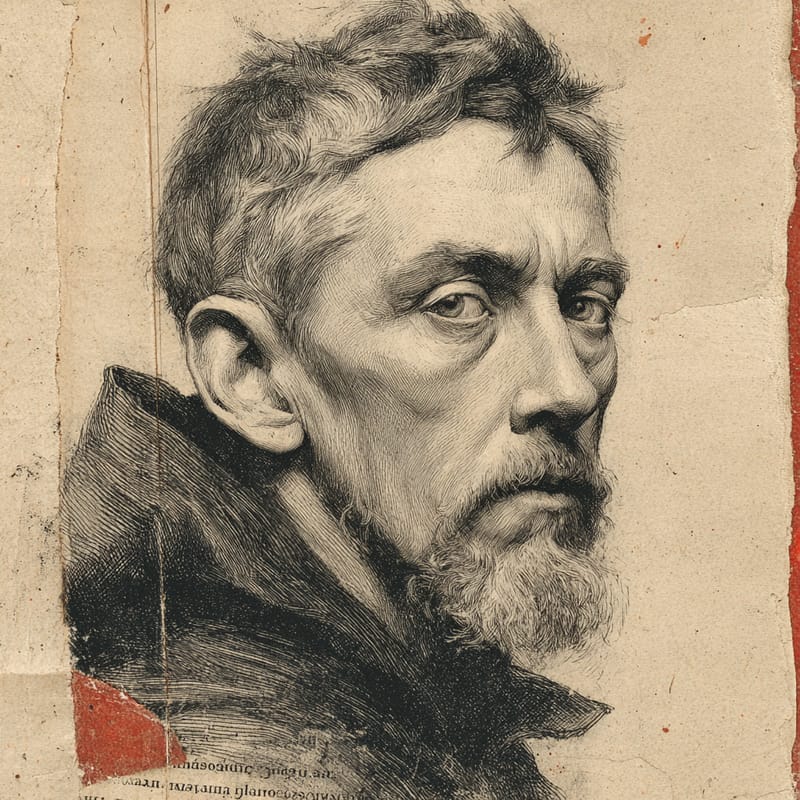
Shevek
A society without government
Le Guin's lived anarchist commune.
Progressive Anarcho-CommunistOne of 729 ideologies · enter the Anarcho-Communist hall →- Role
- Physicist (fiction)
- From
- The Dispossessed
- Region
- Anarres
- Social band
- Progressive
- Placement
- −92 · −92 · +70
§ Where Shevek stands
3 axesAnarres has no money, wages or private property: people work in syndicates, take what they need from common depositories and accept postings from a computerised Division of Labour, and everyday Pravic speech avoids possessive pronouns. Le Guin tests the system with a years-long drought and famine that force hard rationing, yet Shevek remains convinced that shared scarcity is more just than Urras's luxury amid poverty.
Anarres has no state, police or prisons; coordination runs through syndicates, open meetings and the administrative network known as PDC. Shevek's dissent targets the informal power that creeps back anyway: when public opinion and bureaucratic habit stifle new ideas, he and his friend Bedap found the Syndicate of Initiative to publish what the official print syndicates will not and to open radio contact with Urras.
Odo, the movement's founder, was a woman, and Anarres is built for equality: women and men share all work, children grow up in communal learning centres, partnership is voluntary and homosexual love is unremarkable. On Urras Shevek is struck that A-Io's women are shut out of science and public life, while at home the Odonian reproach against egoizing shows how strongly the community expects individuals to share.
How close are you to Shevek?
Three statements, one per axis. Answer them and we’ll drop you on the compass next to them.
§ The story
FictionShevek is the protagonist of Ursula K. Le Guin's novel The Dispossessed: An Ambiguous Utopia, published in 1974 as part of her Hainish Cycle. A gifted physicist, he grows up on Anarres, the dry, barren moon of the richer planet Urras, settled generations earlier by followers of the revolutionary thinker Odo. When a senior colleague obstructs his work on a General Temporal Theory, he makes the rare and controversial journey to Urras, hoping to share his physics with both worlds.
Anarres is Le Guin's portrait of an anarchist society, with no government, money, laws or property, and Shevek is its conscience: loyal to its ideals yet alarmed by the conformity and creeping bureaucracy he finds at home. On Urras he meets a rich capitalist state, A-Io, and its authoritarian socialist rival, Thu, and rejects both. Le Guin traced Odonianism to early Taoist thought, Shelley, Kropotkin, Emma Goldman and Paul Goodman, and the novel, winner of the Hugo, Nebula and Locus awards, remains a touchstone for anarchists and utopian writers.
Notable for
- 01Protagonist of 'The Dispossessed'
- 02Anarres, an anarchist society
- 03'An ambiguous utopia'
Key works & moments
- 1974Ursula K. Le Guin publishes The Dispossessed: An Ambiguous Utopia, set on Urras and its moon Anarres.
- AnarresShevek finds the senior physicist Sabul obstructing his research and taking credit for it.
- AnarresWith Bedap and others, Shevek forms the Syndicate of Initiative to break Anarres's isolation from Urras.
- UrrasShevek addresses a mass demonstration in Nio Esseia that government forces violently crush.
- Last chaptersHe gives his theory to all worlds through the Terran embassy, then returns to Anarres.
- 1975The novel wins the Hugo, Nebula and Locus awards for best novel.
In Shevek's words
“You cannot buy the Revolution. You cannot make the Revolution. You can only be the Revolution. It is in your spirit, or it is nowhere.”
§ Minds closest to Shevek
All minds →




§ Also in the Anarcho-Communist hall
Enter the hall →§ Common questions
4 answersWhat is Shevek's political ideology?
Shevek is an Odonian, the anarchist creed of Le Guin's Anarres: on the 99ideologies three-axis compass, a Progressive Anarcho-Communist. Economically he sits at the far left (−92), living without money, wages or property in a society that shares even scarcity. On governance he is near the libertarian pole (−92), opposing every state, including the creeping bureaucracy of his own world, and socially he is strongly progressive (+70), at home in a society built on gender equality and voluntary partnership.
Is Shevek left-wing or right-wing?
Left-wing, in its libertarian rather than state-socialist form. Shevek believes in common ownership and mutual aid, which puts him on the far left economically, but he is equally hostile to government, rejecting both the capitalist state of A-Io and the authoritarian socialism of Thu on Urras. His radicalism also turns inward: he challenges Anarres's own conformity and informal hierarchies, which makes him an anarchist critic of every concentration of power rather than a partisan of any existing regime.
Is The Dispossessed an anarchist novel?
Yes. Le Guin wrote that Odonianism is anarchism, not the bomb-throwing kind nor the free-market libertarianism of the right, but the tradition she traced through early Taoist thought, Shelley, Kropotkin, Emma Goldman and Paul Goodman. The subtitle, An Ambiguous Utopia, signals that she also shows its costs: drought and famine, social pressure to conform and officials who quietly accumulate power. That honesty is why many anarchists treat the book as fiction's most credible portrait of their ideal.
Which minds are closest to Shevek?
On the 99ideologies three-axis compass, the minds closest to Shevek are Élisée Reclus (98% alike), Peter Kropotkin (96% alike) and Federica Montseny (94% alike). The furthest is Adam Sutler (0% alike).