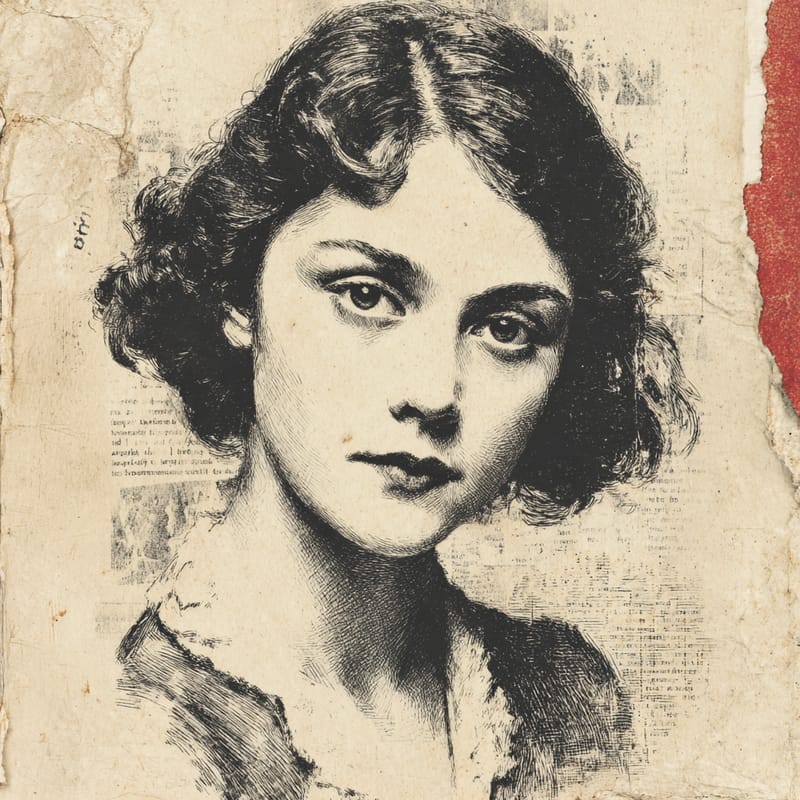
Federica Montseny
The anarchist in government
A movement's dilemma, personified.
Progressive Anarcho-SyndicalistOne of 729 ideologies · enter the Anarcho-Syndicalist hall →- Role
- Minister & militant
- Era
- 1905–1994
- Region
- Spain
- Social band
- Progressive
- Placement
- −80 · −88 · +78
§ Where Federica Montseny stands
3 axesMontseny backed the CNT's goal of libertarian communism and the sweeping collectivisation of Catalan industry and land in 1936, in which workers' committees took over factories, transport and farms. Her economic radicalism was tempered only by the war: by entering the Largo Caballero government she accepted a Republican wartime economy in which state coordination steadily replaced workers' control.
An anarchist who joined a government, Montseny embodied the movement's hardest dilemma. She accepted office in November 1936 on the argument that anti-fascist unity had to come first, and in May 1937 she urged CNT militants in Barcelona to stop fighting the Republic's forces. Yet she never abandoned the goal of a stateless society, and in exile she sided with the CNT's strict anti-state current.
Montseny was one of the most socially radical voices in interwar Spain. Novels such as La Victoria (1925) and her essays in La Revista Blanca championed women's independence and sexual equality, and in 1936 she became the first woman to sit in a Spanish cabinet. She was wary of feminism as a separate cause, treating women's emancipation as part of the wider social revolution.
How close are you to Federica Montseny?
Three statements, one per axis. Answer them and we’ll drop you on the compass next to them.
§ The story
HistoricalFederica Montseny Mañé (1905–1994) was born in Madrid to the anarchist publishers Joan Montseny, known as Federico Urales, and Teresa Mañé, known as Soledad Gustavo, and grew up in a free-thinking household; from 1923 the family published the journal La Revista Blanca in Barcelona. Educated largely at home by her mother, she began writing in her teens, produced a stream of popular novels and essays, and by the early 1930s was one of the most compelling orators and journalists of the CNT and FAI.
In November 1936, with Franco's forces at the gates of Madrid, Montseny joined Francisco Largo Caballero's government as minister of health and social assistance, the first woman to hold cabinet office in Spain. The decision split anarchists between those who saw a necessary sacrifice for the war and those who saw a betrayal of principle. During the Barcelona May Days of 1937 she broadcast appeals for a ceasefire, and she left office when the government fell weeks later. She spent the rest of her life largely in exile in Toulouse, as a leader of the exiled CNT.
Notable for
- 01First female minister in Spain
- 02CNT-FAI leader
- 03Anarcha-feminist writer
Key works & moments
- 1923Her family relaunches La Revista Blanca in Barcelona, and she begins writing regularly for it.
- 1925Publishes La Victoria, a novel championing a modern woman's independence.
- Nov 1936Becomes minister of health in Largo Caballero's government, Spain's first female cabinet minister.
- May 1937Broadcasts appeals for a ceasefire during the Barcelona May Days; leaves government weeks later.
- 1939Flees to France in the Republican exodus and later settles in Toulouse.
§ Minds closest to Federica Montseny
All minds →


§ Also in the Anarcho-Syndicalist hall
Enter the hall →§ Common questions
4 answersWhat was Federica Montseny's political ideology?
Federica Montseny was an anarcho-syndicalist of the CNT and FAI: on the 99ideologies three-axis compass, a Progressive Anarcho-Syndicalist. Economically she sat firmly on the left (−80), backing collectivisation and workers' control. On governance she was strongly libertarian (−88), committed to a stateless society even though she served as a minister in wartime, and socially she was strongly progressive (+78), a writer and politician who championed women's independence and became Spain's first female cabinet minister.
Was Federica Montseny left-wing or right-wing?
Left-wing. Montseny spent her life in the anarchist labour movement, supported the 1936 collectivisations and opposed Franco from the government benches and then from exile. Her left-wing politics were libertarian and syndicalist rather than Marxist: she distrusted the Communists, whose influence in the Republic grew during 1937, and her brief role in government was a wartime compromise, not a conversion to state socialism. Socially she stood at the radical edge of the Spanish left.
Why did Federica Montseny join the Spanish government?
Because the CNT leadership decided, in November 1936, that anarchists had to share responsibility for the war as Franco's troops closed on Madrid. Four CNT figures entered Largo Caballero's cabinet, and Montseny, after hesitating, took the health portfolio. Supporters argued that unity was the price of survival and of protecting the collectives; critics, including many rank-and-file militants, saw a betrayal of anarchism's rejection of the state. The CNT ministers left in May 1937, and the debate has never closed.
Which minds are closest to Federica Montseny?
On the 99ideologies three-axis compass, the minds closest to Federica Montseny are Shevek (94% alike), Emma Goldman (94% alike) and Élisée Reclus (93% alike). The furthest is Adam Sutler (0% alike).