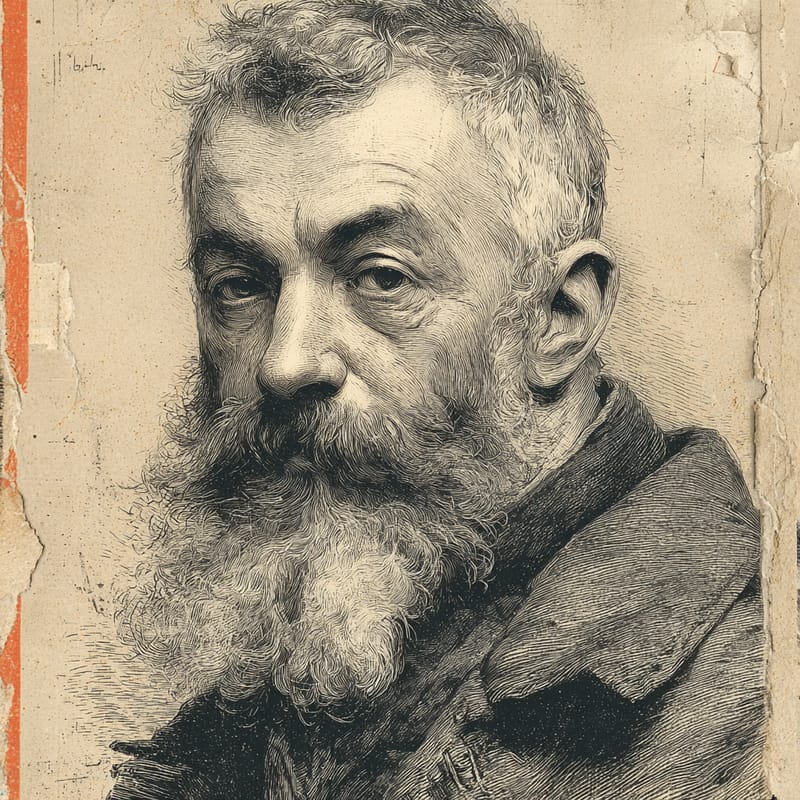
Errico Malatesta
Anarchy and organisation
A lifetime of patient agitation.
Reformist Anarcho-CommunistOne of 729 ideologies · enter the Anarcho-Communist hall →- Role
- Theorist & organiser
- Era
- 1853–1932
- Region
- Italy
- Social band
- Reformist
- Placement
- −92 · −93 · +55
§ Where Errico Malatesta stands
3 axesMalatesta adopted anarchist communism with the Italian Federation in 1876 and wanted land, factories and products held in common. Yet he was a pluralist about economic forms: in later writings he accepted that free communities might experiment with communist, collectivist or even individualist arrangements, provided no one could exploit the labour of others.
He opposed every government, including any revolutionary dictatorship, and his pamphlet Anarchy (1891) defined anarchy simply as society without government. What set him apart was his insistence on organisation: anarchists, he argued, needed federations, programmes and a presence in the unions. In 1927 he criticised the Platform of Makhno and Arshinov as leaning towards centralised, party-like discipline.
Malatesta's social outlook was humane and internationalist rather than iconoclastic. He condemned militarism and nationalism, and in his 1916 article Pro-Government Anarchists rebuked Kropotkin and others who backed the First World War. He accepted revolutionary violence as a grim necessity but condemned cruelty and terror against the innocent, insisting that the means must not betray the ends.
How close are you to Errico Malatesta?
Three statements, one per axis. Answer them and we’ll drop you on the compass next to them.
§ The story
HistoricalErrico Malatesta (1853–1932) was born in Santa Maria Capua Vetere, near Caserta, in the Kingdom of the Two Sicilies. He left medical studies at Naples for politics, moving from Mazzinian republicanism to the International after the Paris Commune of 1871, and in 1872 met Mikhail Bakunin and became a lifelong anarchist. Trained as an electrician to earn his keep, he spent most of the next half-century as an agitator in exile, above all in London but also in Egypt and Argentina, punctuated by arrests, trials and prison terms in several countries.
Malatesta became the movement's most respected organiser and polemicist. He took part in the 1877 Matese insurrection, led agitation in Ancona during the Red Week of 1914 and, after returning to Italy in 1919, edited the daily Umanità Nova through the factory occupations of 1920. He argued against Kropotkin's support for the Allies in 1916, against both anti-organisationists and Makhno's centralising Platform, and against equating anarchism with syndicalism. Under Fascism his journals were suppressed, and he spent his last years under police surveillance in Rome, where he died in 1932.
Notable for
- 01Decades of anarchist organising
- 02'At the Café' and 'Anarchy'
- 03Defined organised anarchism
Key works & moments
- 1872Meets Bakunin and joins the anti-authoritarian International at its Saint-Imier congress.
- 1877Leads the Matese insurrection near Benevento with Carlo Cafiero; arrested, then acquitted in 1878.
- 1891Publishes the pamphlet L'Anarchia (Anarchy), a classic introduction to anarchist ideas.
- 1907Debates Pierre Monatte on syndicalism at the International Anarchist Congress in Amsterdam.
- 1914Helps lead the Red Week uprising in Ancona and the Marches.
- 1920Edits the daily Umanità Nova during the factory occupations; arrested in October.
§ Minds closest to Errico Malatesta
All minds →

§ Also in the Anarcho-Communist hall
Enter the hall →§ Common questions
4 answersWhat was Errico Malatesta's political ideology?
Errico Malatesta was an anarchist communist who stressed organisation and solidarity: on the 99ideologies three-axis compass, a Reformist Anarcho-Communist. Economically he sat at the far left (−92), wanting land and the means of production held in common. On governance he was at the libertarian extreme (−93), rejecting all government, including revolutionary dictatorships, and socially he was moderately progressive (+55), an anti-militarist internationalist whose ethics put human solidarity above doctrine.
Was Errico Malatesta left-wing or right-wing?
Left-wing, as a revolutionary anarchist. Malatesta fought for the abolition of capitalism and the state from the 1870s until his death, led insurrections and strikes, and was persecuted by liberal and Fascist governments alike. He also stood apart from the authoritarian left: he rejected Marxist and Bolshevik plans for a workers' state and warned that a revolutionary government would create a new ruling class. His pragmatism about economic forms and his emphasis on organisation made him a moderating voice within anarchism, not outside it.
Was Errico Malatesta against syndicalism?
Not against unions, but against treating syndicalism as a substitute for anarchism. At the 1907 International Anarchist Congress in Amsterdam he answered Pierre Monatte by arguing that unions are vital for workers' daily struggles but tend by their nature towards reformism, because they must defend members' interests within the existing system. A general strike alone, he said, could not make a revolution. He urged anarchists to work inside the labour movement while keeping their own organisations and goals.
Which minds are closest to Errico Malatesta?
On the 99ideologies three-axis compass, the minds closest to Errico Malatesta are Buenaventura Durruti (98% alike), Peter Kropotkin (97% alike) and Élisée Reclus (96% alike). The furthest is Adam Sutler (0% alike).