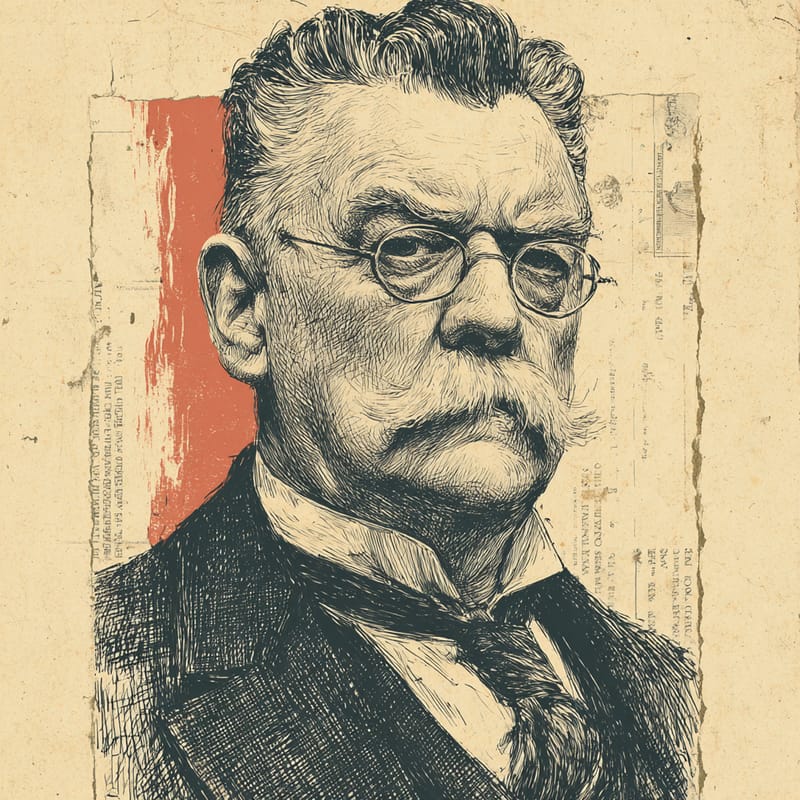
Salvador Allende
The Chilean road to socialism
Socialism through the ballot box.
Reformist Democratic SocialistOne of 729 ideologies · enter the Democratic Socialist hall →- Role
- President
- Era
- 1908–1973
- Region
- Chile
- Social band
- Reformist
- Placement
- −60 · +22 · +45
§ Where Salvador Allende stands
3 axesAllende set out to replace capitalism with socialism by legal means. In July 1971 Congress unanimously approved his constitutional amendment nationalising the large copper mines owned by US companies, and his government bought control of most banks, expropriated large estates under the 1967 agrarian reform law and built a state-owned Social Property Area of major firms, while leaving small and medium businesses in private hands.
Allende called his project the Chilean road to socialism, to be built through elections, Congress and the 1925 constitution rather than armed revolution, and in 1970 he accepted a statute of constitutional guarantees to win Christian Democrat votes in Congress. His government also stretched executive power, using a 1932 decree to requisition firms, and in August 1973 the Chamber of Deputies accused it of breaking the constitution.
Allende's social commitments centred on health and poverty: as health minister he published La realidad médico-social chilena in 1939, tying disease to low wages and poor housing, and as president he guaranteed every child half a litre of milk a day. A secular Freemason and anti-imperialist, he restored relations with Cuba in 1970 and hosted Fidel Castro on a long visit in 1971.
How close are you to Salvador Allende?
Three statements, one per axis. Answer them and we’ll drop you on the compass next to them.
§ The story
HistoricalSalvador Allende Gossens (1908–1973) was a Chilean physician and Marxist politician who served as president of Chile from 1970 until his death during the military coup of 1973. Trained in medicine at the University of Chile, he co-founded the Socialist Party of Chile in 1933, served as health minister in Pedro Aguirre Cerda's Popular Front government from 1939 to 1942 and sat in the Senate from 1945 to 1970, presiding over it in the late 1960s. He ran for president in 1952, 1958 and 1964 before winning on his fourth attempt.
In 1970 his Popular Unity coalition won just over a third of the vote, and Congress confirmed him as Latin America's first Marxist president chosen in open elections. His government nationalised copper, banks and large firms and sped up land reform, but by 1973 Chile faced soaring inflation, shortages, strikes and deep polarisation, while the Nixon administration worked covertly against him. On 11 September 1973 the armed forces, led by General Augusto Pinochet, seized power; Allende died inside the besieged La Moneda palace, and a court-ordered forensic inquiry in 2011 confirmed that he took his own life.
Notable for
- 01Democratically elected Marxist president
- 02Nationalised Chilean copper
- 03Died in the 1973 coup
Key works & moments
- 1933Co-founds the Socialist Party of Chile.
- 1939Becomes health minister in Pedro Aguirre Cerda's Popular Front government.
- 1970Elected president for Popular Unity at his fourth attempt; Congress confirms him in October.
- 1971Congress unanimously approves his constitutional amendment nationalising the large copper mines.
- 1972Denounces pressure on Chile from multinational corporations in a speech to the UN General Assembly.
- 1973Dies in La Moneda palace during the military coup led by General Augusto Pinochet on 11 September.
In their own words
“Go forward knowing that, much sooner than later, the great avenues will open again, through which free men will pass to build a better society.”
§ Minds closest to Salvador Allende
All minds →

§ Also in the Democratic Socialist hall
Enter the hall →§ Common questions
4 answersWhat was Salvador Allende's political ideology?
Salvador Allende was a Marxist democratic socialist: on the 99ideologies three-axis compass, a Reformist Democratic Socialist. Economically he sat well to the left (−60), nationalising copper, banks and major industries and accelerating land reform. On governance he leaned slightly toward the state (+22), extending state control over the economy while insisting on a legal, electoral road to socialism. Socially he was moderately progressive (+45), a physician who put public health, child nutrition and anti-imperialist solidarity at the centre of his politics.
Was Salvador Allende left-wing or right-wing?
Left-wing. Allende co-founded the Socialist Party of Chile, called himself a Marxist, led a Popular Unity coalition that included the Communist Party and restored ties with Cuba. What set him apart from many Marxist leaders of his time was method: he sought socialism through elections and the existing constitution rather than insurrection. That made him a hero to much of the democratic left, while his opponents accused him of bending the law to push through a revolution that most Chileans had not voted for.
Was the United States involved in the coup against Salvador Allende?
Washington worked to undermine Allende, though Chile's own armed forces carried out the coup. Declassified records and the US Senate's Church Committee showed that Richard Nixon ordered the CIA in 1970 to try to stop Allende taking office, and that the US later funded opposition parties and newspapers and restricted Chile's access to credit. The committee found no hard evidence of direct US participation in the coup of 11 September 1973, but the CIA knew of the plotting, did not discourage it and supported the junta that followed.
Which minds are closest to Salvador Allende?
On the 99ideologies three-axis compass, the minds closest to Salvador Allende are Pietro Nenni (96% alike), Eugene V. Debs (96% alike) and Aneurin Bevan (94% alike). The furthest is Hans-Hermann Hoppe (13% alike).