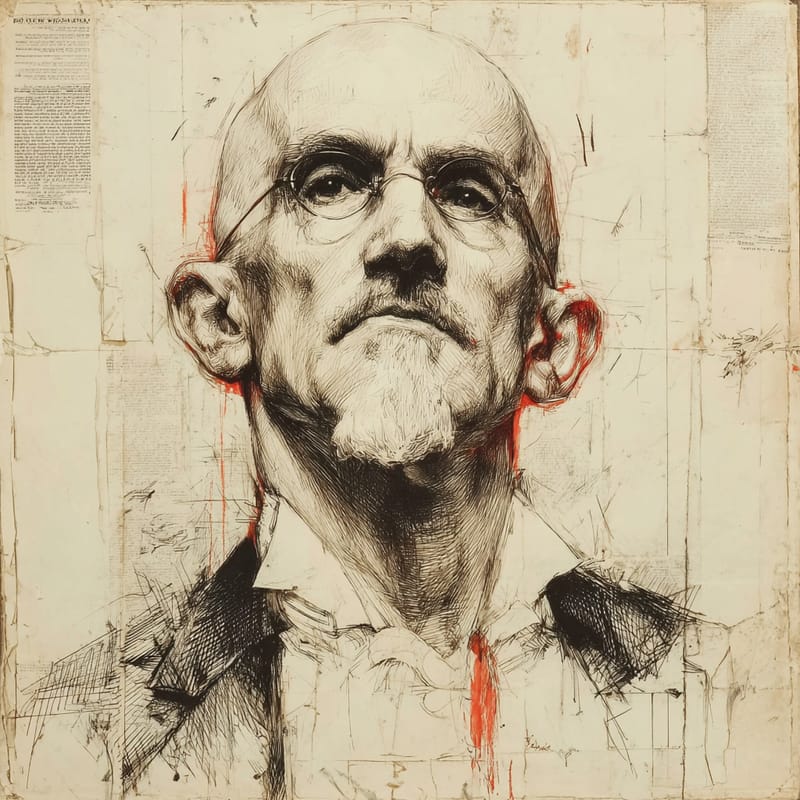
Eugene V. Debs
While there is a soul in prison
American socialism's great tribune.
Reformist Democratic SocialistOne of 729 ideologies · enter the Democratic Socialist hall →- Role
- Labour leader
- Era
- 1855–1926
- Region
- United States
- Social band
- Reformist
- Placement
- −58 · +20 · +55
§ Where Eugene V. Debs stands
3 axesDebs called for collective ownership of the railways, mines and great industries and an end to what he called wage slavery. As the Socialist Party's presidential candidate, most successfully in 1912, he paired that goal with immediate demands such as the eight-hour day, the abolition of child labour and a graduated income tax, reforms that could be won within the existing system.
Debs envisaged a far larger public sector but believed workers could win it democratically, through a mass party and industrial unions rather than armed uprising. He helped found the Socialist Party in 1901 and the Industrial Workers of the World in 1905 but drifted away from the IWW, and although he hailed the Russian Revolution he stayed with the Socialist Party when the Communists split away in 1919.
Debs was progressive for his era: he backed votes for women, campaigned against child labour and refused to speak to segregated audiences in the South. He opposed the American Railway Union's 1894 decision to exclude Black workers, though in The Negro in the Class Struggle (1903) he treated racism as part of the class question and offered Black Americans no separate programme.
How close are you to Eugene V. Debs?
Three statements, one per axis. Answer them and we’ll drop you on the compass next to them.
§ The story
HistoricalEugene Victor Debs (1855–1926) was an American trade unionist and the leading figure of the Socialist Party of America. Born in Terre Haute, Indiana, to immigrants from Alsace, he left school at fourteen to work in the railway shops, became a locomotive fireman and rose to national office in the Brotherhood of Locomotive Firemen, while also serving a term in the Indiana legislature as a Democrat. In 1893 he founded the American Railway Union, one of the first American unions to organise a whole industry rather than a single craft.
The union's 1894 boycott of Pullman cars, in support of striking Pullman workers, was broken by a federal injunction and troops; Debs served six months for contempt of court and turned to socialism. He helped found the Socialist Party in 1901 and ran for president five times between 1900 and 1920, winning about 6 per cent of the vote in 1912. A 1918 speech against the First World War brought a ten-year sentence under the Espionage Act, and he polled more than 900,000 votes in 1920 from a federal penitentiary before President Warren Harding commuted the sentence in 1921.
Notable for
- 01Five socialist presidential runs
- 02Led the Pullman Strike
- 03Jailed for anti-war speech
Key works & moments
- 1893Founds the American Railway Union, organising railway workers across every craft.
- 1894Leads the union's Pullman boycott, broken by a federal injunction and federal troops.
- 1901Helps found the Socialist Party of America.
- 1912Wins about 6 per cent of the presidential vote, the Socialist Party's highest share.
- 1918Arrested after an anti-war speech in Canton, Ohio; sentenced to ten years under the Espionage Act.
- 1920Polls more than 900,000 votes for president as federal prisoner No. 9653.
In their own words
“While there is a lower class, I am in it, and while there is a criminal element I am of it, and while there is a soul in prison, I am not free.”
“The master class has always declared the wars; the subject class has always fought the battles.”
§ Minds closest to Eugene V. Debs
All minds →


§ Also in the Democratic Socialist hall
Enter the hall →§ Common questions
4 answersWhat was Eugene V. Debs's political ideology?
Eugene V. Debs was a democratic socialist: on the 99ideologies three-axis compass, a Reformist Democratic Socialist. Economically he sat well to the left (−58), calling for collective ownership of the major industries and an end to the wage system. On governance he leaned slightly toward the state (+20), envisaging a much larger public sector but seeking it through elections and industrial unions rather than insurrection. Socially he was progressive for his era (+55), backing women's suffrage and opposing child labour and segregated meetings.
Was Eugene V. Debs left-wing or right-wing?
Left-wing: he was the defining figure of early twentieth-century American socialism. Debs wanted to replace capitalism with collective ownership, ran five times for president as a socialist and went to prison for opposing the First World War. He was nonetheless a democrat rather than a Leninist, seeking power through the ballot box and the unions, and he stayed with the Socialist Party when its pro-Bolshevik wing broke away to form the Communist movement in 1919.
Why was Eugene V. Debs sent to prison?
He was jailed twice, both times for defying federal authority. In 1895 he served six months for contempt of court after the American Railway Union ignored a federal injunction during the Pullman boycott. In 1918 he was convicted under the Espionage Act for a speech in Canton, Ohio, that attacked the First World War and praised jailed opponents of the draft, and he was sentenced to ten years. The Supreme Court upheld the conviction unanimously in Debs v. United States (1919), and President Warren Harding commuted the sentence in December 1921.
Which minds are closest to Eugene V. Debs?
On the 99ideologies three-axis compass, the minds closest to Eugene V. Debs are Michael Harrington (97% alike), Salvador Allende (96% alike) and Jean Jaurès (94% alike). The furthest is Hans-Hermann Hoppe (12% alike).