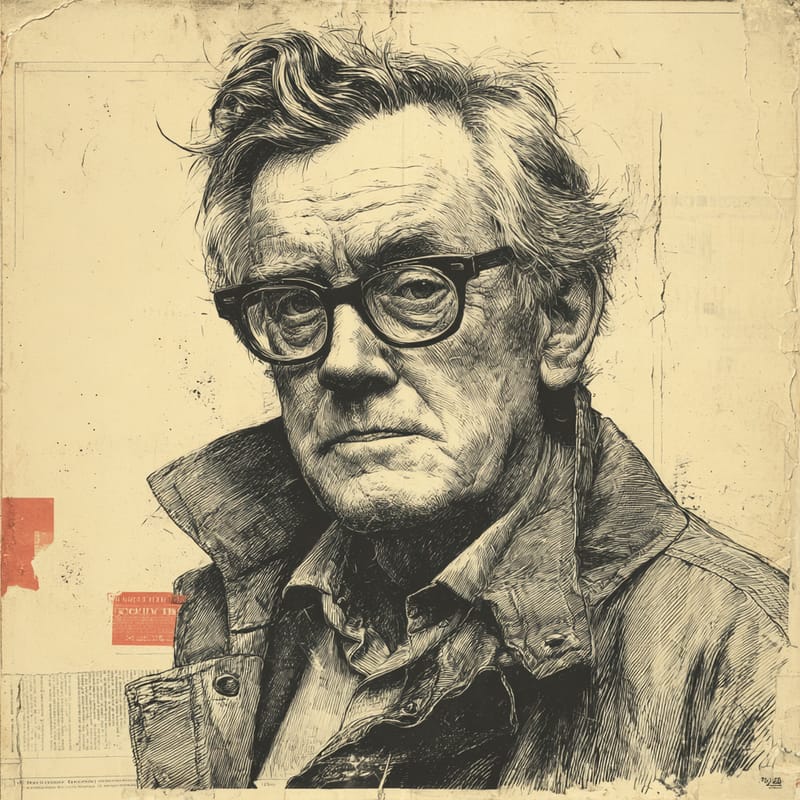
Michael Harrington
The other America
Made poverty visible; built the DSA.
Reformist Democratic SocialistOne of 729 ideologies · enter the Democratic Socialist hall →- Role
- Writer & organiser
- Era
- 1928–1989
- Region
- United States
- Social band
- Reformist
- Placement
- −54 · +18 · +60
§ Where Michael Harrington stands
3 axesHarrington wanted democratic social ownership to replace capitalism over time, and in Socialism (1972) he set that goal apart from the Soviet command economy. In practice he campaigned for full employment, national health insurance and federal anti-poverty spending, the agenda The Other America had helped launch in 1962, which places him left of centre rather than at the revolutionary pole.
Harrington worked inside American democracy, steering socialists toward the left flank of the Democratic Party alongside the unions and the civil rights movement. He chaired the Socialist Party from 1968 to 1972, founded the Democratic Socialist Organizing Committee in 1973 and merged it with the New American Movement in 1982 to form the Democratic Socialists of America, favouring an active federal government but rejecting one-party rule.
Harrington came to the left through Dorothy Day's Catholic Worker movement, living among the poor of New York's Bowery from 1951, and he framed poverty as an affront to human dignity rather than a personal failing. He backed the civil rights movement and criticised the Vietnam War, giving his socialism a humanist, morally urgent tone.
How close are you to Michael Harrington?
Three statements, one per axis. Answer them and we’ll drop you on the compass next to them.
§ The story
HistoricalEdward Michael Harrington Jr. (1928–1989) was an American socialist writer, organiser and political scientist. Born into an Irish Catholic family in St Louis, Missouri, he studied at the College of the Holy Cross, Yale Law School and the University of Chicago, then in 1951 joined Dorothy Day's Catholic Worker movement in New York, living among the poor of the Bowery. Within a few years he had left the Church for secular socialism, rising through Max Shachtman's anti-Stalinist circle into the Socialist Party, and from 1972 he taught political science at Queens College in New York.
Harrington's The Other America (1962) argued that tens of millions of Americans lived in a poverty hidden from the affluent majority. Amplified by Dwight Macdonald's long review in The New Yorker, it reached the Kennedy administration and helped inspire Lyndon Johnson's War on Poverty, whose planners Harrington briefly advised in 1964. He chaired the Socialist Party from 1968 to 1972, popularised the term neoconservative in a 1973 essay and in 1982 co-founded the Democratic Socialists of America. New Left radicals found him too cautious, while former comrades who moved right judged him too radical.
Notable for
- 01'The Other America'
- 02Founded the DSA's predecessor
- 03Bridged socialism and labour
Key works & moments
- 1951Joins Dorothy Day's Catholic Worker movement in New York, living among the Bowery's poor.
- 1962Publishes The Other America: Poverty in the United States.
- 1964Advises Sargent Shriver's task force as it designs Lyndon Johnson's War on Poverty.
- 1968Becomes national chairman of the Socialist Party of America.
- 1973Founds the Democratic Socialist Organizing Committee after leaving the Socialist Party.
- 1982Merges his committee with the New American Movement to form the Democratic Socialists of America.
In their own words
“That the poor are invisible is one of the most important things about them.”
§ Minds closest to Michael Harrington
All minds →

§ Also in the Democratic Socialist hall
Enter the hall →§ Common questions
4 answersWhat was Michael Harrington's political ideology?
Michael Harrington was a democratic socialist: on the 99ideologies three-axis compass, a Reformist Democratic Socialist. Economically he sat left of centre (−54), hoping to replace capitalism with democratic social ownership over time while campaigning for full employment, national health insurance and anti-poverty programmes. On governance he leaned slightly toward the state (+18), favouring an active federal government built through elections and the Democratic Party. Socially he was progressive (+60), a humanist who backed civil rights and treated poverty as an affront to human dignity.
Was Michael Harrington left-wing or right-wing?
Left-wing, and one of the best-known American socialists of the post-war era. Harrington wanted a democratic socialism that would eventually replace capitalism, but he was a gradualist who rejected Soviet communism and argued that socialists should work as the left wing of the Democratic Party, alongside the unions and the civil rights movement. That reformism put him at odds both with the New Left of the 1960s, which found him too cautious, and with former allies who drifted toward neoconservatism.
Did Michael Harrington's The Other America inspire the War on Poverty?
In part, yes. Harrington's 1962 book argued that between 40 and 50 million Americans were poor and largely invisible to the affluent majority. Dwight Macdonald's long review in The New Yorker in January 1963 brought it to the attention of the Kennedy administration, whose economists began planning anti-poverty measures. Lyndon Johnson declared an unconditional war on poverty in January 1964, and Harrington briefly advised the task force under Sargent Shriver that drafted the Economic Opportunity Act. Historians credit the book with making poverty visible, though the policies had many authors.
Which minds are closest to Michael Harrington?
On the 99ideologies three-axis compass, the minds closest to Michael Harrington are Eugene V. Debs (97% alike), Jeremy Corbyn (96% alike) and Salvador Allende (93% alike). The furthest is Adam Sutler (12% alike).