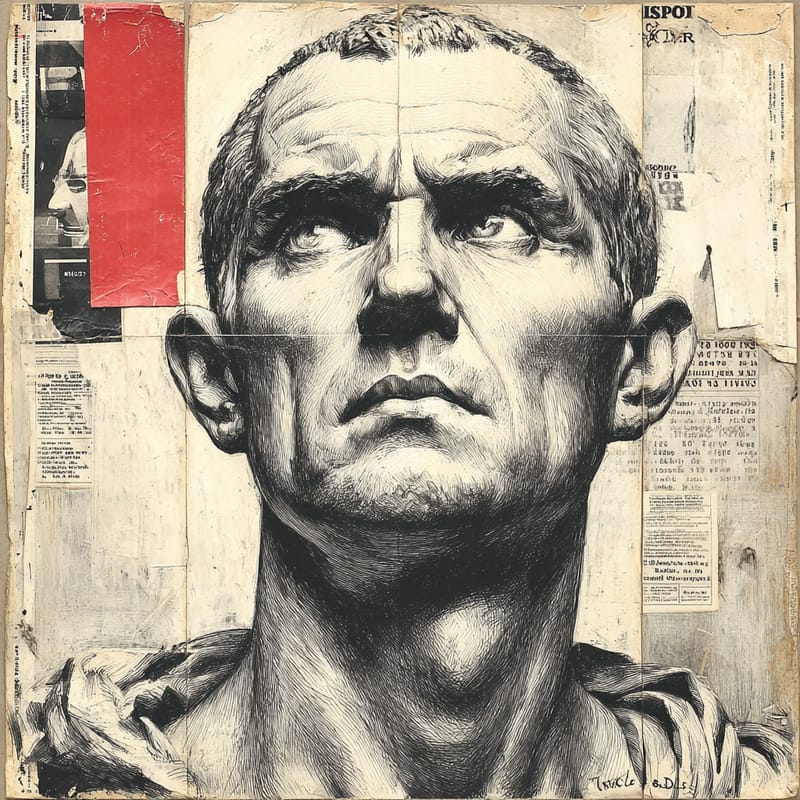
Marcus Licinius Crassus
The richest man in Rome
Wealth as a path to power.
Traditional OligarchistOne of 729 ideologies · enter the Oligarchist hall →- Role
- Triumvir
- Era
- 115–53 BC
- Region
- Roman Republic
- Social band
- Traditional
- Placement
- +74 · +70 · −40
§ Where Marcus Licinius Crassus stands
3 axesCrassus made his fortune as a speculator and landlord. Plutarch reports that he bought burning houses and their neighbours cheaply, then rebuilt with more than 500 slave builders, and he profited from the Sullan proscriptions of 82–81 BC, silver mines and the training of skilled slaves. His wealth was private and acquisitive, built on property, lending and political opportunity rather than on the spoils of office.
Crassus treated money as a direct route to political control. He lent freely to senators and stood surety for Caesar's debts in 61 BC so that Caesar could leave for his province, and the pact of 60 BC let three men override the Senate through allied consuls and tribunes. Its renewal at Luca in 56 BC handed him a second consulship and command of an army in Syria.
Crassus was a conservative member of the Roman nobility, not a social reformer. He rose by fighting for Sulla's aristocratic cause in the civil war of 83–82 BC, and he answered the gravest threat to the slave-owning order, Spartacus's rising of 73–71 BC, with mass crucifixion along the Appian Way. Wealth, rank and the slave economy defined his world.
How close are you to Marcus Licinius Crassus?
Three statements, one per axis. Answer them and we’ll drop you on the compass next to them.
§ The story
HistoricalMarcus Licinius Crassus (c. 115–53 BC) was the richest man in the late Roman Republic and a member of the alliance with Pompey and Julius Caesar known as the First Triumvirate. From a noble plebeian family whose father and brother died in the Marian purges of 87 BC, he joined Sulla in the civil war, commanded the victorious wing at the Colline Gate in 82 BC and enriched himself by buying the confiscated property of the proscribed.
Crassus crushed the slave revolt of Spartacus in 71 BC, crucifying some 6,000 captives along the Appian Way, and shared the consulship with Pompey in 70 BC. He backed rising politicians with loans, including Caesar, and in 60 BC joined Pompey and Caesar in an informal pact that dominated Roman politics. Consul again in 55 BC, he took command in Syria and invaded Parthia in search of military glory to match his partners, but was defeated and killed after the Battle of Carrhae in 53 BC.
Notable for
- 01Richest man in Rome
- 02Member of the First Triumvirate
- 03Crushed Spartacus's revolt
Key works & moments
- 82 BCCommands Sulla's right wing to victory at the Battle of the Colline Gate.
- 71 BCDefeats Spartacus and crucifies some 6,000 captured rebels along the Appian Way.
- 70 BCServes as consul alongside Pompey.
- 60 BCForms the First Triumvirate with Pompey and Julius Caesar.
- 55 BCHolds a second consulship and secures command of the province of Syria.
- 53 BCDefeated by the Parthians at Carrhae and killed during truce negotiations.
§ Minds closest to Marcus Licinius Crassus
All minds →

§ Also in the Oligarchist hall
Enter the hall →§ Common questions
4 answersWhat was Marcus Licinius Crassus's political ideology?
Crassus was a plutocrat who used private wealth to buy political power within the Roman Republic: on the 99ideologies three-axis compass, a Traditional Oligarchist. Economically he sat far toward the market (+74), amassing a fortune through property speculation, lending and the proceeds of Sulla's proscriptions. On governance he leaned strongly toward concentrated power (+70), joining the triumvirate that bypassed the Senate, and socially he was traditional (−40), a defender of rank, property and the slave economy.
Was Crassus left-wing or right-wing?
Modern labels fit Rome only loosely, but Crassus belonged to the conservative, property-owning side. He fought for Sulla's aristocratic cause, crushed Spartacus's slave revolt and grew rich from confiscations. Like other ambitious nobles, though, he also courted popular support and financed politicians who worked through the popular assemblies, above all Julius Caesar. His guiding principle was personal advantage: he backed whoever served his wealth and standing.
How did Crassus become the richest man in Rome?
Through political opportunity as much as business. After Sulla's victory in 82 BC Crassus bought the property of proscribed citizens at knock-down prices, and according to Plutarch he went on to buy burning buildings and their neighbours cheaply, rebuilding with a workforce of more than 500 slave builders. He also owned silver mines, farmland and trained slaves, and lent money to politicians. Plutarch records his view that no one was rich who could not maintain an army from his income.
Which minds are closest to Marcus Licinius Crassus?
On the 99ideologies three-axis compass, the minds closest to Marcus Licinius Crassus are The Cabal (archetype) (97% alike), Boris Berezovsky (95% alike) and Cosimo de' Medici (95% alike). The furthest is Emma Goldman (0% alike).