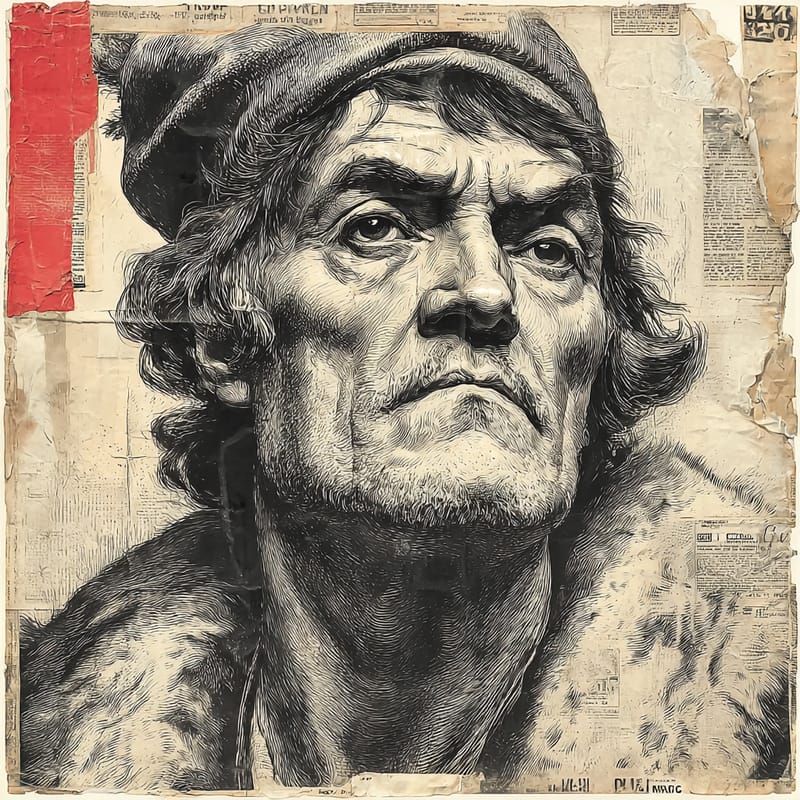
Cosimo de' Medici
Power behind the republic
The bank that ruled a city.
Rooted OligarchistOne of 729 ideologies · enter the Oligarchist hall →- Role
- Banker & de facto ruler
- Era
- 1389–1464
- Region
- Florence
- Social band
- Rooted
- Placement
- +76 · +64 · −30
§ Where Cosimo de' Medici stands
3 axesCosimo was a merchant banker whose wealth rested on international finance and trade. The Medici Bank was organised as a set of partnerships with semi-independent branches, a structure that limited risk, and it profited from handling papal revenues, trading wool and silk and dealing in bills of exchange. Private fortune was the foundation of his power, and the city's tax assessments were notoriously used against his opponents.
Florence remained a republic in form, but Cosimo controlled it from behind the scenes. His partisans used the accoppiatori, officials who decided whose names went into the bags from which magistrates were drawn, to fill the Signoria with friends, and special councils such as the balìa of 1434 and the Council of One Hundred created in 1458 entrenched the regime. Opponents were exiled rather than executed.
Cosimo was a cultivated traditionalist who expressed power through piety and patronage. He paid for the rebuilding of the church of San Lorenzo and the convent of San Marco, where he kept a cell for retreat and endowed a library open to scholars, and commissioned Michelozzo's Palazzo Medici from 1444. His patronage of humanist learning sat within a devout, family-centred and hierarchical civic order.
How close are you to Cosimo de' Medici?
Three statements, one per axis. Answer them and we’ll drop you on the compass next to them.
§ The story
HistoricalCosimo de' Medici (1389–1464), known as Cosimo the Elder, was the banker who made his family the rulers of Florence. The son of Giovanni di Bicci, who founded the Medici Bank in 1397, he expanded it into Europe's leading bank, with branches from London and Bruges to Geneva, Avignon, Venice and Rome and the lucrative business of the papacy. In 1433 the rival Albizzi faction imprisoned and exiled him, but within a year a friendly government recalled him and banished his enemies.
From 1434 until his death Cosimo dominated Florence without holding a throne, governing through allies who controlled the selection of magistrates and through emergency councils that kept opponents out of office. He used his wealth to patronise Brunelleschi, Donatello, Michelozzo and Fra Angelico, helped bring the Council of Florence to the city in 1439 and supported Marsilio Ficino's translations of Plato. His alliance with Francesco Sforza of Milan underpinned the Peace of Lodi in 1454. After his death the city honoured him with the title Pater Patriae, father of his country.
Notable for
- 01Head of the Medici Bank
- 02De facto ruler of Florence
- 03Patron of the Renaissance
Key works & moments
- 1429Takes over the Medici Bank on the death of his father, Giovanni di Bicci.
- 1433Imprisoned in the Palazzo Vecchio and exiled by the rival Albizzi faction.
- 1434Recalled to Florence in triumph; his rivals are banished.
- 1439Helps bring to Florence the church council seeking union of the Eastern and Western churches.
- 1444Commissions Michelozzo's Palazzo Medici and founds the library of San Marco.
- 1454His alliance with Milan underpins the Peace of Lodi, balancing Italy's powers.
§ Minds closest to Cosimo de' Medici
All minds →


§ Also in the Oligarchist hall
Enter the hall →§ Common questions
4 answersWhat was Cosimo de' Medici's political ideology?
Cosimo was a pragmatic oligarch who governed a republic through money and patronage rather than titles: on the 99ideologies three-axis compass, a Rooted Oligarchist. Economically he sat far toward the market (+76), as head of Europe's leading private bank. On governance he leaned strongly toward control (+64), manipulating Florence's elections and councils to keep his faction in power, and socially he was mildly traditional (−30), a pious patron of church and learning within a hierarchical civic order.
Was Cosimo de' Medici left-wing or right-wing?
The labels did not exist in his century, but his politics resemble a conservative, pro-business oligarchy. Cosimo drew support from merchants, newer families and many ordinary Florentines against the old patrician faction of the Albizzi, which gave him a popular veneer. Yet he used that support to entrench his own family's rule, turn taxation against rivals and shut opponents out of office. He was a defender of wealth and order rather than a reformer of society.
Was Cosimo de' Medici a dictator?
Not formally, but in practice he was Florence's master. Cosimo held public office only occasionally and the republican institutions continued, so he could present himself as a private citizen. Real power, however, flowed through his network: his allies controlled who was eligible for office, emergency councils overrode normal procedures, and opponents were exiled. This rule through a nominal republic continued under his son Piero and grandson Lorenzo the Magnificent until the family's expulsion in 1494.
Which minds are closest to Cosimo de' Medici?
On the 99ideologies three-axis compass, the minds closest to Cosimo de' Medici are Boris Berezovsky (99% alike), The Cabal (archetype) (96% alike) and Marcus Licinius Crassus (95% alike). The furthest is Emma Goldman (0% alike).