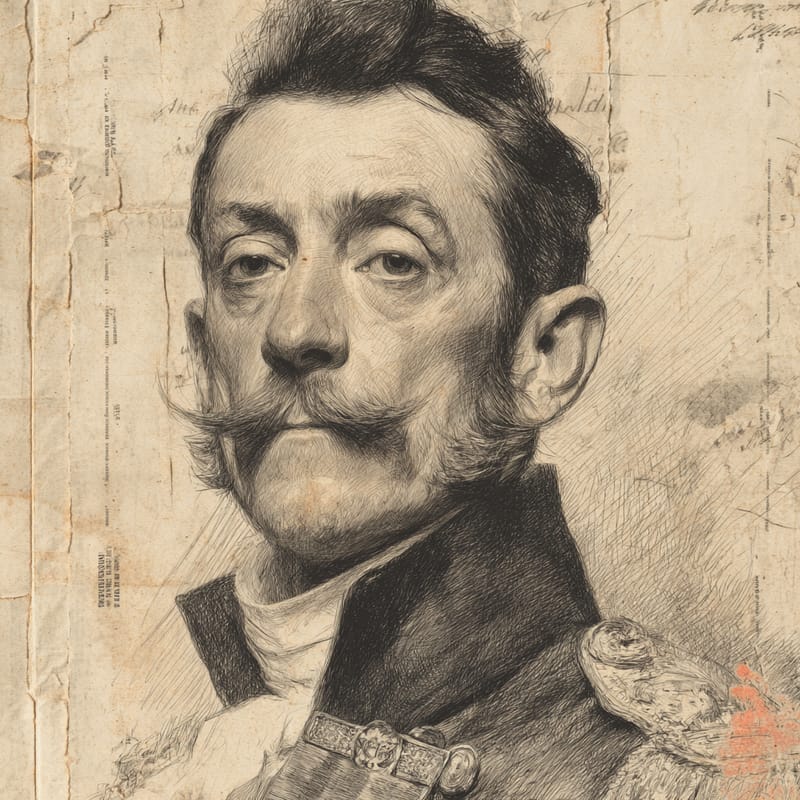
Rafael Trujillo
The nation as estate
A country owned like a business.
Traditional OligarchistOne of 729 ideologies · enter the Oligarchist hall →- Role
- Dictator
- Era
- 1891–1961
- Region
- Dominican Republic
- Social band
- Traditional
- Placement
- +72 · +80 · −46
§ Where Rafael Trujillo stands
3 axesTrujillo ran the economy as a family business. He and his relatives acquired monopolies or controlling stakes in salt, meat, milk and tobacco and, in the 1950s, much of the sugar industry, while compulsory deductions from public salaries flowed to his Dominican Party. The 1940 Trujillo–Hull Treaty ended United States control of Dominican customs, and he paid off the foreign debt in 1947.
Trujillo built one of Latin America's most complete dictatorships. Opposition parties were abolished, adults were expected to carry a Dominican Party membership card, and the Military Intelligence Service, the SIM, ran surveillance, torture and murder. The exiled critic Jesús de Galíndez vanished in New York in 1956, a disappearance widely attributed to his agents, and in 1960 they tried to assassinate Venezuela's president with a car bomb.
Trujillo's regime fused a personality cult, the Catholic establishment and anti-Haitian nationalism. Signs reading God and Trujillo hung in homes, a 1954 concordat with the Vatican bound church and state together, and his government promoted a racialised national identity that cast Haiti as the enemy and culminated in the 1937 border massacre. Women gained the vote in 1942, but the order he defended was patriarchal and hierarchical.
How close are you to Rafael Trujillo?
Three statements, one per axis. Answer them and we’ll drop you on the compass next to them.
§ The story
HistoricalRafael Leónidas Trujillo Molina (1891–1961) ruled the Dominican Republic from 1930 until his assassination in 1961. Born in San Cristóbal to a family of modest means, he joined the National Guard created by the United States Marines during their occupation of 1916–24 and rose rapidly, commanding the army by the late 1920s. In 1930 he used a revolt against President Horacio Vásquez to take power and won a presidential election marked by intimidation and violence.
For thirty-one years Trujillo governed as president or through puppet presidents, renamed the capital Ciudad Trujillo in 1936 and built a personality cult around himself as El Jefe and Benefactor of the Fatherland. In October 1937 his army massacred Haitians and Dominicans of Haitian descent in the border region, and his secret police tortured and killed opponents, including the Mirabal sisters in 1960. After his agents tried to kill Venezuela's president that year, the Organization of American States imposed sanctions, and on 30 May 1961 conspirators, some of whom had received weapons from the CIA, shot him dead.
Notable for
- 01Owned much of the national economy
- 0230-year police state
- 03Cult of personality
Key works & moments
- 1918Joins the National Guard formed under the United States occupation.
- 1930Seizes power after a revolt against President Horacio Vásquez and wins a coerced election.
- 1936The capital, Santo Domingo, is renamed Ciudad Trujillo in his honour.
- 1937Orders the massacre of Haitians and Dominicans of Haitian descent along the border.
- 1960SIM agents murder the Mirabal sisters; sanctions follow his plot against Venezuela's president.
- 1961Assassinated by conspirators on a highway outside the capital on 30 May.
§ Minds closest to Rafael Trujillo
All minds →

§ Also in the Oligarchist hall
Enter the hall →§ Common questions
4 answersWhat was Rafael Trujillo's political ideology?
Trujillo's rule was a personalist dictatorship in which the state and the economy served one family: on the 99ideologies three-axis compass, a Traditional Oligarchist. Economically he sat well toward the market (+72), not as a free-marketeer but as the private owner of monopolies and sugar mills. On governance he was near the authoritarian extreme (+80), running a police state for three decades, and socially he was clearly traditional (−46), fusing Catholicism, a personality cult and anti-Haitian nationalism.
Was Rafael Trujillo left-wing or right-wing?
Right-wing. Trujillo was a fiercely anti-communist dictator who enjoyed United States support for most of his rule, allied himself with the Catholic Church and accumulated private wealth on a vast scale. His public works and the paying off of the foreign debt gave his regime a developmental image, but its purpose was personal enrichment and control. Washington turned against him only in his final years, after his attempt to kill Venezuela's democratic president in 1960.
What was the Parsley Massacre?
It was the killing of Haitians and Dominicans of Haitian descent ordered by Trujillo in the Dominican borderlands in October 1937. Soldiers and civilian auxiliaries killed people over several days, many with machetes; estimates of the dead range from about 12,000 to more than 30,000. The name comes from accounts that soldiers identified victims by making them say perejil, the Spanish word for parsley, which Haitian Creole speakers were said to pronounce differently. It remains the defining atrocity of his rule.
Which minds are closest to Rafael Trujillo?
On the 99ideologies three-axis compass, the minds closest to Rafael Trujillo are Marcus Licinius Crassus (95% alike), Homelander (94% alike) and Giovanni Gentile (94% alike). The furthest is Emma Goldman (0% alike).