
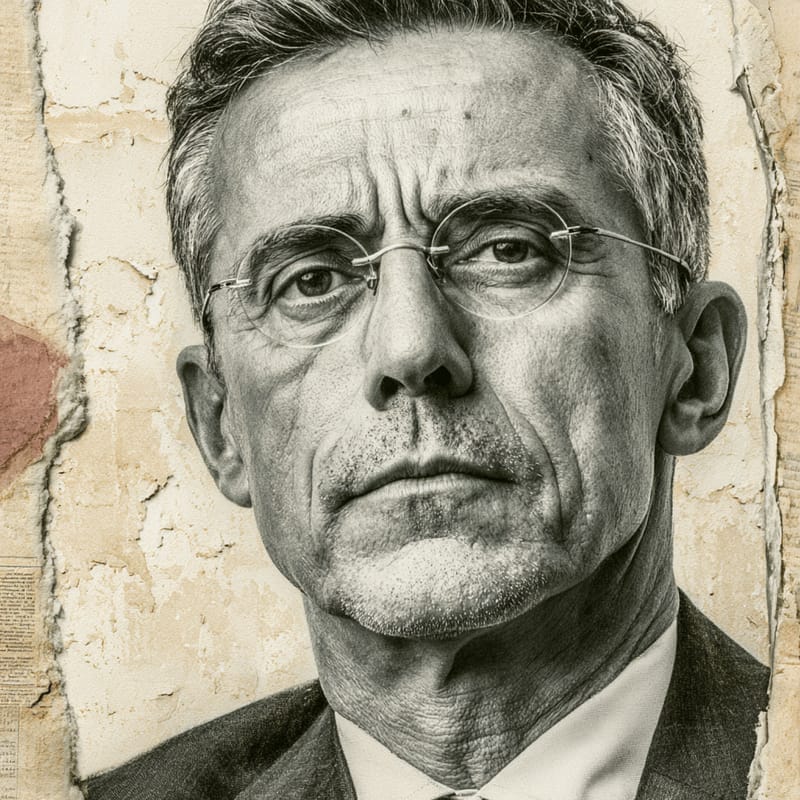
Ludwig Lachmann
Radical subjectivism
Expectations and the unknowable future.
Libertarian CapitalistOne of 729 ideologies · enter the Libertarian Capitalist hall →- Role
- Economist
- Era
- 1906–1990
- Region
- Germany / South Africa
- Social band
- Centre (no modifier)
- Placement
- +88 · −30 · −10
§ Where Ludwig Lachmann stands
3 axesLachmann was a firm defender of the market economy, on unusual grounds: because the future cannot be known, no planner could gather the knowledge needed to direct production. Capital and Its Structure (1956) treated the capital stock as a fragile pattern of complementary goods that only entrepreneurs, revising plans through market prices, can keep in workable order, and The Market as an Economic Process (1986) described markets as perpetually unfolding.
Lachmann shared the Austrian School's classical-liberal scepticism of state economic management, rooted in the limits of knowledge stressed by Hayek, under whom he studied in the 1930s. His 1973 essay Macro-economic Thinking and the Market Economy criticised Keynesian aggregates for hiding the individual plans that governments cannot see, though he wrote far less about politics than about economic theory.
Lachmann's social thought was restrained and centred on institutions rather than causes. In The Legacy of Max Weber (1970) he argued that legal and social institutions serve as points of orientation that make millions of individual plans compatible, a respect for slowly evolved structures that gives his liberalism a mildly conservative cast without any programme of cultural traditionalism.
How close are you to Ludwig Lachmann?
Three statements, one per axis. Answer them and we’ll drop you on the compass next to them.
§ The story
HistoricalLudwig Maurits Lachmann (1906–1990) was a German-born economist of the Austrian School. Born in Berlin to a Jewish family, he took his doctorate at the University of Berlin under Werner Sombart in 1930 and left for England after the Nazis came to power in 1933, studying at the London School of Economics under Friedrich Hayek. He taught at University College Hull before moving in 1949 to the University of the Witwatersrand in Johannesburg, which remained his base for the rest of his life.
Lachmann's Capital and Its Structure (1956) developed Austrian capital theory around the complementarity of capital goods and the plans of their owners, and from the mid-1970s he spent part of each year at New York University, where with Israel Kirzner he helped revive Austrian economics in the United States. Drawing on the British economist G. L. S. Shackle, he pushed subjectivism from tastes to expectations, arguing that an unknowable future makes markets a never-ending process rather than a system tending to equilibrium. Critics, including fellow Austrians, warned that his views left little room for economic order.
Notable for
- 01Radical subjectivism
- 02'The Market as an Economic Process'
- 03Austrian revival figure
Key works & moments
- 1933Leaves Nazi Germany for England and studies at the London School of Economics under Hayek.
- 1956Publishes Capital and Its Structure, a landmark of Austrian capital theory.
- 1970Publishes The Legacy of Max Weber, on institutions and the coordination of plans.
- 1976Publishes From Mises to Shackle, his manifesto for radical subjectivism.
- 1986Publishes The Market as an Economic Process.
§ Minds closest to Ludwig Lachmann
All minds →



§ Also in the Libertarian Capitalist hall
Enter the hall →§ Common questions
4 answersWhat was Ludwig Lachmann's political ideology?
Ludwig Lachmann was a classical liberal economist of the Austrian School: on the 99ideologies three-axis compass, a Libertarian Capitalist. Economically he sat near the market extreme (+88), defending the market as the only way to coordinate plans in an unknowable future. On governance he leaned libertarian (−30), sceptical of the knowledge any planner could claim, and socially he sat just on the traditional side of centre (−10), respecting evolved institutions without any programme of cultural traditionalism.
Was Ludwig Lachmann left-wing or right-wing?
Right of centre in economic terms, as a defender of the market economy against planning and Keynesian management. Lachmann was not a political activist, however: his work concerned the theory of capital, expectations and institutions, and his radical subjectivism made some free-market colleagues uneasy because it questioned whether markets reliably tend toward equilibrium. His politics are best described as classical liberal rather than partisan.
What is radical subjectivism in economics?
Radical subjectivism is Lachmann's extension of the Austrian idea that value is subjective from people's tastes to their expectations. Because the future is unknowable and different people interpret the same information differently, he argued, market prices never settle into a stable equilibrium but reflect a continuing process of plans being formed, revised and disappointed. He set out the view in his 1976 essay From Mises to Shackle and in The Market as an Economic Process (1986), drawing on the British economist G. L. S. Shackle.
Which minds are closest to Ludwig Lachmann?
On the 99ideologies three-axis compass, the minds closest to Ludwig Lachmann are Carl Menger (98% alike), Henry Hazlitt (98% alike) and Jean-Baptiste Say (97% alike). The furthest is Pol Pot (5% alike).