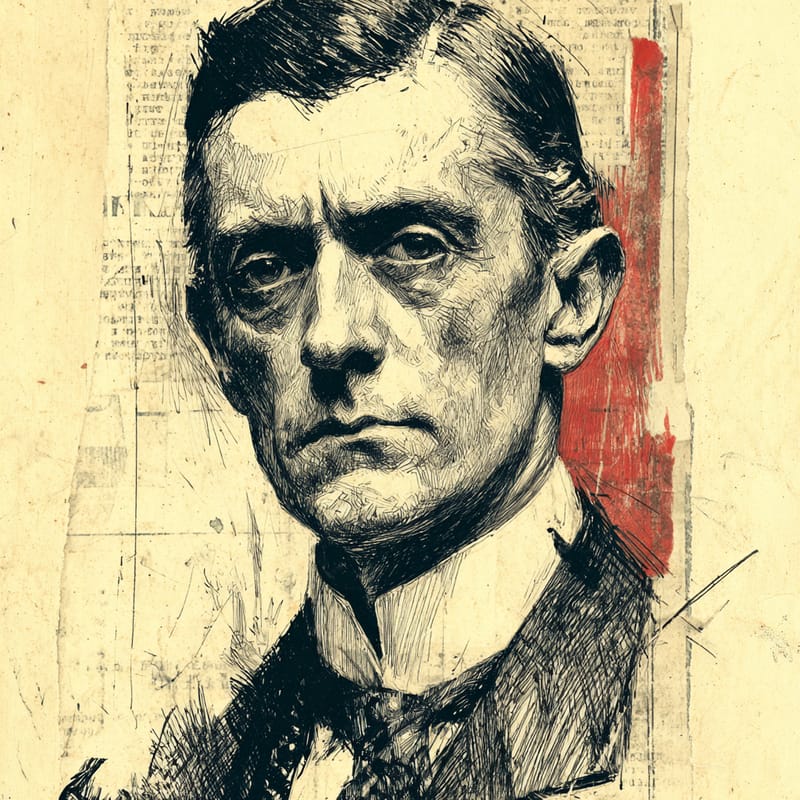
Hank Rearden
The right to produce
The maker who asks no permission.
Rooted Libertarian CapitalistOne of 729 ideologies · enter the Libertarian Capitalist hall →- Role
- Industrialist (fiction)
- From
- Atlas Shrugged
- Region
- United States
- Social band
- Rooted
- Placement
- +97 · −26 · −18
§ Where Hank Rearden stands
3 axesRearden embodies the ideal Rand set out in Atlas Shrugged (1957): a producer who creates value by reason and effort and trades it only for value received. He resists rules forcing him to sell Rearden Metal in government-set fair shares and the Equalization of Opportunity Bill that forces him to sell his ore mines, and treats profit as the moral reward for production.
Rearden wants nothing from the state except to be left alone, and Atlas Shrugged (1957) shows bureaucrats, the State Science Institute and Directive 10-289 strangling his business. He defies the authorities at his trial, but he is no anarchist: like Rand, he accepts a government limited to protecting rights, and his rebellion takes the form of withdrawing his talents rather than violent resistance.
Rearden is stern, disciplined and traditional in bearing: a workaholic who believes in self-reliance and honours a failed marriage out of duty. His moral journey in Atlas Shrugged runs against convention, as he sheds the guilt his wife, mother and brother impose and comes to see his desire for Dagny and his pride in his work as virtues rather than sins.
How close are you to Hank Rearden?
Three statements, one per axis. Answer them and we’ll drop you on the compass next to them.
§ The story
FictionHenry 'Hank' Rearden is one of the central heroes of Ayn Rand's novel Atlas Shrugged, published in 1957. A self-made Pennsylvania steel magnate who began work as a boy in the iron mines, he spends ten years developing Rearden Metal, an alloy lighter and stronger than steel, which Dagny Taggart uses to build the John Galt Line. At home he is surrounded by a wife, mother and brother who disdain his work while living off it, and he begins an affair with Dagny.
Over the novel Rearden is squeezed by ever tighter controls, from the Equalization of Opportunity Bill to Directive 10-289, and he is blackmailed into signing Rearden Metal over to the government. At his trial he refuses to recognise the court's right to judge him, and he finally abandons his mills to join the strike of the men of the mind in Galt's Gulch. Rand meant him as the archetype of the productive industrialist made to feel guilty for his virtue, and he remains a hero to libertarians and Objectivists and a target for critics of her moral individualism.
Notable for
- 01Invented Rearden Metal
- 02Icon of the productive maker
- 03'Atlas Shrugged'
Key works & moments
- 1957Ayn Rand publishes Atlas Shrugged, with Hank Rearden as its steel magnate.
- Part OneRearden Metal rails carry the first train on the John Galt Line.
- Part TwoAt his trial, refuses to accept the court's right to judge his trade.
- Part TwoBlackmailed over his affair with Dagny, he signs Rearden Metal over to the government.
- Part ThreeAbandons his mills and joins the strike in Galt's Gulch.
- 2011Grant Bowler plays Rearden in the film Atlas Shrugged: Part I.
§ Minds closest to Hank Rearden
All minds →




§ Also in the Libertarian Capitalist hall
Enter the hall →The closest minds above are this hall’s whole roster.
§ Common questions
4 answersWhat is Hank Rearden's political ideology?
Hank Rearden embodies Ayn Rand's laissez-faire capitalism and the ethics of rational self-interest she called Objectivism: on the 99ideologies three-axis compass, a Rooted Libertarian Capitalist. Economically he sits at the extreme market end (+97), a self-made industrialist who sees profit as the reward for production. On governance he leans libertarian (−26), wanting the state limited to protecting rights, and socially he is mildly traditional (−18), a stern, duty-bound man whose arc is learning to reject unearned guilt.
Is Hank Rearden left-wing or right-wing?
Right-wing in economic terms: Rearden is fiction's archetypal defender of free enterprise against regulation, redistribution and the idea that business owes society a fair share. Rand, however, rejected conservatism, and Rearden's values are secular and individualist rather than religious or nationalist. That makes him a hero chiefly to libertarians and Objectivists, while critics on the left see him as a romanticised portrait of the industrial capitalist.
Why does the government take Rearden Metal in Atlas Shrugged?
Because in the novel's collectivist America, success itself becomes suspect. Rearden Metal, an alloy Rearden spent ten years developing, is first attacked by the State Science Institute and rival industrialists, then subjected to allocation rules, and finally taken through Directive 10-289, which requires inventors to sign their patents over to the state. Rearden signs only under blackmail. Rand used the episode to argue that regulation punishes producers and that the state lives off the minds it claims to serve.
Which minds are closest to Hank Rearden?
On the 99ideologies three-axis compass, the minds closest to Hank Rearden are Carl Menger (97% alike), Eugen von Böhm-Bawerk (97% alike) and Jean-Baptiste Say (96% alike). The furthest is Pol Pot (2% alike).