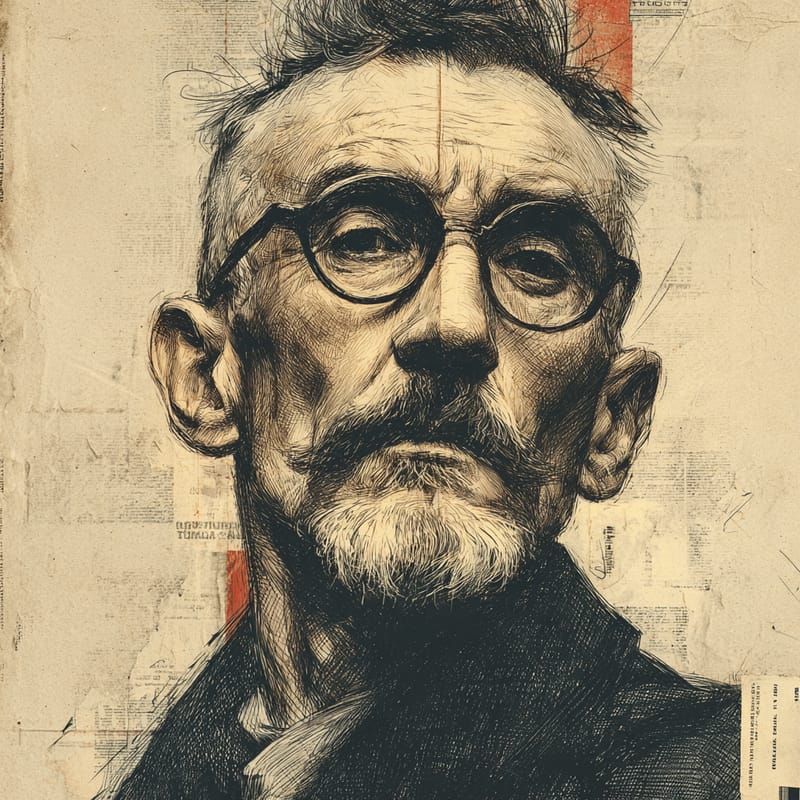
Eduard Limonov
The National Bolshevik Party
Provocation as politics.
Rooted National BolshevikOne of 729 ideologies · enter the National Bolshevik hall →- Role
- Writer & agitator
- Era
- 1943–2020
- Region
- Russia
- Social band
- Rooted
- Placement
- −68 · +82 · −24
§ Where Eduard Limonov stands
3 axesLimonov's programme was anti-capitalist and anti-oligarch rather than systematically socialist. The National Bolshevik Party denounced the privatisations of the 1990s and the wealth of the new oligarchs, and its rallies paraded Soviet symbols and Stalin's name, but Limonov's collectivism was more a revolt against post-Soviet inequality than a worked-out plan for the economy.
Limonov's party was openly authoritarian and revolutionary, built around a leader and a militant vanguard, and Russian courts banned it as extremist in 2007. Paradoxically, his later years were spent defending civil liberties: from 2009 his Strategy-31 protests demanded the freedom of assembly guaranteed by Article 31 of the Russian constitution.
Limonov combined personal transgression with nationalist politics. His fiction was sexually explicit and scandalised Soviet and émigré readers alike, yet his movement campaigned for Russian speakers in former Soviet republics and for the return of Crimea, and after his 2001 arrest prosecutors accused him of planning an armed incursion into northern Kazakhstan, a charge on which he was acquitted.
How close are you to Eduard Limonov?
Three statements, one per axis. Answer them and we’ll drop you on the compass next to them.
§ The story
HistoricalEduard Limonov (1943–2020), born Eduard Savenko, was a Russian writer and political agitator. Raised in Kharkiv, he joined Moscow's underground poetry scene in the late 1960s, emigrated in 1974 and lived in New York, where his scandalous novel It's Me, Eddie drew on his life on the margins of émigré society, before settling in Paris in 1980. Returning to Russia in the early 1990s, he co-founded the National Bolshevik Party with Alexander Dugin in 1993.
Limonov turned politics into performance. His party's flag echoed Nazi design with a hammer and sickle at its centre, its newspaper Limonka courted alienated youth, and its activists staged stunts and occupations. During the Yugoslav wars he spent time with Serb fighters and was filmed in 1992 firing a machine gun towards besieged Sarajevo. Jailed in 2001–03 for illegally buying weapons, he then joined liberal opponents of Vladimir Putin in The Other Russia coalition, before backing the annexation of Crimea in 2014. Emmanuel Carrère's 2011 novel Limonov made him famous far beyond Russia.
Notable for
- 01Founded the National Bolshevik Party
- 02Provocateur-novelist
- 03Post-Soviet ultranationalism
Key works & moments
- 1974Emigrates from the Soviet Union and settles in New York.
- 1979Publishes It's Me, Eddie, a scandalous novel about émigré life in New York.
- 1993Co-founds the National Bolshevik Party with Alexander Dugin; its newspaper Limonka follows in 1994.
- 2001Arrested in the Altai mountains; later convicted of illegally buying weapons.
- 2009Launches the Strategy-31 protests for freedom of assembly in Moscow.
- 2011Emmanuel Carrère's novel Limonov wins France's Prix Renaudot.
§ Minds closest to Eduard Limonov
All minds →
§ Also in the National Bolshevik hall
Enter the hall →§ Common questions
4 answersWhat was Eduard Limonov's political ideology?
Eduard Limonov was a National Bolshevik, the founder of a movement that fused Soviet nostalgia, anti-capitalism and Russian ultranationalism: on the 99ideologies three-axis compass, a Rooted National Bolshevik. Economically he leaned well to the left (−68), attacking oligarchs and privatisation. On governance he was strongly authoritarian (+82), leading a militant revolutionary party. Socially he leaned traditional (−24), putting nationalist mission above his own transgressive literary persona.
Was Eduard Limonov left-wing or right-wing?
Neither label fits on its own. Limonov drew on the far left's anti-capitalism and Soviet imagery and on the far right's ultranationalism and cult of violence, and his National Bolshevik Party attracted punks, artists and radicals from both camps. In the 2000s he even allied with liberal opponents of the Kremlin to defend freedom of assembly, before returning to nationalist causes over Crimea and eastern Ukraine in 2014. Many scholars classify his movement as part of the radical nationalist right.
What was the National Bolshevik Party?
It was a radical Russian movement founded in 1993 by Eduard Limonov and Alexander Dugin. Its flag imitated the Nazi banner with a hammer and sickle in place of the swastika, and its members, known as nazboly, staged provocative protests, occupations of government offices and stunts such as throwing eggs at public figures. Dugin left in 1998. In the 2000s the party joined the opposition to Vladimir Putin, and Russian courts banned it as extremist in 2007.
Which minds are closest to Eduard Limonov?
On the 99ideologies three-axis compass, the minds closest to Eduard Limonov are Ernst Niekisch (97% alike), The Red-Brown Front (archetype) (97% alike) and Karl Radek (92% alike). The furthest is Murray Rothbard (3% alike).