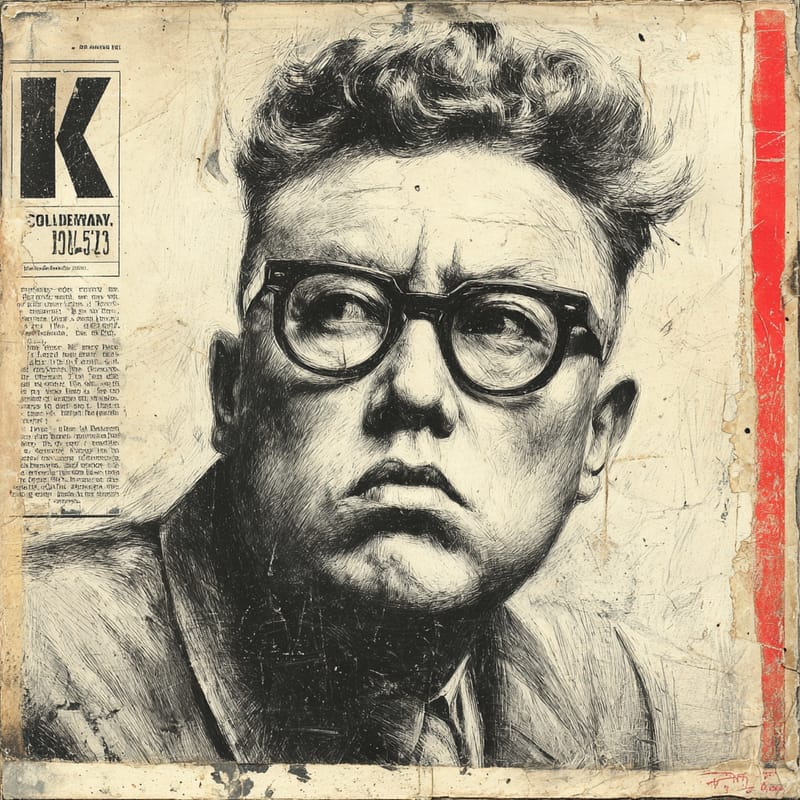
Kim Jong-il
Military-first
Songun and the famine years.
JuchistOne of 729 ideologies · enter the Juchist hall →- Role
- Supreme Leader
- Era
- 1941–2011
- Region
- North Korea
- Social band
- Centre (no modifier)
- Placement
- −76 · +97 · 0
§ Where Kim Jong-il stands
3 axesKim kept the economy state-owned and planned, but his military-first priorities and the collapse of Soviet support left the public distribution system in ruins during the famine of the 1990s. Limited price and wage reforms announced in July 2002 tolerated some market activity, while a botched currency redenomination in November 2009 wiped out private savings as the state reasserted control.
Kim inherited and deepened a hereditary dictatorship. The 1998 constitution elevated the National Defence Commission he chaired to the summit of state power, the kwanliso political prison camps held whole families accused of disloyalty, and his own cult was built to match his father's, with his birthday, 16 February, made a national holiday.
Kim's social record balances modern propaganda against inherited tradition. A film enthusiast, he wrote On the Art of the Cinema in 1973 and in 1978 had the South Korean director Shin Sang-ok and actress Choi Eun-hee abducted to make films for him, yet his succession followed the logic of a royal dynasty and he kept society sealed off from outside culture.
How close are you to Kim Jong-il?
Three statements, one per axis. Answer them and we’ll drop you on the compass next to them.
§ The story
HistoricalKim Jong-il (1941–2011) ruled North Korea from his father Kim Il-sung's death in 1994 until his own death in 2011. Soviet records place his birth in a Red Army camp in the Soviet Far East, though official North Korean accounts claim he was born on Mount Paektu. After graduating from Kim Il-sung University in 1964 he rose through the Workers' Party's propaganda apparatus, taking charge of film and the arts, and was publicly confirmed as his father's successor at the Sixth Party Congress in 1980.
His rule began with a famine in the mid-1990s that killed hundreds of thousands of people, by some estimates far more, as the economy collapsed after the loss of Soviet aid. Kim answered with Songun, or military-first politics, channelling scarce resources to the armed forces and to a nuclear weapons programme that produced the country's first test in 2006. He held summits with South Korean presidents in 2000 and 2007, and in 2002 admitted that North Korean agents had abducted Japanese citizens. He died in December 2011 and was succeeded by his son Kim Jong-un.
Notable for
- 01'Military-first' (Songun) policy
- 02Nuclear-weapons program
- 03Cinematic propaganda obsession
Key works & moments
- 1973Publishes On the Art of the Cinema, codifying film as a tool of propaganda.
- 1980Publicly confirmed as his father's successor at the Sixth Party Congress.
- 1994Takes power after Kim Il-sung's death as famine begins to devastate the country.
- 2000Hosts South Korean president Kim Dae-jung at the first inter-Korean summit in Pyongyang.
- 2006North Korea conducts its first nuclear test on 9 October.
- 2011Dies in December; his son Kim Jong-un succeeds him.
§ Minds closest to Kim Jong-il
All minds →

§ Also in the Juchist hall
Enter the hall →The closest minds above are this hall’s whole roster.
§ Common questions
4 answersWhat was Kim Jong-il's political ideology?
Kim Jong-il ruled through Juche, his father's doctrine of self-reliance, to which he added Songun, or military-first politics: on the 99ideologies three-axis compass, a Juchist. Economically he sat well to the left (−76), preserving a state-owned, planned economy even through famine. On governance he was at the authoritarian extreme (+97), heading a hereditary dictatorship with a vast propaganda apparatus, and socially he sat at the centre (0), pairing modern mass media with dynastic, Confucian-style loyalty.
Was Kim Jong-il left-wing or right-wing?
Officially left-wing, in practice hard to classify. Kim Jong-il headed a communist-founded party and kept a planned, state-owned economy, which places him on the left economically. But his military-first politics, hereditary succession and ethnic nationalism have little to do with Marxist ideas of class struggle, and in 2009 references to communism were dropped from the constitution, so his regime is best understood as a dynastic dictatorship rather than through the usual left-right spectrum.
What was Kim Jong-il's military-first policy?
Songun, or military-first politics, was the doctrine Kim Jong-il developed in the 1990s to put the armed forces at the centre of the state. As famine and the loss of Soviet aid shook the country, he ruled through the National Defence Commission, gave the army first claim on resources and treated it, rather than the working class, as the vanguard of the revolution. Songun was written into the constitution in 2009, and it justified the nuclear and missile programmes behind the 2006 test.
Which minds are closest to Kim Jong-il?
On the 99ideologies three-axis compass, the minds closest to Kim Jong-il are Kim Jong-un (99% alike), Kim Il-sung (98% alike) and The Eternal Leader (archetype) (98% alike). The furthest is Hans-Hermann Hoppe (0% alike).