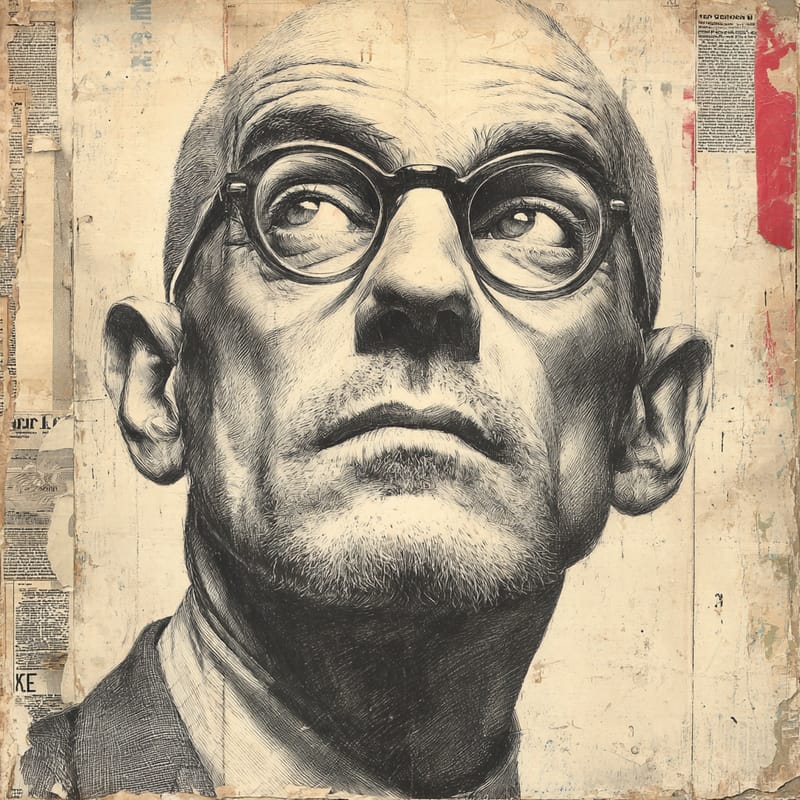
Ernst Niekisch
The original National Bolshevik
Red and nationalist at once.
Rooted National BolshevikOne of 729 ideologies · enter the National Bolshevik hall →- Role
- Theorist
- Era
- 1889–1967
- Region
- Germany
- Social band
- Rooted
- Placement
- −72 · +80 · −30
§ Where Ernst Niekisch stands
3 axesNiekisch rejected capitalism as the system of the bourgeois West and the Versailles powers. In Widerstand and in books such as Entscheidung (1930) he argued that Germany should break with Western liberal economics and look east to the Soviet model, combining a collectivist, planned economy with national independence and a Spartan, anti-consumerist ethos.
Niekisch wanted an authoritarian state forged from Prussian discipline and Soviet methods, sweeping away the Weimar Republic, which he saw as a Western import imposed by defeat. Yet he opposed Hitler: his 1932 pamphlet attacked the Nazi movement, and in 1939 the People's Court sentenced him to life imprisonment for high treason because of his resistance circle.
Niekisch was a revolutionary nationalist rather than a conservative, contemptuous of the bourgeoisie, political Catholicism and Western liberal culture. His ideal was an austere Prussian order, which he contrasted with a Roman, Western spirit he associated with Catholic southern Germany, placing him on the rooted, nationalist side of the social spectrum despite his anti-bourgeois rhetoric.
How close are you to Ernst Niekisch?
Three statements, one per axis. Answer them and we’ll drop you on the compass next to them.
§ The story
HistoricalErnst Niekisch (1889–1967) was a German political writer and the leading theorist of Weimar-era National Bolshevism. A schoolteacher raised in Nördlingen in Bavaria, he joined the Social Democrats and in 1919 briefly chaired the central council of Bavaria's revolutionary workers' and soldiers' councils, for which he served two years in prison. Moving from socialism toward nationalism, he founded the journal Widerstand in 1926 and gathered a circle of writers, Ernst Jünger among its contributors, who sought a German revolution allied with Soviet Russia against the West.
Niekisch's National Bolshevism rejected both liberal democracy and Hitler, whom he regarded as a petty-bourgeois demagogue; his 1932 pamphlet Hitler – ein deutsches Verhängnis warned that Nazism would lead Germany to catastrophe. The Nazis banned Widerstand in 1934, arrested him in 1937 and in 1939 sentenced him to life imprisonment. Freed by the Red Army in 1945, nearly blind, he joined the communists and taught at the Humboldt University in East Berlin, but grew disillusioned after the 1953 uprising and died in West Berlin in 1967.
Notable for
- 01Coined Weimar National Bolshevism
- 02Edited 'Widerstand'
- 03Imprisoned by the Nazis
Key works & moments
- 1919Chairs Bavaria's central council of workers' and soldiers' councils; later jailed for two years.
- 1926Founds Widerstand, the journal of German National Bolshevism.
- 1932Publishes Hitler – ein deutsches Verhängnis, warning that Nazism will ruin Germany.
- 1937Arrested by the Gestapo; in 1939 sentenced to life imprisonment for treason.
- 1945Freed, nearly blind, by the Red Army and joins the communists in the Soviet zone.
§ Minds closest to Ernst Niekisch
All minds →
§ Also in the National Bolshevik hall
Enter the hall →§ Common questions
4 answersWhat was Ernst Niekisch's political ideology?
Ernst Niekisch was the leading theorist of German National Bolshevism, a fusion of anti-Western nationalism with admiration for Soviet Russia: on the 99ideologies three-axis compass, a Rooted National Bolshevik. Economically he stood well to the left (−72), rejecting capitalism as the creed of the bourgeois West. On governance he was strongly authoritarian (+80), calling for a disciplined Prussian-Soviet state. Socially he leaned traditional (−30), as a revolutionary nationalist rooted in Prussian austerity.
Was Ernst Niekisch left-wing or right-wing?
He belonged to both camps at different moments. Niekisch began as a Social Democrat and revolutionary of 1919, became a leading voice of the anti-Western nationalist milieu of the Weimar years, and ended as a communist professor in East Berlin. His National Bolshevism combined left-wing anti-capitalism with right-wing nationalism, which is why historians usually place him among the national revolutionaries of the Weimar right, while recognising his consistent hostility to Hitler.
Was Ernst Niekisch a Nazi?
No. Although he shared the Nazis' hostility to the Weimar Republic, liberalism and the Versailles settlement, Niekisch was an outspoken opponent of Hitler. His 1932 pamphlet Hitler – ein deutsches Verhängnis predicted catastrophe, the regime banned his journal Widerstand in 1934, and he was arrested in 1937 and sentenced to life imprisonment. He spent the rest of the Third Reich in prison, emerging nearly blind when the Red Army freed him in 1945.
Which minds are closest to Ernst Niekisch?
On the 99ideologies three-axis compass, the minds closest to Ernst Niekisch are Eduard Limonov (97% alike), The Red-Brown Front (archetype) (96% alike) and Karl Radek (91% alike). The furthest is Lysander Spooner (2% alike).