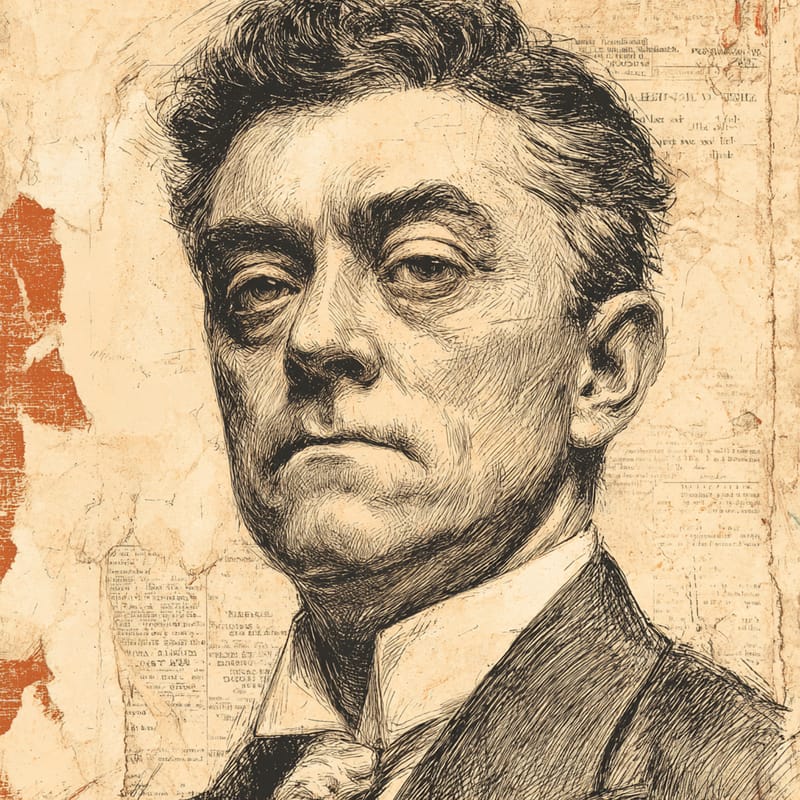
Paul Levi
Luxemburg's executor
Democratic revolution after the martyrs.
Reformist LuxemburgistOne of 729 ideologies · enter the Luxemburgist hall →- Role
- Lawyer & politician
- Era
- 1883–1930
- Region
- Germany
- Social band
- Reformist
- Placement
- −88 · −26 · +55
§ Where Paul Levi stands
3 axesLevi remained a Marxist committed to common ownership of the means of production throughout his career, even after his return to the Social Democrats, where he became a leading voice of the party's left wing. His dispute with Moscow was over method, not goals: he argued that socialism required winning the majority of workers, not a minority insurrection like the March Action of 1921.
Levi defended democracy within the revolutionary movement. As KPD chairman he insisted at the 1919 Heidelberg congress that communists contest parliamentary elections and work inside the trade unions, and in 1921 he denounced the Comintern-backed March Action in his pamphlet Our Path: Against Putschism. His refusal to accept Moscow's discipline on that issue cost him his membership.
A humanist of the revolutionary left, Levi used his legal skills to defend civil liberties and hold the far right to account. In 1929 he represented a journalist sued for libel by Paul Jorns, the military prosecutor who had handled the Luxemburg and Liebknecht murder case, and turned the trial into an exposé of how the killers had been shielded.
How close are you to Paul Levi?
Three statements, one per axis. Answer them and we’ll drop you on the compass next to them.
§ The story
HistoricalPaul Levi (1883–1930) was a German lawyer and socialist politician who led the Communist Party of Germany after the murder of its founders. Born into a Jewish merchant family in Hechingen, he practised law in Frankfurt, and in 1914 he defended Rosa Luxemburg when she was tried for inciting soldiers to disobedience; the two became close comrades. A member of the Spartacus group during the First World War, he became KPD chairman in 1919 after Luxemburg, Karl Liebknecht and Leo Jogiches had been killed.
Levi steered the young party toward elections and union work, but resigned the chairmanship in February 1921 and was expelled that April after publicly condemning the March Action, a disastrous Comintern-backed uprising, as putschism. In 1922 he published Luxemburg's prison manuscript The Russian Revolution, with its criticism of the Bolsheviks. He returned via the Independent Social Democrats to the Social Democratic Party, sitting on its left wing in the Reichstag, and in 1929 helped expose the cover-up of Luxemburg's and Liebknecht's murders. He died in 1930 after a fall from his Berlin flat while ill with fever.
Notable for
- 01Published Luxemburg's prison writings
- 02Led the KPD briefly
- 03Expelled for defending democracy
Key works & moments
- 1914Defends Rosa Luxemburg in Frankfurt when she is tried for inciting soldiers to disobedience.
- 1919Becomes KPD chairman after the murders of Luxemburg, Liebknecht and Leo Jogiches.
- 1919At the Heidelberg congress, commits the KPD to elections and union work, driving out ultra-leftists.
- 1921Condemns the March Action in Our Path: Against Putschism and is expelled from the KPD.
- 1922Publishes Luxemburg's prison manuscript The Russian Revolution.
- 1929Exposes the cover-up of Luxemburg's and Liebknecht's murders in the Jorns libel trial.
§ Minds closest to Paul Levi
All minds →




§ Also in the Luxemburgist hall
Enter the hall →§ Common questions
4 answersWhat was Paul Levi's political ideology?
Paul Levi was a democratic Marxist in the tradition of Rosa Luxemburg: on the 99ideologies three-axis compass, a Reformist Luxemburgist. Economically he stood on the far left (−88), committed to common ownership throughout his career. On governance he leaned libertarian (−26), defending inner-party democracy and opposing minority insurrections and Comintern dictation. Socially he was progressive (+55), a humanist lawyer who used the courts to defend civil liberties and expose right-wing violence.
Was Paul Levi left-wing or right-wing?
Left-wing throughout. Levi led the Communist Party of Germany from 1919 to 1921 and, after his expulsion, sat on the left wing of the Social Democratic Party until his death. Within the left he stood for the democratic, mass-based strategy associated with Luxemburg: he wanted socialism, but argued that it could only be won by the majority of workers, not by a disciplined minority acting on orders from Moscow.
Why was Paul Levi expelled from the Communist Party?
Because he publicly denounced the March Action of 1921. That spring the KPD, urged on by Comintern emissaries, attempted an insurrection in central Germany that collapsed within days, with loss of life and thousands of arrests. Levi, who had already resigned as chairman, attacked the rising as putschism in a pamphlet, Our Path: Against Putschism, and was expelled in April 1921 for breaking party discipline. Lenin is reported to have thought his criticism largely correct but his public breach unacceptable.
Which minds are closest to Paul Levi?
On the 99ideologies three-axis compass, the minds closest to Paul Levi are Franz Mehring (98% alike), Karl Liebknecht (97% alike) and The Spartacist (archetype) (96% alike). The furthest is Adam Sutler (0% alike).