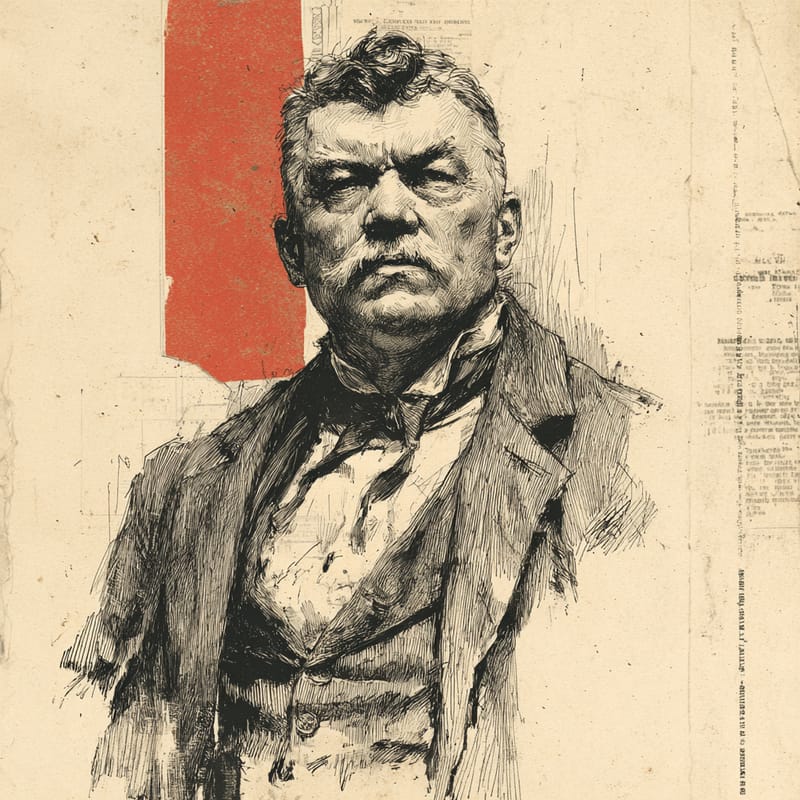
Big Bill Haywood
One Big Union
Founded the Wobblies.
Reformist SyndicalistOne of 729 ideologies · enter the Syndicalist hall →- Role
- Union leader
- Era
- 1869–1928
- Region
- United States
- Social band
- Reformist
- Placement
- −78 · −24 · +45
§ Where Big Bill Haywood stands
3 axesHaywood wanted workers to own and run industry through their unions. The IWW's preamble, adopted at the 1905 convention he chaired, declared that the working class and the employing class have nothing in common and, as revised in 1908, called for abolishing the wage system. Organising by industry rather than craft was meant to unite every worker in a plant so that the union could one day take over production.
Haywood put power on the shop floor rather than in legislatures, championing strikes, sabotage and the general strike over electoral politics. After the Socialist Party adopted a 1912 rule against advocating sabotage, its members voted in 1913 to recall him from the national executive. His flight to Soviet Russia in 1921 showed his hostility to the state bending towards the Bolshevik revolution.
The IWW under Haywood organised the workers the craft unions shunned: immigrants, women, migratory labourers and Black workers. At Lawrence in 1912 it united textile workers of many nationalities, and that year he urged Louisiana's timber workers to bring their Black fellow workers into the same convention hall rather than meet separately.
How close are you to Big Bill Haywood?
Three statements, one per axis. Answer them and we’ll drop you on the compass next to them.
§ The story
HistoricalWilliam Dudley Haywood (1869–1928), known as Big Bill, was an American labour leader. Born in Salt Lake City, he went down the mines as a boy, joined the Western Federation of Miners in 1896 and rose to become its secretary-treasurer, leading its battles with mine owners in the Rocky Mountain states. In June 1905 he chaired the Chicago convention that founded the Industrial Workers of the World, the Wobblies, which aimed to unite all workers in One Big Union regardless of trade, race or sex.
In 1906 Haywood was arrested in Colorado and taken to Idaho to stand trial for the murder of former governor Frank Steunenberg; defended by Clarence Darrow, he was acquitted in 1907. He helped lead the 1912 Lawrence textile strike and the 1913 Paterson silk strike, and in 1913 the Socialist Party removed him from its national executive over his advocacy of direct action. Convicted with scores of Wobblies under the Espionage Act in 1918, he jumped bail in 1921 and fled to Soviet Russia, where he died; part of his ashes lies in the Kremlin Wall.
Notable for
- 01Co-founded the IWW (Wobblies)
- 02'One Big Union'
- 03Led major strikes
Key works & moments
- 1896Joins the Western Federation of Miners at Silver City, Idaho.
- 1905Chairs the founding convention of the Industrial Workers of the World in Chicago.
- 1907Acquitted of conspiring to murder former Idaho governor Frank Steunenberg, with Clarence Darrow defending.
- 1912Helps lead the Lawrence textile strike, remembered as the Bread and Roses strike.
- 1918Convicted with scores of Wobblies under the Espionage Act and sentenced to 20 years.
- 1921Jumps bail and flees to Soviet Russia, where he dies in 1928.
In their own words
“This is the Continental Congress of the working class.”
§ Minds closest to Big Bill Haywood
All minds →

§ Also in the Syndicalist hall
Enter the hall →§ Common questions
4 answersWhat was Big Bill Haywood's political ideology?
Big Bill Haywood was a revolutionary industrial unionist: on the 99ideologies three-axis compass, a Reformist Syndicalist. Economically he sat far to the left (−78), wanting One Big Union to abolish the wage system and run industry. On governance he leaned libertarian (−24), preferring direct action at the point of production to elections and legislatures. Socially he was progressive (+45), organising the immigrants, women, migratory labourers and Black workers whom the craft unions excluded.
Was Big Bill Haywood left-wing or right-wing?
Left-wing, on its revolutionary edge. Haywood wanted to abolish capitalism and the wage system and put industry under workers' control, and he spent his life in radical organisations: the Western Federation of Miners, the Socialist Party until 1913 and the Industrial Workers of the World. He rejected the gradual, electoral socialism of many party colleagues in favour of strikes and direct action, and he ended his life in Soviet Russia.
What was the Industrial Workers of the World?
The IWW, nicknamed the Wobblies, is a revolutionary union founded in Chicago in 1905 by socialists, anarchists and radical unionists including Haywood, Eugene Debs, Mother Jones and Lucy Parsons. Rejecting the craft-based American Federation of Labor, it set out to organise all workers by industry in One Big Union, regardless of skill, race or sex, and to abolish the wage system through direct action and ultimately a general strike. It peaked in the 1910s before wartime prosecutions crippled it, though it still exists.
Which minds are closest to Big Bill Haywood?
On the 99ideologies three-axis compass, the minds closest to Big Bill Haywood are James Connolly (99% alike), Tom Mann (99% alike) and Victor Griffuelhes (99% alike). The furthest is Adam Sutler (2% alike).