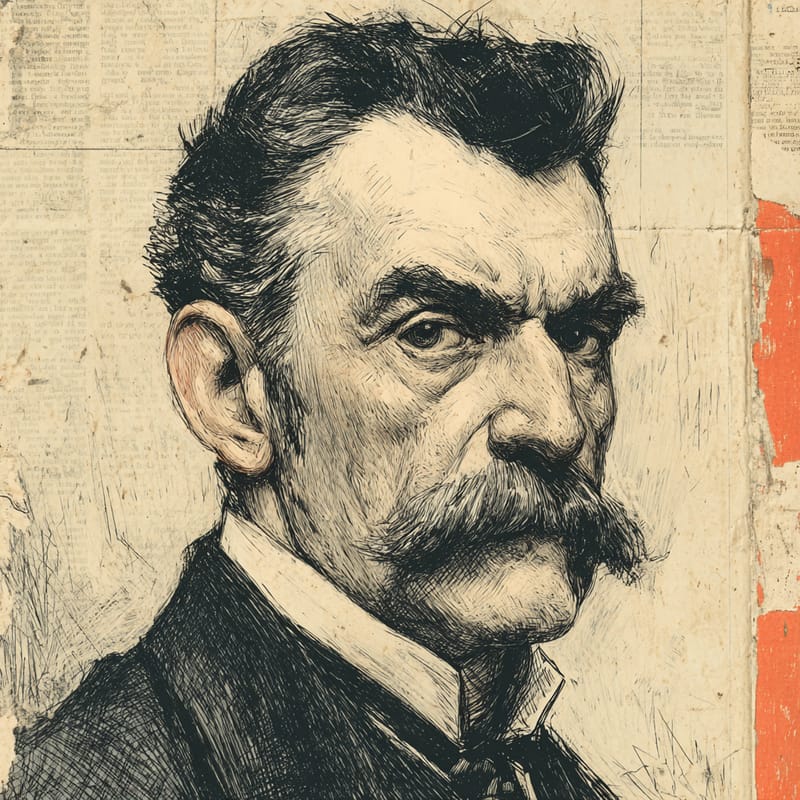
Victor Griffuelhes
The CGT's militant
Led France's great syndicalist union.
Reformist SyndicalistOne of 729 ideologies · enter the Syndicalist hall →- Role
- Union leader
- Era
- 1874–1922
- Region
- France
- Social band
- Reformist
- Placement
- −78 · −26 · +42
§ Where Victor Griffuelhes stands
3 axesGriffuelhes held that workers' own unions, federated in the CGT, should wrest control of the economy from capitalist employers. The Charter of Amiens gave syndicalism a double task: winning immediate gains such as shorter hours and higher wages, and preparing complete emancipation through the expropriation of capital, with the union becoming the future unit of production and distribution.
Griffuelhes defined revolutionary syndicalism as direct action by the workers themselves, through strikes, boycotts and sabotage, rather than through legislation. The Charter of Amiens declared the CGT independent of all political parties and sects, leaving members free to vote as they wished but keeping party politics out of the union, and it named the general strike as the means of emancipation.
A self-taught artisan, Griffuelhes embodied the militant working-class culture of the pre-war CGT, which campaigned against militarism and for shorter hours. Its 1906 May Day campaign, announcing that from that date workers would work no more than eight hours a day, turned the eight-hour day and workers' dignity into a national cause.
How close are you to Victor Griffuelhes?
Three statements, one per axis. Answer them and we’ll drop you on the compass next to them.
§ The story
HistoricalVictor Griffuelhes (1874–1922) was a French trade unionist who led the General Confederation of Labour (CGT) as its general secretary from 1901 to 1909, the years of its revolutionary-syndicalist heyday. Born in Nérac in south-western France, he trained as a shoemaker and moved to Paris, where he joined the Blanquist socialists of Édouard Vaillant before devoting himself wholly to the union movement, rising through the Paris unions to the head of the young confederation.
Under Griffuelhes the CGT absorbed the Federation of Bourses du Travail in 1902, launched the 1906 May Day campaign for the eight-hour day and adopted the Charter of Amiens at its October 1906 congress, a text he chiefly drafted that committed the union to independence from every political party. His militancy brought clashes with Georges Clemenceau's government, which arrested CGT leaders after deadly strike confrontations in 1908. He resigned in 1909 amid internal disputes and never regained his former influence.
Notable for
- 01Led the CGT
- 02Shaped the Charter of Amiens
- 03Revolutionary syndicalist practice
Key works & moments
- 1901Elected general secretary of the General Confederation of Labour (CGT).
- 1902Oversees the CGT's merger with the Federation of Bourses du Travail at Montpellier.
- 1906Leads the May Day campaign for the eight-hour day.
- 1906Chiefly drafts the Charter of Amiens, declaring the CGT independent of all parties.
- 1908Arrested with other CGT leaders after deadly strike clashes at Draveil and Villeneuve-Saint-Georges.
- 1909Resigns as general secretary amid internal disputes.
§ Minds closest to Victor Griffuelhes
All minds →

§ Also in the Syndicalist hall
Enter the hall →§ Common questions
4 answersWhat was Victor Griffuelhes's political ideology?
Victor Griffuelhes was a revolutionary syndicalist: on the 99ideologies three-axis compass, a Reformist Syndicalist. Economically he sat far to the left (−78), seeking the expropriation of capital and the management of production by unions. On governance he leaned libertarian (−26), championing direct action and the union's independence from all parties under the 1906 Charter of Amiens. Socially he was progressive (+42), a self-taught militant of the antimilitarist working-class culture of the pre-war CGT.
Was Victor Griffuelhes left-wing or right-wing?
Left-wing. Griffuelhes came from the Blanquist revolutionary socialist tradition and led the CGT when it aimed to abolish capitalism through union action and the general strike. He rejected parliamentary socialism and kept the confederation independent of the socialist party, but his practical leadership also pursued concrete reforms such as the eight-hour day, combining day-to-day bargaining with a revolutionary horizon.
What was the Charter of Amiens?
It is the resolution adopted by the CGT at its congress in Amiens in October 1906, chiefly drafted by Griffuelhes. It declared the union independent of all political parties and sects, gave syndicalism the double task of winning everyday improvements and preparing the complete emancipation of workers through the expropriation of capital, named the general strike as the means, and described the union as the future basis of production and distribution. It remains a reference point for French unions' independence from parties.
Which minds are closest to Victor Griffuelhes?
On the 99ideologies three-axis compass, the minds closest to Victor Griffuelhes are Big Bill Haywood (99% alike), James Connolly (98% alike) and Stephen Blackpool (illustrative) (97% alike). The furthest is Adam Sutler (2% alike).