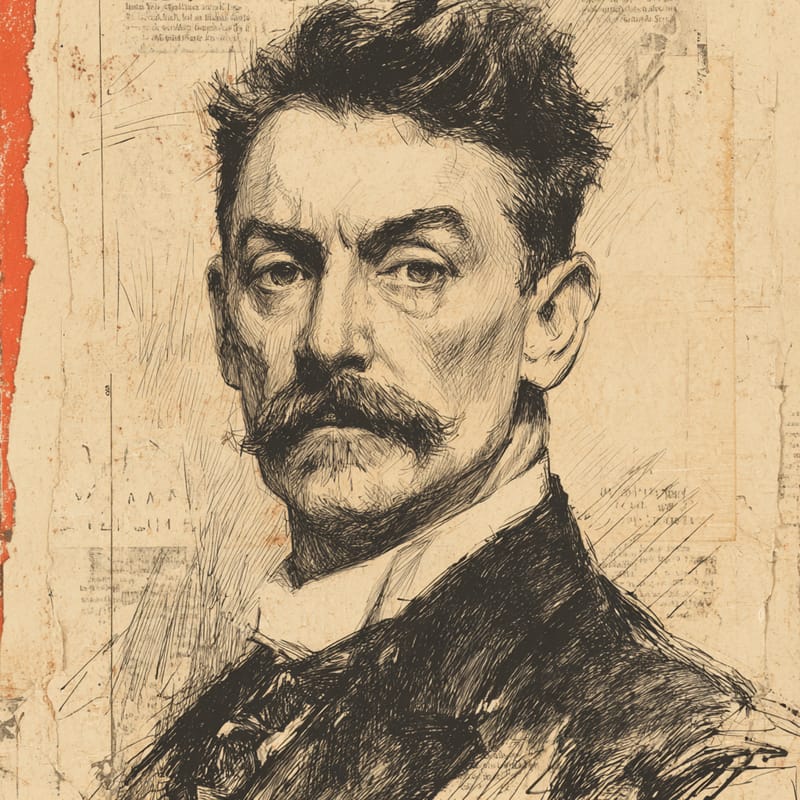
Alexander Schapiro
The international secretary
Knitting the world's syndicalists together.
Reformist Anarcho-SyndicalistOne of 729 ideologies · enter the Anarcho-Syndicalist hall →- Role
- Organiser
- Era
- 1882–1946
- Region
- Russia / international
- Social band
- Reformist
- Placement
- −80 · −90 · +55
§ Where Alexander Schapiro stands
3 axesSchapiro worked for an economy run by federated unions rather than owners or the state. The IWA's founding principles, adopted in Berlin in 1922, set its goal as the reorganisation of social life on the basis of free communism, with workers' own organisations taking over production and distribution. Like other syndicalist veterans of the revolution, he concluded that nationalisation under a party merely exchanged private bosses for state ones.
He rejected both the state and party control of labour. The IWA was created explicitly against the Profintern, the Moscow-led union international founded in 1921, insisting that workers' organisations stay independent of governments and parties. Having seen the Bolsheviks suppress anarchist and syndicalist groups at first hand between 1918 and 1922, he drew the lesson that a workers' state would crush workers' self-organisation.
Schapiro's progressivism was above all internationalist. A Jewish émigré who worked in Britain, Russia, Germany and France, he devoted his career to building solidarity across national lines, and the IWA's 1922 principles rejected militarism and nationalism along with the state, a stance he carried from Berlin to Paris and finally to New York.
How close are you to Alexander Schapiro?
Three statements, one per axis. Answer them and we’ll drop you on the compass next to them.
§ The story
HistoricalAlexander Schapiro (1882–1946) was a Russian-born Jewish anarchist who spent his youth in the émigré radical milieus of western Europe, above all London, where he moved in Peter Kropotkin's circle and the Jewish anarchist movement of the East End. At the 1907 International Anarchist Congress in Amsterdam he was chosen for the international bureau set up to link national movements. He returned to Russia after the 1917 revolution and joined the anarcho-syndicalists grouped around the paper Golos Truda.
Schapiro's experience of Bolshevik repression made him one of its early anarchist critics, and he left Soviet Russia in 1922 as the crackdown on anarchists intensified. In Berlin that winter he helped found the International Workers' Association, the anarcho-syndicalist rival to Moscow's Red International of Labour Unions, and served as one of its three secretaries alongside Rudolf Rocker and Augustin Souchy. He spent the interwar years in Berlin and Paris editing syndicalist papers and linking unions across Europe and Latin America, and died in New York in 1946.
Notable for
- 01Co-founded the IWA-AIT
- 02Anarcho-syndicalist international organiser
- 03Critic of Bolshevik centralism
Key works & moments
- 1907Joins the international bureau created at the Amsterdam International Anarchist Congress.
- 1917Returns to revolutionary Russia and joins the anarcho-syndicalists of Golos Truda.
- 1922Leaves Soviet Russia amid the Bolshevik crackdown on anarchists.
- 1922–23Co-founds the International Workers' Association in Berlin, serving as one of its three secretaries.
- 1946Dies in New York, his last refuge after decades of exile.
§ Minds closest to Alexander Schapiro
All minds →

§ Also in the Anarcho-Syndicalist hall
Enter the hall →§ Common questions
4 answersWhat was Alexander Schapiro's political ideology?
Alexander Schapiro was an anarcho-syndicalist and one of the architects of its international movement: on the 99ideologies three-axis compass, a Reformist Anarcho-Syndicalist. Economically he sat firmly on the left (−80), favouring production run by federated unions. On governance he was strongly libertarian (−90), rejecting both the state and party control of labour, and socially he was moderately progressive (+55), an internationalist who opposed militarism and nationalism.
Was Alexander Schapiro left-wing or right-wing?
Left-wing, on its libertarian side. Schapiro spent his life in the anarchist and syndicalist movements, working for an economy owned and run by workers. His time in revolutionary Russia made him a firm opponent of the Bolsheviks, and the International Workers' Association he helped found in 1922 was a deliberate alternative to the Moscow-led labour international. Like other anarcho-syndicalists, he belonged to the anti-authoritarian left that rejected both capitalism and the one-party state.
What was the International Workers' Association?
It was the international federation of anarcho-syndicalist unions founded in Berlin at a congress held from late December 1922 into January 1923. Its first secretaries were Rudolf Rocker, Augustin Souchy and Alexander Schapiro, and its member unions came to include Germany's FAUD, Argentina's FORA and Spain's CNT, by far the largest. Its principles called for free communism built by independent unions and rejected states, parties and militarism. It was created as a rival to the Communist-led Red International of Labour Unions and still exists.
Which minds are closest to Alexander Schapiro?
On the 99ideologies three-axis compass, the minds closest to Alexander Schapiro are Diego Abad de Santillán (99% alike), Christian Cornelissen (99% alike) and Helmut Rüdiger (98% alike). The furthest is Adam Sutler (0% alike).