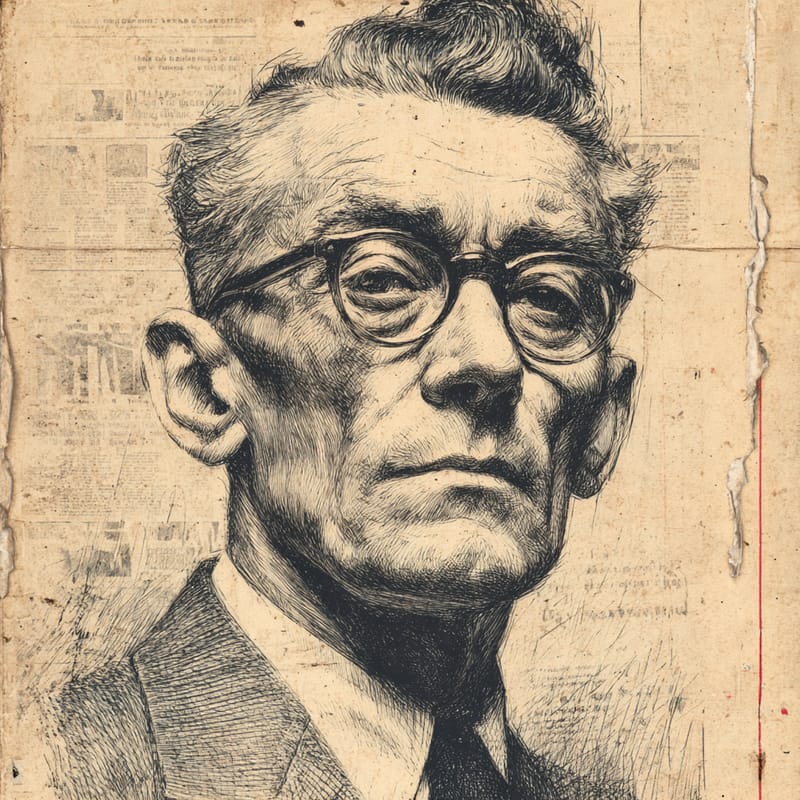
Helmut Rüdiger
Federalism after defeat
Keeping the idea alive in exile.
Reformist Anarcho-SyndicalistOne of 729 ideologies · enter the Anarcho-Syndicalist hall →- Role
- Theorist
- Era
- 1903–1966
- Region
- Germany / Sweden
- Social band
- Reformist
- Placement
- −76 · −88 · +54
§ Where Helmut Rüdiger stands
3 axesRüdiger remained committed to an economy run by federated workers' organisations rather than private owners or the state, the aim set out in the FAUD's 1919 declaration of principles. In exile he stressed decentralisation and the gradual extension of self-management over sweeping expropriation, which keeps him firmly on the left while less absolute than the movement's revolutionary communists.
He rejected the centralised state, whether fascist, Stalinist or bureaucratic, and made federalism the core of his thought: power should flow upward from local communities and workplaces. Having watched the Spanish revolution of 1936 crushed between Franco and the Communists, he argued that libertarians must build federal structures patiently inside existing democracies rather than await a single revolutionary rupture.
Rüdiger's progressivism was humanist and internationalist. Moving from Germany to Spain to Sweden, he worked within the International Workers' Association, whose 1922 principles rejected militarism and nationalism, and he treated democracy, civil liberty and cultural freedom as values to defend against both fascism and Stalinism rather than as bourgeois illusions.
How close are you to Helmut Rüdiger?
Three statements, one per axis. Answer them and we’ll drop you on the compass next to them.
§ The story
HistoricalHelmut Rüdiger (1903–1966) was a German anarcho-syndicalist journalist and theorist who came of age in the Free Workers' Union of Germany (FAUD), the syndicalist federation whose declaration of principles Rudolf Rocker had drafted in 1919. When the Nazis destroyed the German labour movement in 1933 he continued his work abroad, and during the Spanish Civil War he worked in Barcelona for the International Workers' Association, the syndicalist international to which the Spanish CNT belonged.
After Franco's victory in 1939 Rüdiger settled in Sweden, where he wrote for the syndicalist movement around the SAC and became one of anarcho-syndicalism's leading thinkers in exile. Facing a century in which fascism, Stalinism and the welfare state had all marginalised his movement, he argued for a pragmatic, federalist path that would work within existing democracies to widen self-management and decentralisation. Purists accused this line of reformism; admirers saw a serious attempt to keep libertarian socialism relevant after its defeats.
Notable for
- 01IWA-AIT secretary
- 02Federalist syndicalist theory
- 03Sustained the movement in exile
Key works & moments
- 1920sActive as a journalist in Germany's anarcho-syndicalist FAUD.
- 1933The Nazis crush the German labour movement; Rüdiger continues his work in exile.
- 1936–39Works in Barcelona for the International Workers' Association during the Spanish Revolution.
- 1939Settles in Sweden after Franco's victory and joins the circle of the syndicalist SAC.
- 1950sArgues for a pragmatic, federalist syndicalism suited to postwar democracies.
§ Minds closest to Helmut Rüdiger
All minds →


§ Also in the Anarcho-Syndicalist hall
Enter the hall →§ Common questions
4 answersWhat was Helmut Rüdiger's political ideology?
Helmut Rüdiger was a federalist anarcho-syndicalist: on the 99ideologies three-axis compass, a Reformist Anarcho-Syndicalist. Economically he sat firmly on the left (−76), favouring a decentralised economy run by federated workers' organisations. On governance he was strongly libertarian (−88), making federalism and the rejection of the centralised state the heart of his thought, and socially he was moderately progressive (+54), a humanist internationalist who defended civil liberties against fascism and Stalinism.
Was Helmut Rüdiger left-wing or right-wing?
Left-wing, within the libertarian socialist tradition. Rüdiger spent his life in the anarcho-syndicalist movement, from Germany's FAUD to the International Workers' Association in Spain and the syndicalists of Sweden, and he wanted workers rather than owners or officials to run the economy. Within that left he was a pragmatist, arguing for gradual, federalist change inside democracies, which set him apart from insurrectionary anarchists but never reconciled him to the centralised state.
What did Helmut Rüdiger mean by federalism?
He meant organising society from the bottom up, with power residing in local communities and workplaces and passing upward only by delegation to federations that coordinate without commanding. The idea runs from Proudhon and Bakunin through the syndicalist unions, but Rüdiger made it the core of his thought after the defeats of the 1930s, presenting federalism as an alternative to both the totalitarian state and the centralised welfare state, and as something that could be widened step by step within democratic societies.
Which minds are closest to Helmut Rüdiger?
On the 99ideologies three-axis compass, the minds closest to Helmut Rüdiger are Christian Cornelissen (99% alike), Tom Joad (99% alike) and Alexander Schapiro (98% alike). The furthest is Adam Sutler (0% alike).