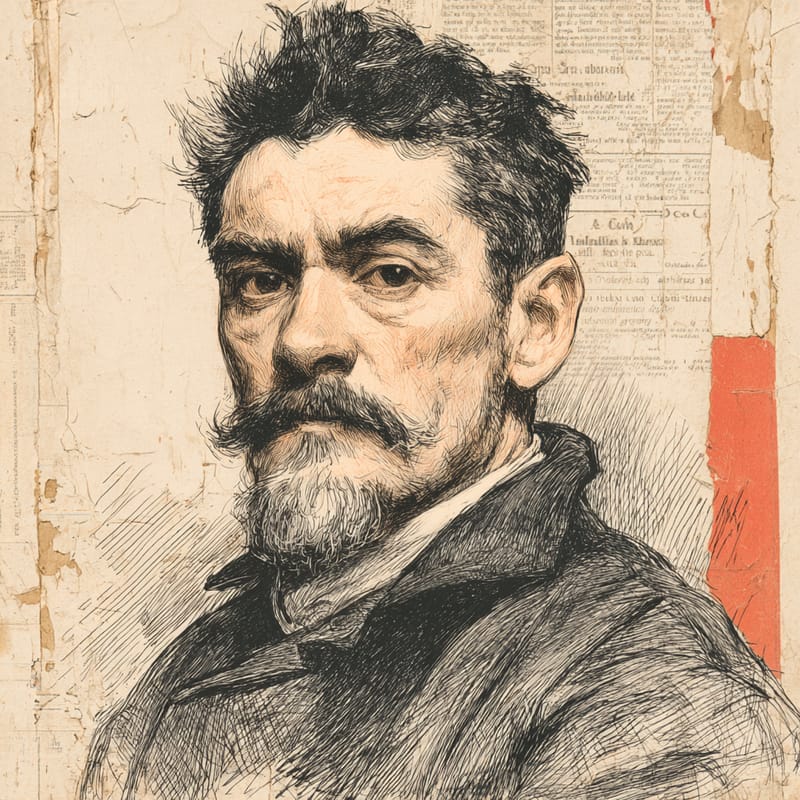
Pierre Monatte
La Vie Ouvrière
Revolutionary unionism, kept independent.
Reformist Anarcho-SyndicalistOne of 729 ideologies · enter the Anarcho-Syndicalist hall →- Role
- Union organiser
- Era
- 1881–1960
- Region
- France
- Social band
- Reformist
- Placement
- −79 · −88 · +50
§ Where Pierre Monatte stands
3 axesMonatte held to the Charter of Amiens of 1906, which gave the unions a double task: winning immediate gains and preparing the complete emancipation of workers through the expropriation of capital, with the union becoming the basic unit of production and distribution. That vision of a union-run economy places him far to the left, though short of the purely communal models of anarchist communism.
Union independence was Monatte's lifelong cause. He defended it against the state and the Socialist Party before 1914, against the CGT leaders who joined the wartime Union sacrée, and against the Communist International after 1923, when his refusal to accept party discipline over the unions led to his expulsion from the French Communist Party in 1924.
Monatte's progressivism was anti-militarist and internationalist. As a young man he joined the Dreyfusard cause, and his December 1914 resignation from the CGT leadership was one of the first public breaks with the patriotic consensus of the war. He saw workers' education as central, building La Vie ouvrière as a review where militants could study economics, history and strategy.
How close are you to Pierre Monatte?
Three statements, one per axis. Answer them and we’ll drop you on the compass next to them.
§ The story
HistoricalPierre Monatte (1881–1960) was born in Monlet, in the Haute-Loire, and made his living in Paris as a proofreader. Drawn into anarchist and Dreyfusard circles as a young man, he joined the CGT, France's main union confederation, and became one of the revolutionary syndicalists who believed the unions themselves, not parties, would make the revolution. He championed the CGT's 1906 Charter of Amiens and in 1907 defended syndicalism against Errico Malatesta at the International Anarchist Congress in Amsterdam.
In 1909 Monatte founded La Vie ouvrière, a review that became the intellectual centre of revolutionary syndicalism. In December 1914 he resigned from the CGT's confederal committee in protest at its support for the war. Inspired by 1917, he joined the French Communist Party in 1923 but was expelled in 1924 for resisting Moscow's Bolshevisation of the party, and in 1925 he founded La Révolution prolétarienne, where he defended union independence against both Communist and reformist control for the rest of his life.
Notable for
- 01Founded 'La Vie Ouvrière'
- 02CGT revolutionary syndicalist
- 03Defended union autonomy
Key works & moments
- 1906Champions the CGT's Charter of Amiens, declaring the unions independent of all political parties.
- 1907Defends syndicalism against Malatesta at the International Anarchist Congress in Amsterdam.
- 1909Founds the review La Vie ouvrière, hub of revolutionary syndicalism.
- 1914Resigns from the CGT confederal committee in protest at its support for the war.
- 1924Expelled from the French Communist Party for opposing its Bolshevisation.
- 1925Founds La Révolution prolétarienne, defending independent revolutionary syndicalism.
§ Minds closest to Pierre Monatte
All minds →

§ Also in the Anarcho-Syndicalist hall
Enter the hall →§ Common questions
4 answersWhat was Pierre Monatte's political ideology?
Pierre Monatte was a revolutionary syndicalist who came out of the anarchist movement: on the 99ideologies three-axis compass, a Reformist Anarcho-Syndicalist. Economically he sat firmly on the left (−79), wanting unions to expropriate capital and run production. On governance he was strongly libertarian (−88), defending union independence from the state and every party, and socially he was moderately progressive (+50), an anti-militarist and internationalist who broke early with the patriotic consensus of 1914.
Was Pierre Monatte left-wing or right-wing?
Left-wing. Monatte spent his life in the revolutionary wing of the French labour movement, sought the abolition of capitalism through union action and opposed the First World War. His left-wing politics were independent rather than partisan: he distrusted the Socialist Party before 1914, joined the Communists only briefly before being expelled, and spent his last decades criticising both Stalinist and reformist control of the unions. He stands for a syndicalist left that refused to take orders from any party.
Was Pierre Monatte a communist?
Only briefly, and on his own terms. Enthusiastic about the Russian Revolution, Monatte joined the French Communist Party in 1923, hoping to bring revolutionary syndicalists and Communists together. Within a year he clashed with the leadership over Moscow's drive to Bolshevise the party and subordinate the unions to it, and he was expelled in 1924 along with Alfred Rosmer. He then founded La Révolution prolétarienne in 1925 and remained a revolutionary syndicalist, critical of Stalinism, for the rest of his life.
Which minds are closest to Pierre Monatte?
On the 99ideologies three-axis compass, the minds closest to Pierre Monatte are Christian Cornelissen (99% alike), Helmut Rüdiger (98% alike) and Alexander Schapiro (98% alike). The furthest is Adam Sutler (0% alike).