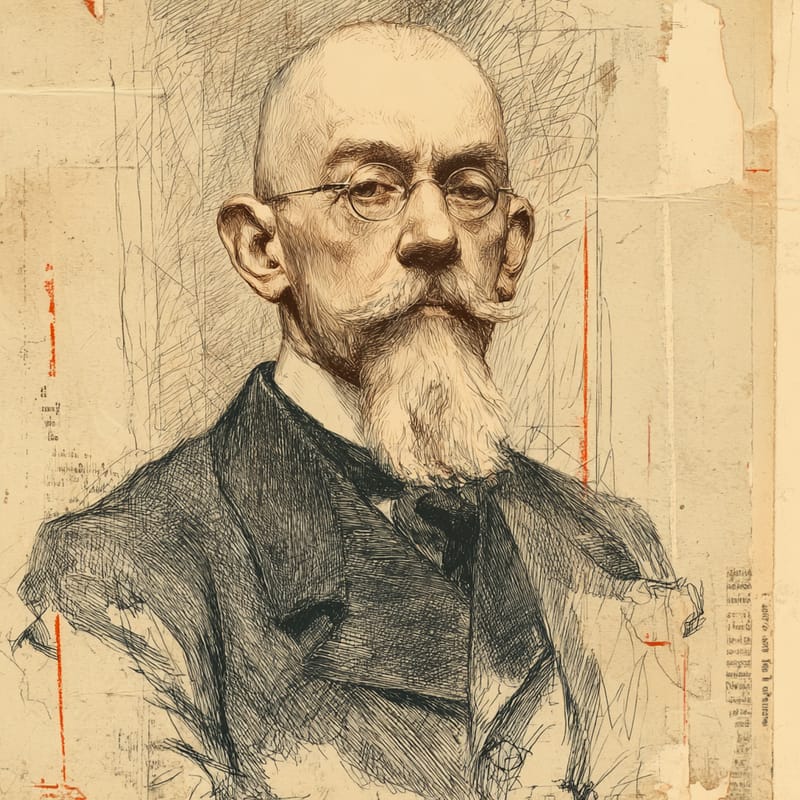
Christian Cornelissen
Syndicalism's economist
Theorising the unions' new order.
Reformist Anarcho-SyndicalistOne of 729 ideologies · enter the Anarcho-Syndicalist hall →- Role
- Theorist & economist
- Era
- 1864–1942
- Region
- Netherlands
- Social band
- Reformist
- Placement
- −78 · −89 · +52
§ Where Christian Cornelissen stands
3 axesCornelissen wanted capitalist property replaced by collective ownership organised through industrial unions, which would manage production after the revolution. His Théorie de la valeur (1903) criticised both Marx's labour theory of value and the marginalist economics of Jevons and Böhm-Bawerk, trying to ground syndicalist demands in a rigorous account of how wages, prices and profits are actually formed.
Like the NAS and the French CGT, Cornelissen rejected parliamentary politics and party leadership of the unions, holding that workers' own syndicates should both fight capital and replace the state as the framework of social life. The CGT's 1906 Charter of Amiens, which declared the unions independent of all parties, expressed the stateless, union-based federalism his bulletin promoted from 1907.
Cornelissen was a progressive internationalist whose life's work was linking labour movements across borders. Yet his internationalism had limits: in 1916 he joined Kropotkin and Jean Grave in the Manifesto of the Sixteen, arguing that German militarism had to be defeated, a stance most anarchists condemned as a betrayal of anti-war principle.
How close are you to Christian Cornelissen?
Three statements, one per axis. Answer them and we’ll drop you on the compass next to them.
§ The story
HistoricalChristiaan Cornelissen (1864–1942), often written Christian, was a Dutch socialist theorist and economist, born in 's-Hertogenbosch. In the 1880s he joined Ferdinand Domela Nieuwenhuis's socialist movement and moved with it from parliamentary socialism towards anarchism, becoming a leading figure in the National Labour Secretariat (NAS), the Dutch union centre founded in 1893 that turned into a stronghold of revolutionary syndicalism. Around the turn of the century he settled in France, where he worked among the revolutionary syndicalists of the CGT.
Cornelissen gave syndicalism much of its economic theory, beginning with Théorie de la valeur (1903), part of a multi-volume treatise on economics, and from 1907 he edited the Bulletin international du mouvement syndicaliste, linking unions across countries. His standing among anarchists suffered in 1916, when he signed the Manifesto of the Sixteen, drafted by Peter Kropotkin and Jean Grave, backing the Allies against Germany and breaking with the anti-war majority of the movement. He spent his last years in France, where he died in 1942.
Notable for
- 01Syndicalist economic theory
- 02International labour organiser
- 03Anti-war internationalist
Key works & moments
- 1893The National Labour Secretariat (NAS) is founded; Cornelissen becomes one of its leading figures.
- 1903Publishes Théorie de la valeur, a critique of Marxist and marginalist value theory.
- 1907Launches the Bulletin international du mouvement syndicaliste, linking syndicalist unions until 1914.
- 1916Signs the Manifesto of the Sixteen supporting the Allied war effort.
§ Minds closest to Christian Cornelissen
All minds →



§ Also in the Anarcho-Syndicalist hall
Enter the hall →§ Common questions
4 answersWhat was Christian Cornelissen's political ideology?
Christian Cornelissen was a revolutionary syndicalist and economist: on the 99ideologies three-axis compass, a Reformist Anarcho-Syndicalist. Economically he sat firmly on the left (−78), seeking collective ownership managed through industrial unions. On governance he was strongly libertarian (−89), rejecting parliaments and parties in favour of union federations, and socially he was moderately progressive (+52), an internationalist whose support for the Allies in 1916 set him apart from most anarchists.
Was Christian Cornelissen left-wing or right-wing?
Left-wing. Cornelissen spent his career in the Dutch and French labour movements, arguing that unions should abolish capitalism and run the economy themselves, and his economic treatises were written to arm that cause. He belonged to the anti-parliamentary, anarchist-leaning left rather than to social democracy or Marxism. His one sharp departure from left-wing consensus came in 1916, when he backed the Allied war effort against Germany, a position most of his comrades rejected.
Did Christian Cornelissen support the First World War?
Yes. In 1916 he was one of the signatories of the Manifesto of the Sixteen, drafted by Peter Kropotkin and Jean Grave, which argued that German aggression threatened Europe's progress and that anarchists should support resistance to it. Errico Malatesta answered with his article Pro-Government Anarchists, and most of the movement sided with him. For Cornelissen, who had spent years building international links between unions, the stance cost him standing among anti-war syndicalists.
Which minds are closest to Christian Cornelissen?
On the 99ideologies three-axis compass, the minds closest to Christian Cornelissen are Pierre Monatte (99% alike), Helmut Rüdiger (99% alike) and Alexander Schapiro (99% alike). The furthest is Adam Sutler (0% alike).