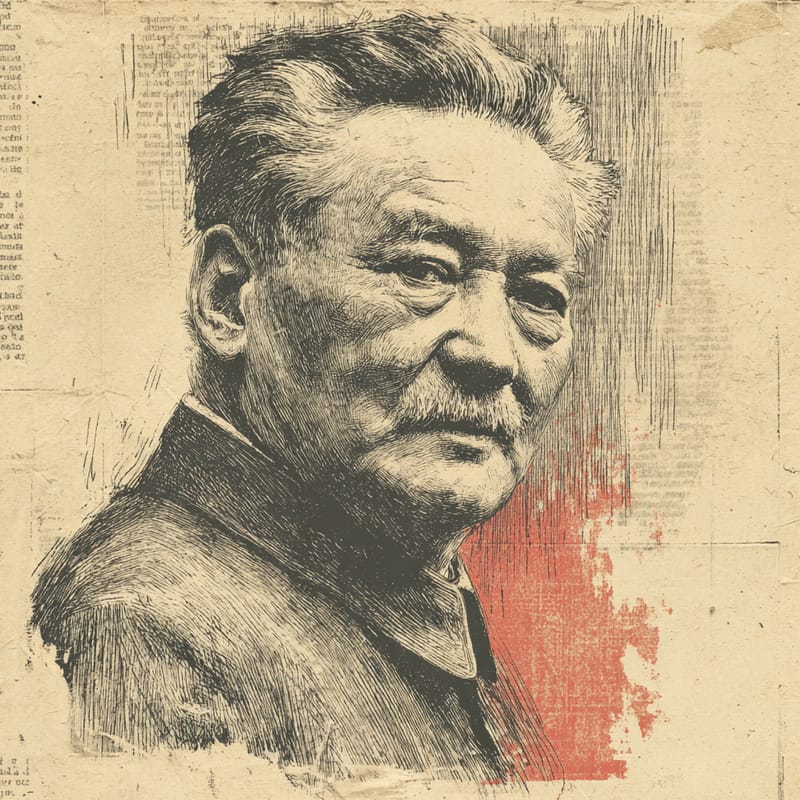
Deng Xiaoping
To get rich is glorious
Market reform under one-party rule.
Rooted TechnocratOne of 729 ideologies · enter the Technocrat hall →- Role
- Paramount Leader
- Era
- 1904–1997
- Region
- China
- Social band
- Rooted
- Placement
- +64 · +34 · −20
§ Where Deng Xiaoping stands
3 axesDeng moved China decisively towards the market without abandoning state ownership of key sectors. The household responsibility system returned farming to families, special economic zones such as Shenzhen opened to foreign capital from 1980, and his 1992 southern tour pushed for faster marketisation. He called the result socialism with Chinese characteristics, keeping banks, land and heavy industry under state control.
Deng ruled through an unchallenged Communist Party, laying down the Four Cardinal Principles in 1979, jailing the Democracy Wall activist Wei Jingsheng and approving the bloody suppression of the Tiananmen protests in 1989. Yet he also ended the era of mass campaigns and personality cults, and the 1982 constitution limited the state president and premier to two terms, a check that softened his authoritarianism.
Deng was a pragmatist who judged policies by results, famously comparing them to cats valued for catching mice whatever their colour. But he defended Marxist orthodoxy and national pride, backing campaigns against 'spiritual pollution' in 1983 and 'bourgeois liberalisation' in 1987, and his government enforced the one-child policy from 1980.
How close are you to Deng Xiaoping?
Three statements, one per axis. Answer them and we’ll drop you on the compass next to them.
§ The story
HistoricalDeng Xiaoping (1904–1997) was the paramount leader of the People's Republic of China from the late 1970s until the early 1990s. Born in Sichuan, he joined the communist movement as a work-study student in France in the 1920s, survived the Long March and served as a senior political commissar in the civil war. After 1949 he became the party's general secretary, but he was purged twice during the Cultural Revolution, returned after Mao Zedong's death in 1976 and outmanoeuvred Mao's chosen successor, Hua Guofeng.
From the party's Third Plenum in December 1978 Deng launched 'reform and opening': decollectivised farming, special economic zones and foreign investment that set off decades of rapid growth and lifted hundreds of millions out of poverty. He also insisted on the party's monopoly on power. In 1989 he backed martial law and the army's crushing of the Tiananmen Square protests, in which estimates of the dead range from several hundred to several thousand, and his 1992 southern tour then relaunched market reform.
Notable for
- 01Launched China's economic reforms
- 02Special Economic Zones
- 03'Socialism with Chinese characteristics'
Key works & moments
- 1956Becomes general secretary of the Chinese Communist Party.
- 1966–73Purged in the Cultural Revolution and sent to work at a tractor plant in Jiangxi.
- 1978Launches reform and opening at the Third Plenum of the 11th Central Committee.
- 1980Establishes special economic zones, including Shenzhen, to attract foreign investment.
- 1989Backs martial law and the armed suppression of the Tiananmen Square protests.
- 1992His southern tour revives market reform after the post-Tiananmen retrenchment.
§ Minds closest to Deng Xiaoping
All minds →

§ Also in the Technocrat hall
Enter the hall →§ Common questions
4 answersWhat was Deng Xiaoping's political ideology?
Deng was a pragmatic Marxist-Leninist who embraced markets to build national power: on the 99ideologies three-axis compass, a Rooted Technocrat. Economically he leaned towards the market (+64), opening China to private enterprise and foreign capital while keeping state ownership of strategic sectors. On governance he was authoritarian (+34), upholding one-party rule, and socially he was moderately traditional (−20), defending party orthodoxy and national pride against Western liberal ideas.
Was Deng Xiaoping left-wing or right-wing?
Officially a communist of the left, but his economics moved China to the right. Deng dismantled collective farming, welcomed foreign capital and tolerated rising inequality, which Maoists denounced as capitalism. Politically he was neither liberal nor democratic: he kept the party's monopoly on power and crushed the 1989 protests. Most historians describe him as a pragmatic authoritarian who used market means for the party's ends, which is why he defies a simple left–right label.
Did Deng Xiaoping say 'to get rich is glorious'?
Probably not. The phrase became the standard Western shorthand for his reforms, but no reliable record has been found of Deng saying it. What he did argue, in talks from the mid-1980s, was that some people and regions should be allowed to get rich first and then help the rest catch up, and he defended markets and private initiative as compatible with socialism. The slogan captures the spirit others saw in his policies rather than his own words.
Which minds are closest to Deng Xiaoping?
On the 99ideologies three-axis compass, the minds closest to Deng Xiaoping are Lee Kuan Yew (96% alike), Zhu Rongji (96% alike) and George H. W. Bush (93% alike). The furthest is Emma Goldman (9% alike).