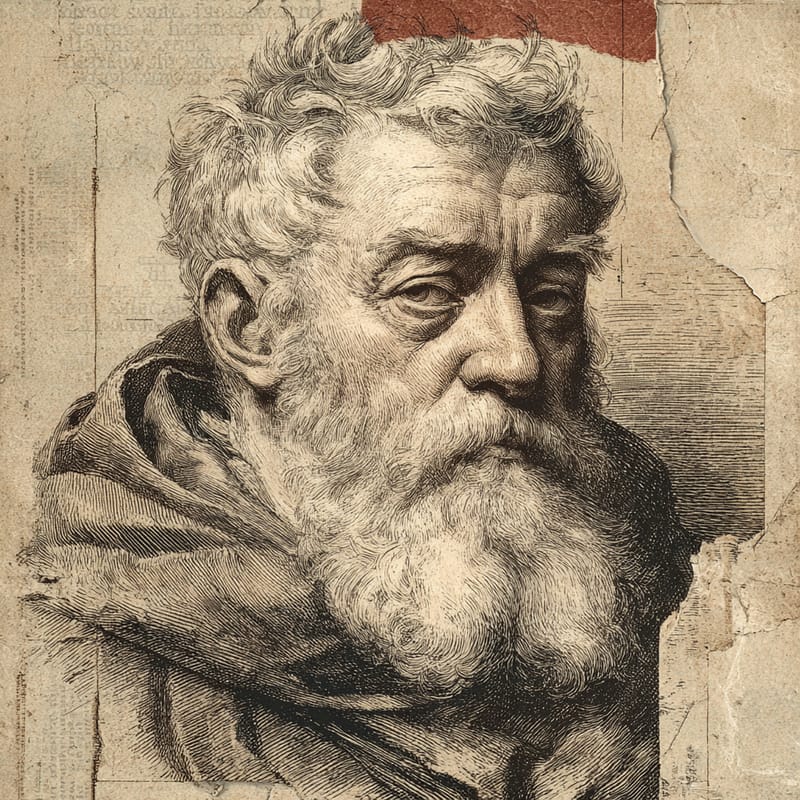
Hari Seldon
Psychohistory
Society steered by predictive science.
Heterodox TechnocratOne of 729 ideologies · enter the Technocrat hall →- Role
- Mathematician (fiction)
- From
- Foundation
- Region
- the Galactic Empire
- Social band
- Heterodox
- Placement
- +68 · +26 · +15
§ Where Hari Seldon stands
3 axesSeldon's Plan works through the self-interest of individuals rather than against it. Psychohistory forecasts aggregate behaviour much as economists model a market, and in Foundation (1951) the Foundation survives by trading its technology, as merchant princes such as Hober Mallow make commerce the main source of its power. The Plan steers the economy indirectly, setting conditions instead of commanding production.
Seldon's vision is rule by foresight from above. Leaders on Terminus believe they act freely, yet each 'Seldon crisis' leaves only one viable path, and a secret Second Foundation of mental scientists quietly corrects deviations from the Plan. Legitimacy rests on mathematics and the elite who understand it, though Seldon himself governs openly only as first minister to Emperor Cleon I in Forward the Foundation (1993).
Seldon embodies a rationalist faith that history obeys laws discoverable by science. His project preserves knowledge in the Encyclopedia Galactica, and in Foundation (1951) the early Foundation dresses its technology up as a religion to control superstitious neighbours, treating belief as a tool. The outlook is modernising and secular, but the Plan's reliance on manipulation tempers any liberal reading.
How close are you to Hari Seldon?
Three statements, one per axis. Answer them and we’ll drop you on the compass next to them.
§ The story
FictionHari Seldon is the mathematician at the heart of Isaac Asimov's Foundation series, whose stories first appeared in Astounding Science Fiction from 1942 and were collected as the Foundation trilogy in 1951–53. Seldon invents psychohistory, a statistical science that forecasts the behaviour of vast populations, and predicts that the Galactic Empire will fall and be followed by 30,000 years of barbarism. He devises the Seldon Plan to shorten that dark age to a single millennium.
Put on trial by the imperial authorities, Seldon has his followers exiled to the remote planet Terminus, ostensibly to compile an encyclopedia, and after his death appears as a recorded image at each predicted crisis, while a hidden Second Foundation guards the Plan. Asimov modelled the saga on Gibbon's history of Rome's decline. Seldon has become the emblem of social engineering by prediction, invoked by economists such as Paul Krugman, who credited the books with drawing him to economics, and by modern advocates of data-driven forecasting.
Notable for
- 01Invented psychohistory (in-story)
- 02Founded the Foundation
- 03Engineered the Seldon Plan
Key works & moments
- 1942Asimov's first Foundation story appears in Astounding Science Fiction.
- 1951Foundation opens with Seldon on trial, predicting the Empire's fall and accepting exile to Terminus.
- 1952In Foundation and Empire, the mutant Mule, beyond psychohistory's reach, derails the Seldon Plan.
- 1953Second Foundation reveals the hidden guardians Seldon created to keep his Plan on course.
- 1988Prelude to Foundation portrays the young Seldon developing psychohistory on Trantor.
- 2021Apple TV+ launches its Foundation series, with Jared Harris as Seldon.
§ Minds closest to Hari Seldon
All minds →





§ Also in the Technocrat hall
Enter the hall →§ Common questions
4 answersWhat is Hari Seldon's political ideology?
Hari Seldon is fiction's purest technocrat: on the 99ideologies three-axis compass, a Heterodox Technocrat. Economically he leans clearly towards markets (+68), since his Plan works through trade and self-interest rather than central command. On governance he favours guidance by an expert elite (+26), with a secret Second Foundation steering history, and socially he is mildly progressive (+15), a secular rationalist who believes science can redeem a declining civilisation.
Is Hari Seldon left-wing or right-wing?
Neither: Seldon stands outside the left–right divide as a believer in government by scientific foresight. His Plan accepts commerce and private ambition as engines of recovery, which leans right economically, but it also rests on deliberate social engineering by a self-appointed elite, a habit critics associate with planners of every stripe. Asimov wrote him as a figure of reason rather than of party, pitted against an imperial court too complacent to see its own decline.
Is Hari Seldon's psychohistory possible?
Not as Asimov imagined it. Psychohistory predicts the future of whole societies with mathematical precision, on two conditions: the population must be enormous, and it must not know about the predictions. Real social science can forecast some aggregate trends, and the idea has inspired economists and data scientists, but human societies are too complex and reflexive for such certainty. Asimov built that limit into the story: the Mule, a single unpredictable mutant, throws the Plan off course.
Which minds are closest to Hari Seldon?
On the 99ideologies three-axis compass, the minds closest to Hari Seldon are Jean Monnet (97% alike), Mario Monti (96% alike) and Tony Stark (95% alike). The furthest is Emma Goldman (15% alike).