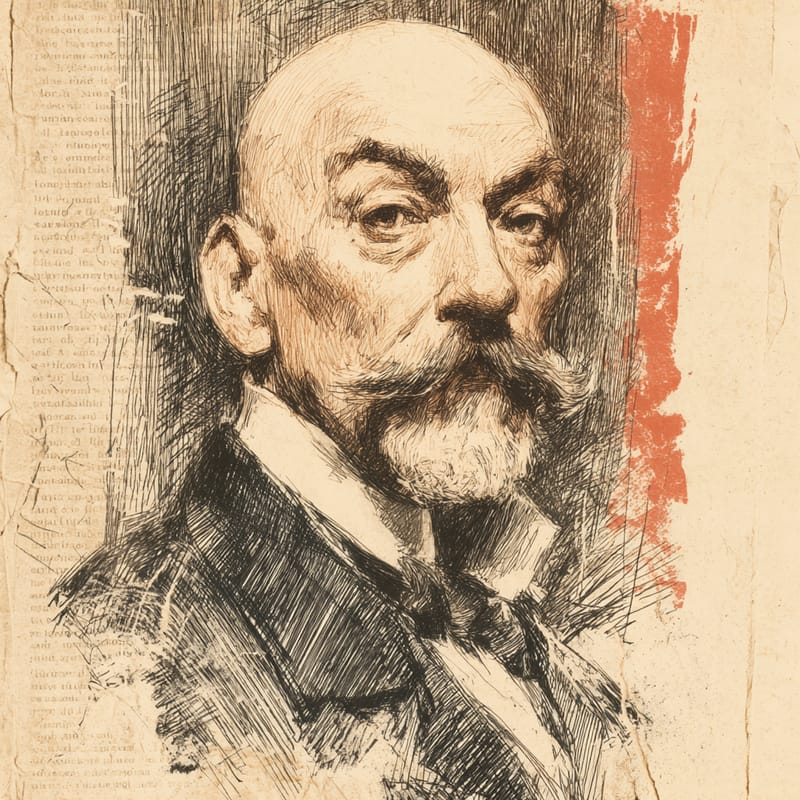
Jean Monnet
The father of Europe
Integration by expert design.
TechnocratOne of 729 ideologies · enter the Technocrat hall →- Role
- Planner & founder
- Era
- 1888–1979
- Region
- France
- Social band
- Centre (no modifier)
- Placement
- +64 · +24 · +10
§ Where Jean Monnet stands
3 axesMonnet the financier believed in markets, but not in leaving them alone. The Monnet Plan of 1947 steered investment into coal, electricity, steel, cement, farm machinery and transport through indicative targets and Marshall aid rather than state command, and the 1951 Treaty of Paris replaced national coal and steel cartels with a common market under supranational rules. His aim was to modernise a capitalist economy, not to replace it.
His 'Monnet method' built Europe through small, concrete steps managed by experts, binding governments into common institutions before public opinion was consulted. The ECSC's High Authority, which he led from 1952 to 1955, could take decisions binding on member states, and he favoured independent bodies run by technical elites over mass politics, though always within democratic states and by treaty.
Monnet was a cosmopolitan modernist who lived and worked in Britain, the United States and China and saw national rivalry as Europe's curse. The Schuman Declaration of 9 May 1950, which he drafted, aimed to make war between France and Germany 'not merely unthinkable, but materially impossible', yet he steered clear of divisive cultural questions, keeping his internationalism pragmatic rather than radical.
How close are you to Jean Monnet?
Three statements, one per axis. Answer them and we’ll drop you on the compass next to them.
§ The story
HistoricalJean Monnet (1888–1979) was a French businessman, financier and administrator who never held elected office yet shaped postwar Europe. The son of a cognac merchant, he left school at 16 to sell brandy abroad, helped coordinate Allied shipping and supplies in the First World War and became deputy secretary-general of the League of Nations in 1919. Between the wars he worked as an international banker, and in 1940 he proposed a Franco-British union before moving to Washington to help organise war supplies.
After the liberation Monnet headed France's new planning commission, whose Monnet Plan rebuilt basic industries from 1947. In 1950 he drafted the proposal announced by foreign minister Robert Schuman to pool French and German coal and steel, and became the first president of the European Coal and Steel Community's High Authority. His Action Committee for the United States of Europe then lobbied for the 1957 Treaties of Rome. Critics see in his incremental 'Monnet method' an elite project with too little democratic consent; in 1988 his remains were moved to the Panthéon.
Notable for
- 01French postwar planning
- 02Architect of the EU's forerunner
- 03'Monnet method' of integration
Key works & moments
- 1919Appointed deputy secretary-general of the new League of Nations at 30.
- 1940Proposes a Franco-British political union as France faces defeat.
- 1946Becomes France's first planning commissioner; the Monnet Plan modernises heavy industry.
- 1950Drafts the Schuman Declaration proposing a European Coal and Steel Community.
- 1952–55Serves as first president of the ECSC High Authority in Luxembourg.
- 1955Founds the Action Committee for the United States of Europe.
In their own words
“Europe will be forged in crises, and will be the sum of the solutions adopted for those crises.”
§ Minds closest to Jean Monnet
All minds →

§ Also in the Technocrat hall
Enter the hall →§ Common questions
4 answersWhat was Jean Monnet's political ideology?
Monnet was a pragmatic, pro-European technocrat: on the 99ideologies three-axis compass, a Technocrat. Economically he leaned towards markets (+64), using indicative planning to modernise French capitalism and building a common market in coal and steel. On governance he favoured strong supranational institutions run by experts (+24), and socially he sat near the centre (+10), an internationalist and modernist who avoided cultural battles. He never stood for election.
Was Jean Monnet left-wing or right-wing?
Neither, by temperament and record. Monnet worked with socialists, Christian democrats and liberals alike, and his career sat outside party politics. His support for national planning and supranational authority appealed to the centre-left, while his background in finance and his commitment to a common market and private enterprise reassured the centre-right. He is best seen as a centrist technocrat whose overriding cause was European integration and peace.
Why is Jean Monnet called the father of Europe?
Because he designed the first European community and the method that built its successors. Monnet drafted the 1950 Schuman Declaration, which led to the European Coal and Steel Community in 1952, and he served as the first president of its High Authority. Through his Action Committee for the United States of Europe he then pushed for the European Economic Community and Euratom, created by the Treaties of Rome in 1957. In 1976 European leaders made him the first Honorary Citizen of Europe.
Which minds are closest to Jean Monnet?
On the 99ideologies three-axis compass, the minds closest to Jean Monnet are Hari Seldon (97% alike), Mario Monti (97% alike) and Robert McNamara (96% alike). The furthest is Emma Goldman (16% alike).