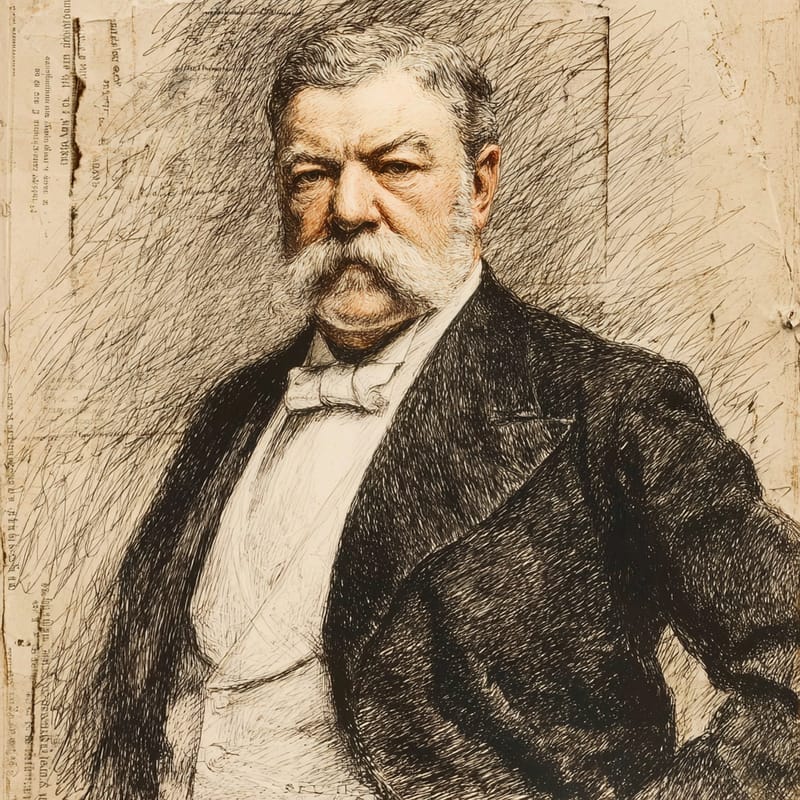
William Howard Taft
Law, order, and the market
The constitutional conservative.
Rooted Civic ConservativeOne of 729 ideologies · enter the Civic Conservative hall →- Role
- President & Chief Justice
- Era
- 1857–1930
- Region
- United States
- Social band
- Rooted
- Placement
- +34 · +42 · −25
§ Where William Howard Taft stands
3 axesTaft trusted markets, property and the courts. He signed the 1909 Payne–Aldrich Tariff that kept protection high, but enforced the Sherman Antitrust Act vigorously, suing US Steel in 1911, and backed the income tax amendment. As chief justice he wrote Bailey v Drexel Furniture (1922), striking down a federal tax on child labour, though he dissented when the Court voided a minimum wage for women in 1923.
Taft revered constitutional order and the authority of judges. His 1916 book Our Chief Magistrate and His Powers rejected Roosevelt's expansive view of the presidency, insisting the president act only on powers granted by law, yet as chief justice he wrote Myers v United States (1926), upholding the president's power to remove executive officials, and Olmstead v United States (1928), allowing wiretap evidence.
Taft was a sober institutional traditionalist rather than a moral crusader. He was hissed by delegates when he voiced doubts about women's suffrage at their 1910 national convention, and as chief justice he wrote Gong Lum v Rice (1927), upholding Mississippi's exclusion of a Chinese American girl from a white school. Yet he vetoed a literacy test for immigrants in 1913.
How close are you to William Howard Taft?
Three statements, one per axis. Answer them and we’ll drop you on the compass next to them.
§ The story
HistoricalWilliam Howard Taft (1857–1930) was the 27th president of the United States, from 1909 to 1913, and the tenth chief justice, from 1921 to 1930, the only person to hold both offices. Born into a prominent Cincinnati Republican family and educated at Yale, he built a career as a judge and as US solicitor general before serving as the first civilian governor of the Philippines and as Theodore Roosevelt's secretary of war. Roosevelt chose him as his successor, and he easily won the 1908 election.
Taft's presidency pursued Roosevelt's agenda in a more legalistic style, bringing more antitrust suits than his predecessor, but his signing of the protectionist Payne–Aldrich Tariff and his dismissal of the conservationist Gifford Pinchot alienated progressives. Roosevelt challenged him in 1912, and the Republican split handed the White House to Woodrow Wilson, with Taft a distant third. As chief justice he modernised the federal judiciary, persuaded Congress to fund the Supreme Court's own building and led a conservative court that often struck down economic regulation.
Notable for
- 01US President, then Chief Justice
- 02Trust-busting
- 03Constitutional restraint
Key works & moments
- 1901Becomes the first civilian governor of the Philippines under American rule.
- 1908Elected president as Theodore Roosevelt's chosen successor.
- 1909Signs the Payne–Aldrich Tariff and proposes the income tax amendment to Congress.
- 1911His Justice Department sues US Steel, deepening the rift with Roosevelt.
- 1912Finishes third behind Woodrow Wilson and Roosevelt as the Republican vote splits.
- 1921Appointed chief justice by Warren Harding, the only former president to serve on the Supreme Court.
§ Minds closest to William Howard Taft
All minds →

§ Also in the Civic Conservative hall
Enter the hall →The closest minds above are this hall’s whole roster.
§ Common questions
4 answersWhat was William Howard Taft's political ideology?
William Howard Taft was a constitutional conservative: on the 99ideologies three-axis compass, a Rooted Civic Conservative. Economically he sat right of centre (+34), defending property and a protective tariff while enforcing antitrust law through the courts. On governance he leaned towards strong institutional authority (+42), revering law, judges and order, and socially he was moderately traditional (−25), wary of women's suffrage and of rapid social change.
Was William Howard Taft left-wing or right-wing?
Right of centre. Taft belonged to the conservative wing of the Republican Party, and his clash with Theodore Roosevelt in 1912 was in large part a struggle between conservative and progressive Republicans. Yet he was no reactionary: he filed more antitrust suits than Roosevelt, backed the income tax amendment, postal savings and parcel post, and as chief justice dissented from striking down a minimum wage. He saw the courts, not popular movements, as the proper guardians of change.
Why did Taft and Theodore Roosevelt fall out?
Because Roosevelt came to see his chosen successor as a betrayer of progressive Republicanism. Taft signed the high Payne–Aldrich Tariff in 1909, fired Roosevelt's ally Gifford Pinchot as chief forester in 1910, and in 1911 sued US Steel over a 1907 acquisition Roosevelt had personally approved. Roosevelt challenged Taft for the 1912 nomination, lost at the convention and ran as the Progressive, or Bull Moose, candidate. The split let Woodrow Wilson win, with Taft carrying only Utah and Vermont.
Which minds are closest to William Howard Taft?
On the 99ideologies three-axis compass, the minds closest to William Howard Taft are Georges Pompidou (98% alike), Dwight D. Eisenhower (97% alike) and Lord Shaftesbury (95% alike). The furthest is Emma Goldman (14% alike).