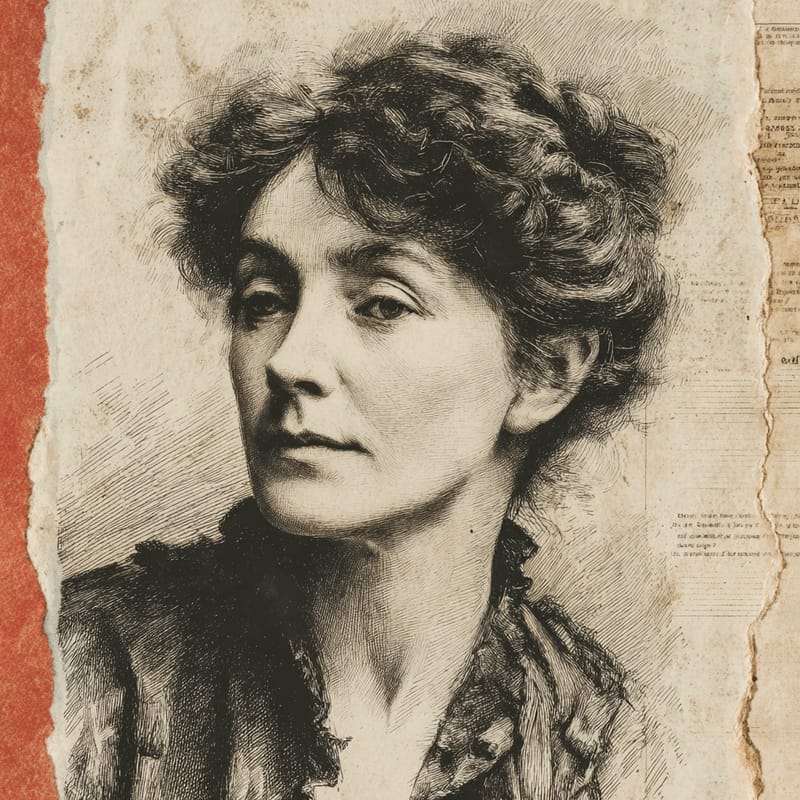
Sylvia Pankhurst
Suffrage and the soviets
Council communism, British style.
Reformist Council CommunistOne of 729 ideologies · enter the Council Communist hall →- Role
- Activist
- Era
- 1882–1960
- Region
- United Kingdom
- Social band
- Reformist
- Placement
- −88 · −70 · +60
§ Where Sylvia Pankhurst stands
3 axesPankhurst wanted capitalism replaced by common ownership administered through workers' soviets. Her group renamed itself the Workers' Socialist Federation in 1918, and the Workers' Dreadnought called for a British soviet republic. Even during the war her East London federation ran cost-price restaurants, a toy factory and the Mothers' Arms nursery in Bow, practical experiments in meeting need outside the market.
A left communist, Pankhurst rejected parliamentary elections and affiliation to the Labour Party in favour of rule by workers' councils, a stand Lenin attacked in 1920. Her refusal to hand the Workers' Dreadnought to party discipline led to her expulsion from the Communist Party in 1921. She sought council power rather than no power at all, and later defended Ethiopia's monarchy against fascist conquest.
Pankhurst was a radical progressive on almost every social question. She campaigned for votes for all adults and for maternity care, set out in Save the Mothers (1930), and against racism and empire, employing the Jamaican poet Claude McKay on the Workers' Dreadnought in 1920. She refused to marry her partner, the Italian anarchist Silvio Corio, and raised their son outside marriage.
How close are you to Sylvia Pankhurst?
Three statements, one per axis. Answer them and we’ll drop you on the compass next to them.
§ The story
HistoricalEstelle Sylvia Pankhurst (1882–1960) was a British suffragette, socialist and anti-fascist campaigner, a daughter of the suffrage leader Emmeline Pankhurst. Trained as an artist in Manchester and at the Royal College of Art, she joined her mother's Women's Social and Political Union, endured repeated imprisonment, hunger strikes and force-feeding, and from 1913 built a working-class suffrage movement in London's East End, which the WSPU leadership expelled early in 1914 for its ties to the labour movement.
Pankhurst opposed the First World War, welcomed the Russian Revolution and, as a founder of British communism, argued against parliamentary tactics with Lenin, who criticised her in Left-Wing Communism: An Infantile Disorder (1920). Expelled from the Communist Party of Great Britain in 1921 for refusing to put her paper, the Workers' Dreadnought, under party control, she turned to anti-fascism and, after Italy invaded Ethiopia in 1935, to the Ethiopian cause. She settled in Addis Ababa in 1956 and was given a state funeral there in 1960.
Notable for
- 01Workers' Socialist Federation
- 02Left-communist of 'Left-Wing Communism'
- 03Anti-fascist organiser
Key works & moments
- 1914Expelled from the WSPU, her East London Federation launches its paper, the Woman's Dreadnought.
- 1917Renames her paper the Workers' Dreadnought and hails the Russian Revolution.
- 1920Visits Soviet Russia for the Comintern's Second Congress and argues anti-parliamentary tactics with Lenin.
- 1921Expelled from the Communist Party of Great Britain over control of the Workers' Dreadnought.
- 1936Founds New Times and Ethiopia News to oppose Italy's occupation of Ethiopia.
- 1956Moves to Addis Ababa, where she dies in 1960 and receives a state funeral.
§ Minds closest to Sylvia Pankhurst
All minds →


§ Also in the Council Communist hall
Enter the hall →§ Common questions
4 answersWhat was Sylvia Pankhurst's political ideology?
Sylvia Pankhurst was a feminist left communist: on the 99ideologies three-axis compass, a Reformist Council Communist. Economically she sat near the socialist pole (−88), seeking common ownership run through workers' soviets. On governance she was strongly libertarian (−70), rejecting parliament and party discipline in favour of council democracy. Socially she was clearly progressive (+60), campaigning for women's suffrage, maternal welfare and racial equality and against fascism and colonialism.
Was Sylvia Pankhurst left-wing or right-wing?
Firmly left-wing, and further left than the rest of her famous family. While her mother Emmeline and sister Christabel backed the First World War, and Emmeline was later adopted as a Conservative parliamentary candidate, Sylvia opposed the war, embraced the Russian Revolution and helped found British communism. She stood on the libertarian side of the far left, putting workers' councils above parliament and party, which is why Lenin criticised her and the Communist Party expelled her.
Why did Sylvia Pankhurst fall out with her mother and sister?
Mainly over socialism and class. Emmeline and Christabel Pankhurst ran the Women's Social and Political Union as a disciplined, single-issue movement independent of the parties, while Sylvia tied her East End campaign to the labour movement and to working-class women. After she spoke at a London rally for the locked-out Dublin workers in November 1913, Christabel expelled her federation from the WSPU early in 1914. The First World War widened the split: her mother and sister became ardent supporters of the war effort, while Sylvia opposed it.
Which minds are closest to Sylvia Pankhurst?
On the 99ideologies three-axis compass, the minds closest to Sylvia Pankhurst are The Communard (archetype) (96% alike), Cornelius Castoriadis (96% alike) and Anton Pannekoek (95% alike). The furthest is Adam Sutler (0% alike).