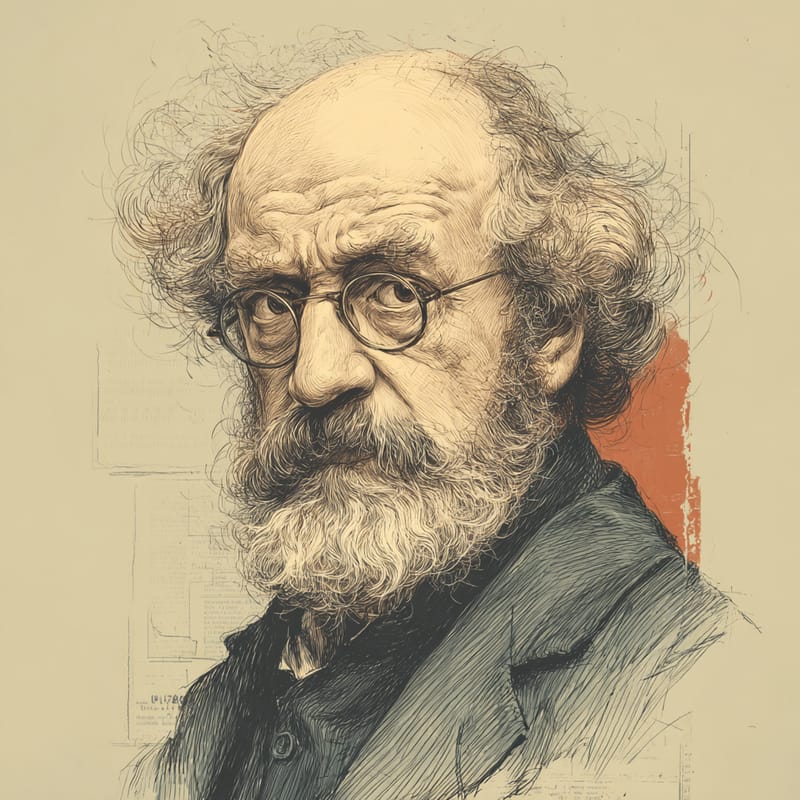
Cornelius Castoriadis
Autonomy and self-management
Socialism or Barbarism.
Reformist Council CommunistOne of 729 ideologies · enter the Council Communist hall →- Role
- Philosopher
- Era
- 1922–1997
- Region
- Greece / France
- Social band
- Reformist
- Placement
- −90 · −72 · +50
§ Where Cornelius Castoriadis stands
3 axesCastoriadis's blueprint for socialism, the essays On the Content of Socialism (1955–58), envisaged factories run by workers' councils, a democratic plan prepared with the help of a central plan factory, and full equality of wages and incomes. He rejected both private capitalism and the state-owned economies of the East, which he saw as ruled by a bureaucratic class.
Autonomy was his central political value. He saw the Hungarian workers' councils of 1956 as a living model of direct democracy, praised the Athenian assembly as a precedent for self-government and attacked bureaucracy in every form, from the Bolshevik party to Western corporations and parties. He still envisaged federated councils and collective institutions, not the absence of all rule.
Castoriadis defined freedom as a society's power to question its own laws and traditions, the theme of The Imaginary Institution of Society (1975). He welcomed the women's, youth and ecological movements as bearers of autonomy, co-writing From Ecology to Autonomy (1981) with Daniel Cohn-Bendit, while criticising consumerism and what he called the rising tide of insignificance.
How close are you to Cornelius Castoriadis?
Three statements, one per axis. Answer them and we’ll drop you on the compass next to them.
§ The story
HistoricalCornelius Castoriadis (1922–1997) was a Greek-French philosopher, economist and psychoanalyst. Born in Constantinople and raised in Athens, he joined the communist youth as a teenager, then became a Trotskyist and opposed both the Greek Communist Party and the occupiers during the Second World War. In 1945 he left for Paris aboard the ship Mataroa, worked as an economist at the OECD and its predecessor until 1970, and wrote under pseudonyms such as Pierre Chaulieu and Paul Cardan.
With Claude Lefort he founded the group and journal Socialisme ou Barbarie in 1949, which analysed the Soviet Union as a bureaucratic class society and championed workers' self-management; its ideas fed into May 1968. He later broke with Marxism, and in The Imaginary Institution of Society (1975) recast his politics as a project of individual and collective autonomy, in which societies consciously create and question their own institutions. He practised as a psychoanalyst from the 1970s and remained a critic of both Soviet communism and Western consumer capitalism until his death in Paris.
Notable for
- 01'Socialisme ou Barbarie'
- 02Theory of autonomy
- 03Critique of bureaucracy
Key works & moments
- 1945Leaves Greece for Paris aboard the Mataroa with other young Greek scholars.
- 1949Co-founds the group and journal Socialisme ou Barbarie with Claude Lefort.
- 1955–58Publishes On the Content of Socialism, a blueprint for workers' self-management.
- 1968Co-writes Mai 68: la brèche with Edgar Morin and Claude Lefort.
- 1975Publishes The Imaginary Institution of Society, his major philosophical work.
§ Minds closest to Cornelius Castoriadis
All minds →

§ Also in the Council Communist hall
Enter the hall →The closest minds above are this hall’s whole roster.
§ Common questions
4 answersWhat was Cornelius Castoriadis's political ideology?
Cornelius Castoriadis was a libertarian socialist and theorist of autonomy: on the 99ideologies three-axis compass, a Reformist Council Communist. Economically he sat near the socialist pole (−90), proposing council-run production and equal incomes. On governance he was strongly libertarian (−72), championing direct democracy against bureaucracy in both East and West. Socially he was clearly progressive (+50), defining freedom as a society's power to question and remake its own institutions.
Was Cornelius Castoriadis left-wing or right-wing?
Left-wing, but an anti-Stalinist and eventually post-Marxist left. Castoriadis wanted capitalism replaced by workers' self-management and equal wages, which places him on the far left economically. Yet he condemned the Soviet Union as a bureaucratic class society from the late 1940s, broke with Marxism in the 1960s and attacked Leninist parties, so he belongs to the libertarian, council-based wing of the left rather than to communism of the Soviet kind.
Was Cornelius Castoriadis a Marxist?
He began as one and ended as a critic. Castoriadis came to Marxism through Greek communism and then Trotskyism, and in Socialisme ou Barbarie he first used Marxist tools against the Soviet bureaucracy. In the essays Marxism and Revolutionary Theory (1964–65), later the first part of The Imaginary Institution of Society, he concluded that a revolutionary had to choose between Marxist orthodoxy and the project of radical social change, and he chose the latter. He kept the goal of self-management but grounded it in a philosophy of autonomy rather than historical materialism.
Which minds are closest to Cornelius Castoriadis?
On the 99ideologies three-axis compass, the minds closest to Cornelius Castoriadis are The Communard (archetype) (99% alike), Anton Pannekoek (99% alike) and Otto Rühle (98% alike). The furthest is Adam Sutler (0% alike).