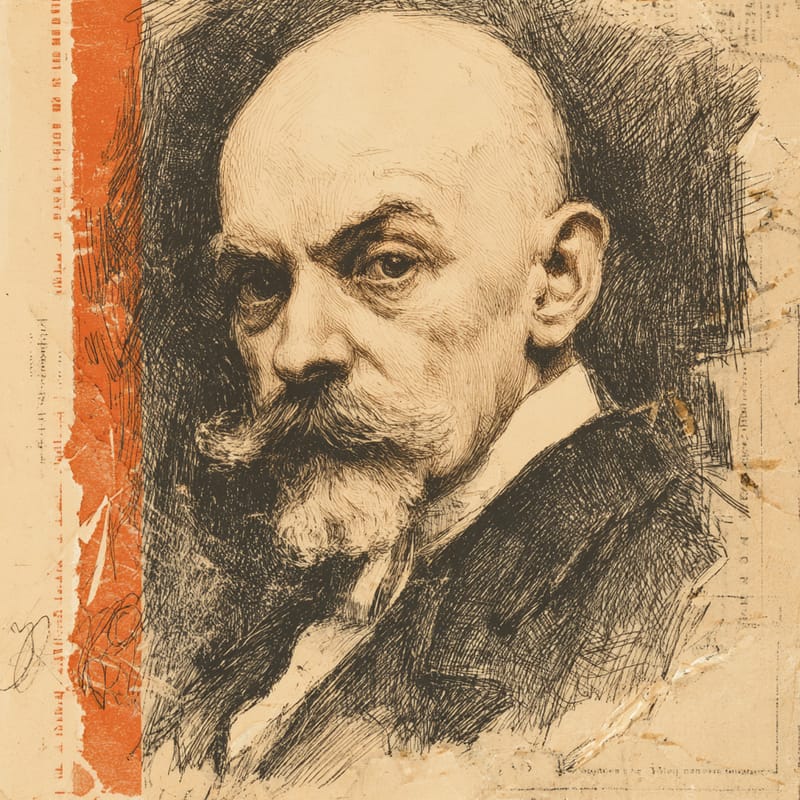
Otto Rühle
The revolution is not a party matter
Against all party bureaucracy.
Reformist Council CommunistOne of 729 ideologies · enter the Council Communist hall →- Role
- Theorist
- Era
- 1874–1943
- Region
- Germany
- Social band
- Reformist
- Placement
- −90 · −76 · +46
§ Where Otto Rühle stands
3 axesRühle wanted common ownership organised from the shop floor upward. In the early 1920s he championed the General Workers' Union–Unitary Organisation (AAUE), which merged economic and political struggle in factory-based organisations without a separate party. He regarded the Soviet planned economy as state capitalism, a new form of exploitation rather than socialism.
Rühle pushed council communism to its most anti-party conclusion. In The Revolution Is Not a Party Affair (1920) he argued that parties, built on leaders and followers, belong to bourgeois politics, and in The Struggle Against Fascism Begins with the Struggle Against Bolshevism (1939) he described Bolshevism as the model for fascist dictatorship. Only the self-organised class itself, he held, could make a revolution.
Rühle was above all a progressive educator. His writings on working-class childhood, including Das proletarische Kind, attacked authoritarian schooling and harsh family discipline, and with Alice Rühle-Gerstel he applied Alfred Adler's individual psychology to child-rearing and education, treating the liberation of children as part of the social revolution.
How close are you to Otto Rühle?
Three statements, one per axis. Answer them and we’ll drop you on the compass next to them.
§ The story
HistoricalOtto Rühle (1874–1943) was a German teacher, educational writer and revolutionary socialist. Born in Saxony, he became a Social Democratic educator and was elected to the Reichstag in 1912. In March 1915 he joined Karl Liebknecht as one of the first two deputies to vote against war credits, and he took part in founding the Communist Party of Germany at the turn of 1918–19 before breaking with it over parliamentary and trade-union tactics.
Rühle joined the Communist Workers' Party (KAPD) in 1920 but soon concluded that every party, however revolutionary, reproduced the split between leaders and led, the argument of his essay The Revolution Is Not a Party Affair (1920). With his wife, the psychologist Alice Rühle-Gerstel, he wrote on proletarian childhood and Adlerian psychology. He left Germany in 1932, settled in Mexico in 1936, sat on the Dewey Commission into the Moscow Trials and argued that fascism and Bolshevism were twin forms of dictatorship.
Notable for
- 01'The Revolution Is Not a Party Affair'
- 02Council-communist organiser
- 03Anti-bureaucratic Marxism
Key works & moments
- 1912Elected to the Reichstag as a Social Democrat.
- 1915Joins Karl Liebknecht in voting against war credits in the Reichstag.
- 1918–19Takes part in founding the Communist Party of Germany.
- 1920Writes The Revolution Is Not a Party Affair and breaks with the KAPD.
- 1937Sits on the Dewey Commission investigating the Moscow Trials' charges against Trotsky.
- 1939Publishes The Struggle Against Fascism Begins with the Struggle Against Bolshevism.
§ Minds closest to Otto Rühle
All minds →

§ Also in the Council Communist hall
Enter the hall →§ Common questions
4 answersWhat was Otto Rühle's political ideology?
Otto Rühle was an anti-party council communist: on the 99ideologies three-axis compass, a Reformist Council Communist. Economically he sat near the socialist pole (−90), seeking common ownership organised through factory-based councils. On governance he was strongly libertarian (−76), arguing that even revolutionary parties reproduce domination and that only the self-organised class can free itself. Socially he was progressive (+46), a reforming educator who championed children against authoritarian schooling.
Was Otto Rühle left-wing or right-wing?
Left-wing. Rühle was a revolutionary socialist who voted against the First World War, helped found German communism and wanted capitalism replaced by workers' councils. Within the left he stood at the anti-authoritarian edge: he broke with the Communist Party and then with the KAPD, and from the 1930s argued that Bolshevism had pioneered the methods of fascist dictatorship. He belongs with the council communists rather than with the Leninist or social-democratic left.
What did Otto Rühle mean by 'the revolution is not a party affair'?
He meant that workers must free themselves through their own organisations, not through a party acting on their behalf. In his 1920 essay of that title, written amid the splits of German communism, Rühle argued that parties, with their leaders, programmes and electoral habits, were products of bourgeois parliamentary politics and would always subordinate the class to an apparatus. He proposed instead unified workplace organisations combining economic and political struggle, and he later saw the Soviet party-state as proof of his warning.
Which minds are closest to Otto Rühle?
On the 99ideologies three-axis compass, the minds closest to Otto Rühle are Anton Pannekoek (99% alike), Herman Gorter (98% alike) and Cornelius Castoriadis (98% alike). The furthest is Adam Sutler (0% alike).