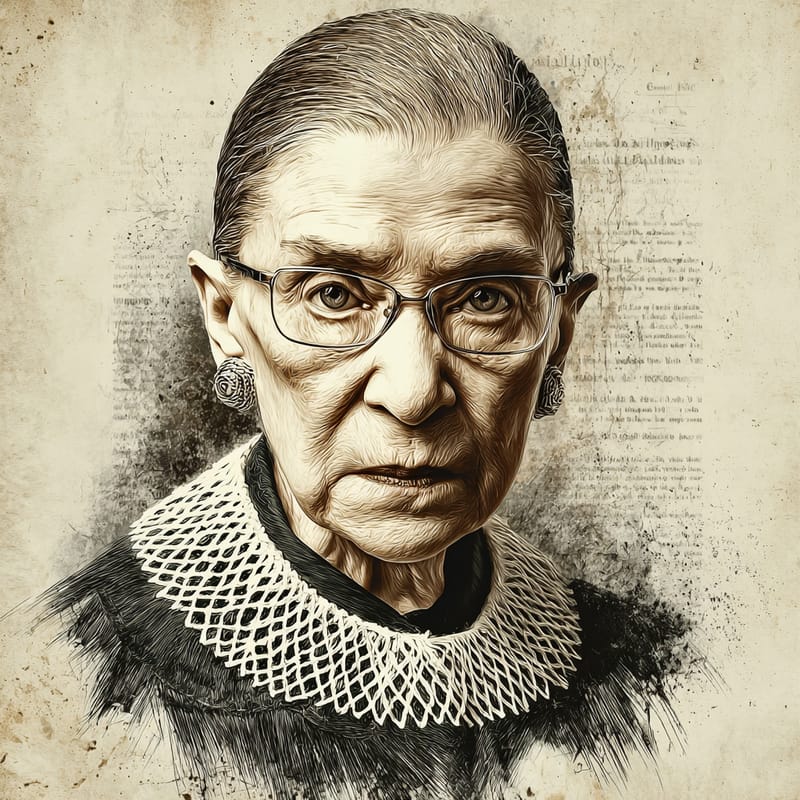
Ruth Bader Ginsburg
Liberty and equal dignity
Rights litigation as lifelong craft.
Progressive Civil LibertarianOne of 729 ideologies · enter the Civil Libertarian hall →- Role
- Supreme Court Justice
- Era
- 1933–2020
- Region
- United States
- Social band
- Progressive
- Placement
- +38 · −26 · +75
§ Where Ruth Bader Ginsburg stands
3 axesGinsburg's cause was equal treatment under law rather than economic redistribution, and her litigation sought women's equal access to jobs and benefits within the existing market economy. Frontiero v. Richardson (1973) and Weinberger v. Wiesenfeld (1975) struck down sex-based rules in military and Social Security benefits, and her 2007 Ledbetter dissent treated pay discrimination as a question of fairness, not a challenge to private enterprise.
Ginsburg defended individuals against overreaching government. She wrote the unanimous opinion in Timbs v. Indiana (2019), applying the Constitution's ban on excessive fines to the states in a civil forfeiture case, and her opinion in Olmstead v. L.C. (1999) held that needlessly confining disabled people in institutions violated federal law. Yet she backed strong federal protection of voting rights, as her Shelby County dissent showed.
Ginsburg was a leading legal architect of gender equality in the United States. Her majority opinion in United States v. Virginia (1996) opened the Virginia Military Institute to women, she dissented in Gonzales v. Carhart (2007) on the ground that abortion restrictions threatened women's autonomy and equal citizenship, and she joined the 2015 Obergefell v. Hodges majority recognising same-sex marriage.
How close are you to Ruth Bader Ginsburg?
Three statements, one per axis. Answer them and we’ll drop you on the compass next to them.
§ The story
LivingRuth Bader Ginsburg (1933–2020) was an associate justice of the US Supreme Court from 1993 until her death, the second woman to sit on it. Born Joan Ruth Bader in Brooklyn, she graduated from Cornell and studied law at Harvard and Columbia, yet struggled to find legal work as a woman and mother. As a law professor she co-founded the ACLU's Women's Rights Project in 1972 and argued six sex-discrimination cases before the Supreme Court, winning five, before Jimmy Carter appointed her to the federal appeals court in Washington in 1980.
Nominated by Bill Clinton and confirmed 96–3 in 1993, Ginsburg began as a cautious institutionalist but became the senior justice of the court's liberal wing, known for forceful dissents in cases such as Bush v. Gore (2000), Ledbetter v. Goodyear (2007) and Shelby County v. Holder (2013). Late in life she became a pop-culture icon nicknamed the Notorious RBG. Her decision not to retire under Barack Obama remains debated, since her death in September 2020 let Donald Trump appoint Amy Coney Barrett and gave conservatives a 6–3 majority.
Notable for
- 01Gender-equality litigation
- 02Influential Supreme Court dissents
- 03Equal-protection advocacy
Key works & moments
- 1972Co-founds the ACLU Women's Rights Project and becomes Columbia Law School's first tenured woman professor.
- 1973Argues Frontiero v. Richardson, her first case before the Supreme Court.
- 1993Confirmed to the Supreme Court by 96 votes to 3 after nomination by Bill Clinton.
- 1996Writes United States v. Virginia, opening the Virginia Military Institute to women.
- 2007Reads her Ledbetter dissent from the bench; Congress responds with the 2009 Lilly Ledbetter Fair Pay Act.
- 2013Dissents in Shelby County v. Holder against ending Voting Rights Act preclearance.
In their own words
“Throwing out preclearance when it has worked and is continuing to work to stop discriminatory changes is like throwing away your umbrella in a rainstorm because you are not getting wet.”
§ Minds closest to Ruth Bader Ginsburg
All minds →

§ Also in the Civil Libertarian hall
Enter the hall →§ Common questions
4 answersWhat was Ruth Bader Ginsburg's political ideology?
Ruth Bader Ginsburg was a liberal jurist and pioneering advocate of gender equality: on the 99ideologies three-axis compass, a Progressive Civil Libertarian. Economically she sat on the market side of centre (+38), because her cause was equal access within the economy rather than redistribution. On governance she leaned libertarian (−26), defending individual rights against state power, and socially she was strongly progressive (+75), leading the legal fight against sex discrimination and backing abortion rights and same-sex marriage.
Was Ruth Bader Ginsburg left-wing or right-wing?
Left of centre, as a liberal by American standards. On the Supreme Court she anchored the liberal bloc, dissenting in Bush v. Gore, Shelby County v. Holder and Burwell v. Hobby Lobby, and she consistently backed abortion rights, voting rights and anti-discrimination law. But she was not a radical: she valued incremental change, criticised the sweep of Roe v. Wade's reasoning and was known as a moderate on the appeals court in the 1980s, so she is best seen as a liberal legal reformer rather than a socialist.
What did Ruth Bader Ginsburg do for women's rights?
She made sex discrimination a constitutional question. Before joining the bench, Ginsburg's ACLU litigation persuaded the Supreme Court that laws treating men and women differently deserve heightened scrutiny, often by representing men harmed by sex stereotypes, as in Weinberger v. Wiesenfeld (1975). As a justice she wrote the 1996 Virginia Military Institute decision requiring an exceedingly persuasive justification for sex-based government action, and her 2007 Ledbetter dissent prompted the Lilly Ledbetter Fair Pay Act, the first bill Barack Obama signed, in 2009.
Which minds are closest to Ruth Bader Ginsburg?
On the 99ideologies three-axis compass, the minds closest to Ruth Bader Ginsburg are Ida B. Wells (96% alike), Nadine Strossen (96% alike) and Roger Baldwin (94% alike). The furthest is Gregor Strasser (11% alike).