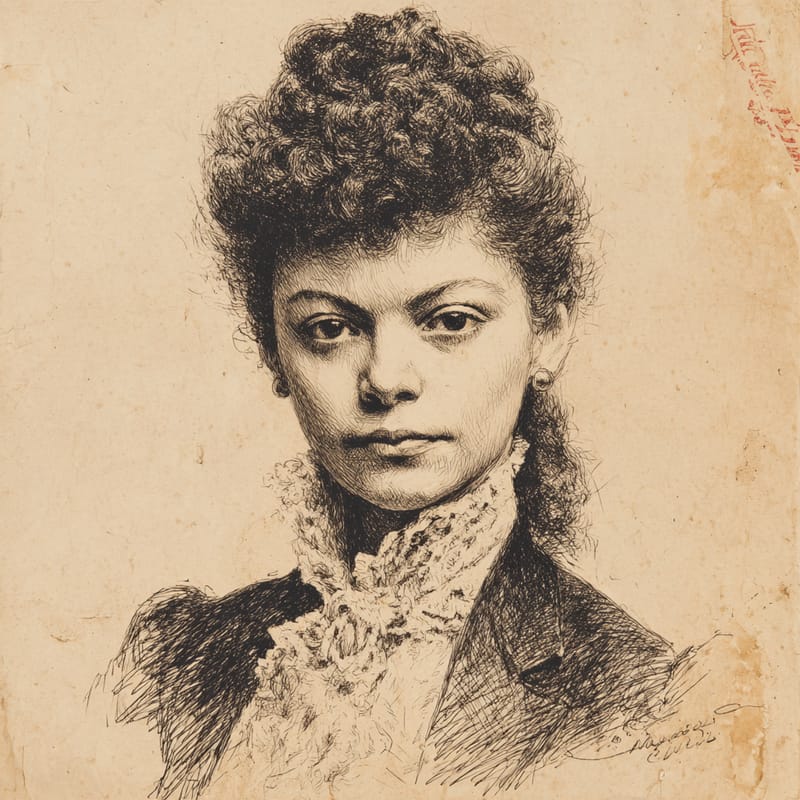
Ida B. Wells
Truth-telling against terror
Press freedom and equal rights.
Progressive Civil LibertarianOne of 729 ideologies · enter the Civil Libertarian hall →- Role
- Journalist & activist
- Era
- 1862–1931
- Region
- United States
- Social band
- Progressive
- Placement
- +40 · −28 · +65
§ Where Ida B. Wells stands
3 axesWells saw lynching partly as an economic weapon: the 1892 Memphis killings followed the success of the People's Grocery, which had drawn Black customers from a white-owned rival. Her remedies were self-help rather than collectivism, urging Black Memphians to boycott the streetcars and move west to Oklahoma, and she built her influence as an independent newspaper owner and lecturer.
Wells's central demand was due process: lynching, she argued, punished people without charge, trial or evidence, and she called on governments to enforce the law against mobs. She defended press freedom after a mob destroyed her newspaper in 1892, and in 1898 she met President William McKinley to press for federal action after the lynching of a Black postmaster in South Carolina.
Wells challenged segregation and white supremacy throughout her life, from her 1884 lawsuit against a railroad's segregated seating to her refusal to march at the back of the 1913 women's suffrage parade in Washington. That year she founded the Alpha Suffrage Club for Black women in Chicago, insisting that the rights of women and of Black Americans were one cause.
How close are you to Ida B. Wells?
Three statements, one per axis. Answer them and we’ll drop you on the compass next to them.
§ The story
HistoricalIda Bell Wells (1862–1931), later Wells-Barnett, was an American journalist, teacher and civil rights campaigner. Born into slavery in Holly Springs, Mississippi, during the Civil War, she was left to raise her siblings when yellow fever killed her parents in 1878, and she worked as a teacher before moving to Memphis. In 1884 she sued a railroad after being forcibly removed from the ladies' car; she won at first, but the Tennessee Supreme Court reversed the verdict. She became co-owner of the Memphis Free Speech and Headlight.
After a white mob lynched three Black grocers in Memphis in 1892, among them her friend Thomas Moss, Wells began investigating lynching and showed that rape, the usual justification offered, was not even alleged in most cases, exposing lynching as terror against Black economic and political advancement. When a mob wrecked her newspaper's office, she carried on from the North and in Britain, publishing Southern Horrors (1892) and A Red Record (1895). She later helped found the NAACP, organised Black women's suffrage in Chicago and fought segregation until her death.
Notable for
- 01Anti-lynching journalism
- 02Co-founded the NAACP
- 03Suffrage and civil-rights advocacy
Key works & moments
- 1884Sues a railroad after being dragged from the ladies' car for refusing to move.
- 1892Publishes Southern Horrors after a Memphis mob lynches three Black grocers, including her friend.
- 1893Tours Britain on the first of two lecture campaigns against American lynching.
- 1895Publishes A Red Record, a statistical study of lynching in the United States.
- 1909Joins the founders of the National Association for the Advancement of Colored People.
- 1913Founds the Alpha Suffrage Club and defies segregation at the Washington suffrage parade.
In their own words
“A Winchester rifle should have a place of honor in every black home, and it should be used for that protection which the law refuses to give.”
§ Minds closest to Ida B. Wells
All minds →



§ Also in the Civil Libertarian hall
Enter the hall →§ Common questions
4 answersWhat was Ida B. Wells's political ideology?
Ida B. Wells was a civil rights radical and feminist whose politics centred on equal rights, due process and a free press: on the 99ideologies three-axis compass, a Progressive Civil Libertarian. Economically she sat on the market side of centre (+40), championing Black self-help, independent enterprise and boycotts rather than socialism. On governance she leaned libertarian (−28), demanding the rule of law against mob violence and defending press freedom, and socially she was clearly progressive (+65), fighting segregation and campaigning for women's suffrage.
Was Ida B. Wells left-wing or right-wing?
By the standards of her time she belonged to the radical wing of the civil rights movement, which places her on the left socially and politically. She rejected Booker T. Washington's accommodation with segregation, demanded federal action against lynching and organised Black women's suffrage. Her economic views were less radical: she favoured self-help, Black enterprise and economic pressure such as boycotts and migration rather than a socialist programme, so her politics fit a rights-based liberalism more than the economic left.
Why did Ida B. Wells campaign against lynching?
Because she saw it as organised terror rather than justice. After a Memphis mob lynched her friend Thomas Moss and two other Black grocers in 1892, Wells investigated hundreds of cases and found that the common excuse, an alleged assault on a white woman, was absent in most and often false where it was made. In Southern Horrors (1892) and A Red Record (1895) she argued that lynching aimed to crush Black economic and political progress, and she urged federal action, boycotts and armed self-defence.
Which minds are closest to Ida B. Wells?
On the 99ideologies three-axis compass, the minds closest to Ida B. Wells are Nadine Strossen (100% alike), Roger Baldwin (98% alike) and Atticus Finch (97% alike). The furthest is Gregor Strasser (13% alike).