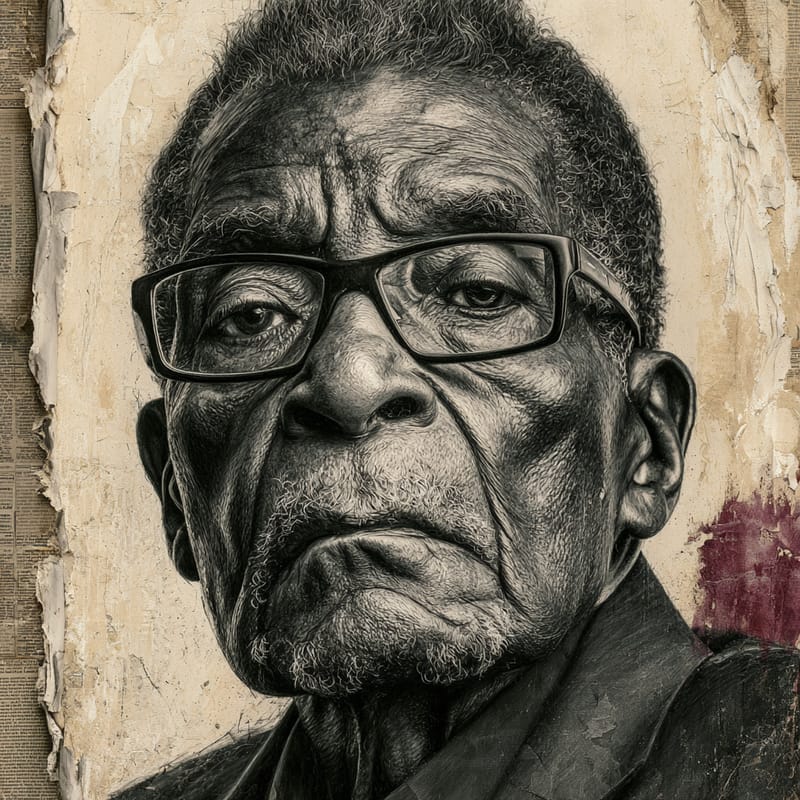
Robert Mugabe
Left-Wing NationalistOne of 729 ideologies · enter the Left-Wing Nationalist hall →- Role
- —
- Era
- —
- Region
- —
- Social band
- Centre (no modifier)
- Placement
- −75 · +50 · 0
§ Where Robert Mugabe stands
3 axesMugabe called himself a Marxist-Leninist, and in the 1980s his government expanded free schooling and rural health care within a tightly regulated economy. After a 1990s turn to IMF-backed structural adjustment he returned to radical redistribution with the Fast Track Land Reform of 2000, seizing most white-owned commercial farms, followed by price controls and money printing that ended in the hyperinflation of 2007–08.
Mugabe's rule grew steadily more coercive. The North Korean-trained Fifth Brigade killed an estimated 20,000 civilians in Matabeleland and the Midlands in the Gukurahundi campaign of 1983–87, the 1987 Unity Accord absorbed the main opposition party into ZANU–PF, and later elections, above all the 2008 presidential run-off, were marred by violence and allegations of fraud.
Mugabe combined modernising and conservative strands. His early government expanded education dramatically, and the 1982 Legal Age of Majority Act gave Black women full legal adulthood at 18. Yet he was a Jesuit-educated Catholic and a social conservative who from 1995 denounced gay people in vitriolic terms, and after 2000 he turned to racialised attacks on white farmers and Western powers.
How close are you to Robert Mugabe?
Three statements, one per axis. Answer them and we’ll drop you on the compass next to them.
§ The story
HistoricalRobert Gabriel Mugabe (1924–2019) led Zimbabwe for 37 years, as prime minister from 1980 and as executive president from 1987 to 2017. A mission-educated teacher who had worked in newly independent Ghana, he was a founding leader of the Zimbabwe African National Union in 1963, spent a decade in Rhodesian detention and then led its guerrilla war against Ian Smith's white-minority government from Mozambique. He won the 1980 election that followed the Lancaster House Agreement.
Mugabe's early years brought reconciliation rhetoric and a dramatic expansion of schooling and health care, but also the Gukurahundi massacres of 1983–87. From 2000 his government seized white-owned commercial farms, agricultural output collapsed and hyperinflation peaked in 2008, while elections were marred by violence against the opposition; Operation Murambatsvina in 2005 destroyed the homes or livelihoods of an estimated 700,000 urban poor. To admirers he remained an anti-colonial hero, to critics a liberator turned tyrant. A military intervention forced him out in 2017, and he died in Singapore in 2019.
Key works & moments
- 1963Helps found the Zimbabwe African National Union; detained by the Rhodesian government from 1964 to 1974.
- 1980Wins the independence election and becomes Zimbabwe's first prime minister.
- 1983–87The Fifth Brigade's Gukurahundi campaign kills thousands of Ndebele civilians in Matabeleland.
- 1987Becomes executive president; the Unity Accord merges ZANU and ZAPU into ZANU–PF.
- 2000Launches Fast Track Land Reform after losing a constitutional referendum; white-owned farms are seized.
- 2017Resigns in November after a military takeover ends 37 years in power.
§ Minds closest to Robert Mugabe
All minds →


§ Also in the Left-Wing Nationalist hall
Enter the hall →§ Common questions
4 answersWhat was Robert Mugabe's political ideology?
Robert Mugabe was an anti-colonial nationalist who professed Marxism-Leninism: on the 99ideologies three-axis compass, a Left-Wing Nationalist. Economically he sat well to the left (−75), redistributing land and expanding state control of the economy; on governance he was clearly authoritarian (+50), ruling through a dominant party, security forces and manipulated elections. The compass leaves his social axis unrated, but his record mixed early educational expansion with marked social conservatism, including hostility to gay rights.
Was Robert Mugabe left-wing or right-wing?
Left-wing in origin and rhetoric, authoritarian in practice. Mugabe came to power as a self-declared Marxist-Leninist liberation leader backed by China, redistributed land and framed his rule as anti-imperialist. But his later regime looked more like a personal and patronage-based dictatorship than a socialist project, and his social conservatism, notably his hostility to gay rights, did not fit the progressive left. He is best described as an authoritarian left-wing nationalist.
Why did Robert Mugabe seize white-owned farms?
He presented the seizures as completing the liberation struggle. At independence in 1980 a few thousand white farmers held much of Zimbabwe's best land, and the Lancaster House settlement limited redistribution to a willing-buyer, willing-seller basis for ten years. After voters rejected his draft constitution in February 2000, and facing the new Movement for Democratic Change, he backed war veterans' farm occupations and launched the Fast Track Land Reform. Critics argue the timing was political; the seizures transferred land to Black farmers and ruling-party allies but caused output to collapse.
Which minds are closest to Robert Mugabe?
On the 99ideologies three-axis compass, the minds closest to Robert Mugabe are Ne Win (100% alike), The Liberator (archetype) (98% alike) and Julius Nyerere (95% alike). The furthest is Hans-Hermann Hoppe (8% alike).