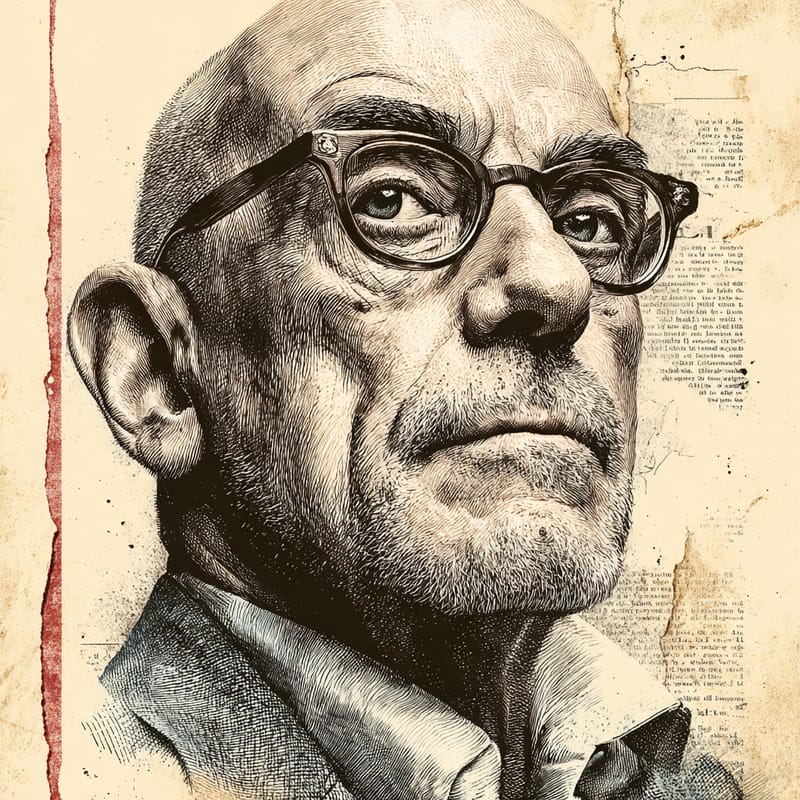
Norman Podhoretz
Commentary's crusader
From the left to the hawkish right.
Traditional Neo-Conservative (Neocon)One of 729 ideologies · enter the Neo-Conservative (Neocon) hall →- Role
- Editor
- Era
- b. 1930
- Region
- United States
- Social band
- Traditional
- Placement
- +26 · +26 · −48
§ Where Norman Podhoretz stands
3 axesEconomics was never Podhoretz's main battlefield, but his turn from the left included a turn towards capitalism. Having published radical social critics such as Paul Goodman in the early 1960s, he made Commentary from about 1970 a forum for critiques of Great Society liberalism and defences of the market economy, a shift he recounted in Breaking Ranks (1979).
Podhoretz is a militant advocate of American power. The Present Danger (1980) called for rearmament against the Soviet Union, Why We Were in Vietnam (1982) defended the war as morally justified, and in 2007 he published World War IV and argued in Commentary for bombing Iran's nuclear facilities.
Podhoretz is a strong cultural traditionalist. As early as 1958 he attacked Jack Kerouac and the Beats in 'The Know-Nothing Bohemians', and from 1970 his Commentary waged war on the counterculture, radical feminism and the New Left's anti-Americanism, which he blamed for corroding the moral confidence of American society.
How close are you to Norman Podhoretz?
Three statements, one per axis. Answer them and we’ll drop you on the compass next to them.
§ The story
HistoricalNorman Podhoretz (b. 1930) is an American editor and writer who edited Commentary magazine from 1960 to 1995. The son of Jewish immigrants in Brooklyn's Brownsville, he studied English at Columbia under Lionel Trilling and at Cambridge under F. R. Leavis before serving in the US Army. Taking over Commentary at 30, he first steered it leftward, serialising Paul Goodman's Growing Up Absurd, and his candid 1967 memoir of ambition, Making It, scandalised the New York literary world.
By around 1970 Podhoretz had broken with the New Left, and over the next two decades he made Commentary the flagship of neoconservatism, attacking the counterculture, détente and what he saw as American self-doubt after Vietnam. His books The Present Danger (1980) and Why We Were in Vietnam (1982) helped frame Reagan-era hawkishness, and after 2001 he called the struggle against radical Islamism World War IV. He was awarded the Presidential Medal of Freedom in 2004. Critics, including former friends whose estrangement he chronicled in Ex-Friends (1999), accused him of zealotry.
Notable for
- 01Edited 'Commentary'
- 02'Making It'
- 03Neoconservative polemics
Key works & moments
- 1958Attacks Jack Kerouac and the Beats in the essay 'The Know-Nothing Bohemians'.
- 1960Becomes editor of Commentary, which he leads until 1995.
- 1967Publishes Making It, a frank memoir of literary ambition.
- 1979Breaking Ranks recounts his break with the New Left.
- 1980The Present Danger urges a tougher stand against the Soviet Union.
- 2007Publishes World War IV and makes the case for bombing Iran in Commentary.
§ Minds closest to Norman Podhoretz
All minds →

§ Also in the Neo-Conservative (Neocon) hall
Enter the hall →§ Common questions
4 answersWhat is Norman Podhoretz's political ideology?
Norman Podhoretz is a neoconservative, one of the movement's founding editors and its most combative polemicist: on the 99ideologies three-axis compass, a Traditional Neo-Conservative (Neocon). Economically he sits right of centre (+26), having moved from the radical social criticism of the early 1960s to a defence of capitalism. On governance he favours assertive American power (+26), from Reagan-era rearmament to the war on terror, and socially he is strongly traditional (−48), a lifelong critic of the counterculture and the New Left.
Is Norman Podhoretz left-wing or right-wing?
Right-wing, after an early career on the liberal left. In the early 1960s Podhoretz published radical critics in Commentary and moved among the writers of the emerging New Left. By around 1970 he had turned against what he saw as its anti-Americanism and cultural nihilism, and he became one of the most hawkish and culturally conservative voices in American journalism, a trajectory he described in Breaking Ranks (1979).
How did Norman Podhoretz make Commentary a neoconservative magazine?
By turning it against the left he had once courted. After a liberal-left phase in the early 1960s, Podhoretz from about 1970 filled Commentary with essays attacking the New Left, the counterculture, racial quotas and détente, by writers including Midge Decter, Jeane Kirkpatrick and Irving Kristol. Kirkpatrick's 1979 essay 'Dictatorships and Double Standards' appeared in its pages and caught Ronald Reagan's attention, making the magazine an intellectual source for his foreign policy.
Which minds are closest to Norman Podhoretz?
On the 99ideologies three-axis compass, the minds closest to Norman Podhoretz are Irving Kristol (98% alike), Leo Strauss (98% alike) and Charles Krauthammer (97% alike). The furthest is Emma Goldman (14% alike).