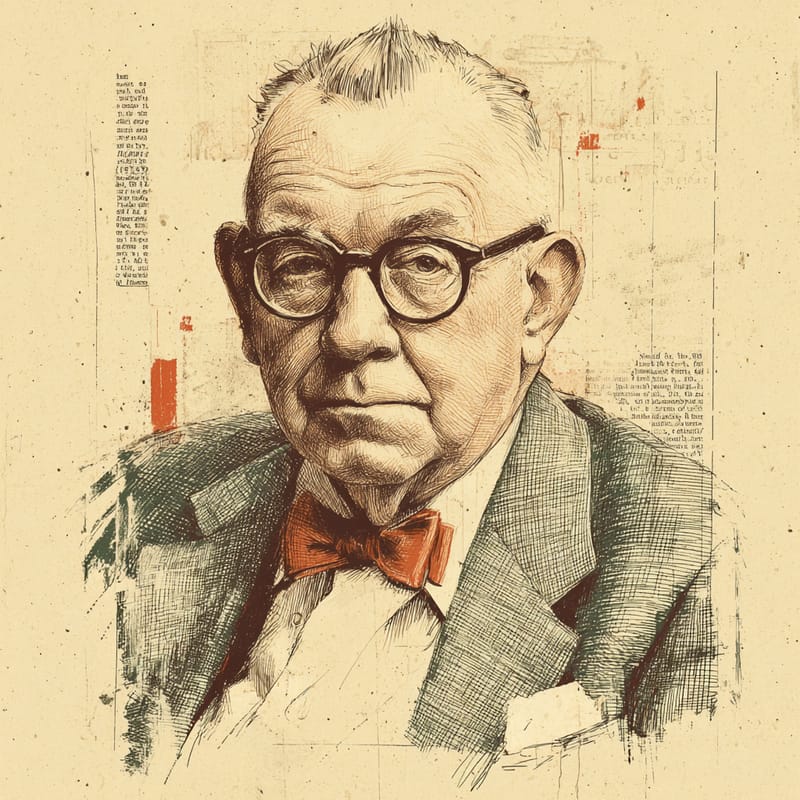
Irving Kristol
The godfather of neoconservatism
A liberal mugged by reality.
Traditional Neo-Conservative (Neocon)One of 729 ideologies · enter the Neo-Conservative (Neocon) hall →- Role
- Writer & editor
- Era
- 1920–2009
- Region
- United States
- Social band
- Traditional
- Placement
- +28 · +24 · −45
§ Where Irving Kristol stands
3 axesKristol defended capitalism as the economic basis of a free society without idolising it: his 1978 book Two Cheers for Capitalism withheld the third cheer because markets cannot supply moral meaning. He promoted supply-side tax cutting in the 1970s, yet in 'The Neoconservative Persuasion' (2003) he dismissed Hayek's fear that the welfare state leads to serfdom, accepting a conservative welfare state.
Kristol saw government as a guardian of public morality and was sceptical of utopian social engineering: The Public Interest, founded in 1965, documented the unintended consequences of liberal programmes. Abroad he favoured a strong foreign policy guided by national interest, founding the journal The National Interest in 1985.
Kristol was a cultural conservative who saw the 1960s counterculture and a liberal 'new class' of intellectuals as threats to bourgeois virtue. He made the case for censoring pornography in a 1971 essay, defended religion as a source of social morality, and argued that liberal individualism alone could not sustain a decent society.
How close are you to Irving Kristol?
Three statements, one per axis. Answer them and we’ll drop you on the compass next to them.
§ The story
HistoricalIrving Kristol (1920–2009) was an American essayist and editor, widely called the godfather of neoconservatism. Born in Brooklyn to Jewish immigrant parents, he was a Trotskyist student at City College of New York, served in the US Army in Europe during the Second World War and married the historian Gertrude Himmelfarb. He was managing editor of Commentary, co-founded the London-based magazine Encounter in 1953 with the poet Stephen Spender, and in 1965 co-founded The Public Interest with the sociologist Daniel Bell.
Kristol's journey from Trotskyism through anti-communist liberalism to the right gave neoconservatism its defining story. Through The Public Interest, which he edited until 2002, he argued that Great Society programmes often produced unintended harms, and he helped popularise supply-side economics among Republicans in the 1970s. Encounter's covert CIA funding through the Congress for Cultural Freedom, revealed in 1967 after he had left, later shadowed his record. He received the Presidential Medal of Freedom in 2002, and his son Bill carried the movement into a new generation.
Notable for
- 01Founded 'The Public Interest'
- 02'Two Cheers for Capitalism'
- 03Defined neoconservatism
Key works & moments
- 1953Co-founds the magazine Encounter in London with Stephen Spender.
- 1965Co-founds The Public Interest with Daniel Bell.
- 1971Publishes an essay making the case for censorship of pornography.
- 1978Publishes Two Cheers for Capitalism.
- 1983Reflections of a Neoconservative collects his essays defining the movement.
- 2002Receives the Presidential Medal of Freedom from George W. Bush.
§ Minds closest to Irving Kristol
All minds →

§ Also in the Neo-Conservative (Neocon) hall
Enter the hall →§ Common questions
4 answersWhat was Irving Kristol's political ideology?
Irving Kristol was the founding figure of American neoconservatism: on the 99ideologies three-axis compass, a Traditional Neo-Conservative (Neocon). Economically he sat right of centre (+28), giving capitalism two cheers, championing supply-side tax cuts and accepting a modest welfare state. On governance he favoured a state that upholds public morality and a firm foreign policy (+24), while distrusting utopian social engineering, and socially he was clearly traditional (−45), defending religion and bourgeois virtue against the counterculture.
Was Irving Kristol left-wing or right-wing?
Right-wing in his mature career, after a youth on the far left. Kristol was a Trotskyist at City College, an anti-communist liberal in the 1950s and a critic of the Great Society by the late 1960s, and he supported Richard Nixon in 1972 before becoming a Republican. His neoconservatism differed from libertarian conservatism by accepting a welfare state, and from traditional conservatism by its urban, intellectual and reform-minded roots.
Did Irving Kristol invent the term neoconservative?
No, but he embraced it and made it respectable. The label was popularised in the early 1970s by the socialist writer Michael Harrington and others as a pejorative for former leftists who had turned against the New Left and the Great Society. Kristol was one of the few to accept the name, and his essays, collected in Reflections of a Neoconservative (1983) and Neoconservatism: The Autobiography of an Idea (1995), defined it as a persuasion rather than a movement.
Which minds are closest to Irving Kristol?
On the 99ideologies three-axis compass, the minds closest to Irving Kristol are Norman Podhoretz (98% alike), Charles Krauthammer (97% alike) and Leo Strauss (96% alike). The furthest is Emma Goldman (15% alike).