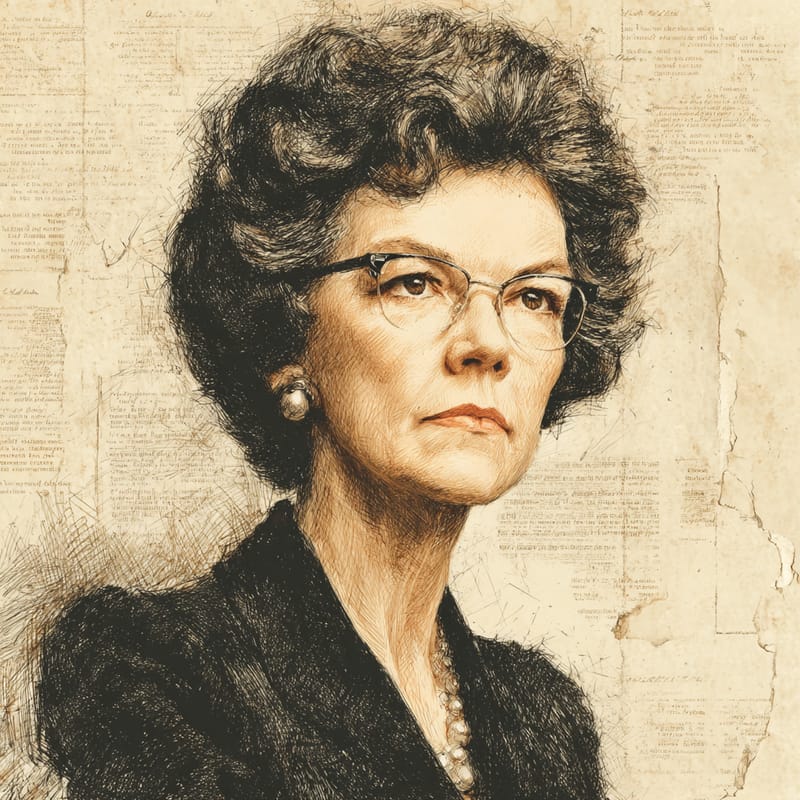
Jeane Kirkpatrick
Dictatorships and double standards
Cold-War realism with a moral edge.
Traditional Neo-Conservative (Neocon)One of 729 ideologies · enter the Neo-Conservative (Neocon) hall →- Role
- Ambassador
- Era
- 1926–2006
- Region
- United States
- Social band
- Traditional
- Placement
- +24 · +32 · −42
§ Where Jeane Kirkpatrick stands
3 axesKirkpatrick moved from the democratic socialist left, joining the Young People's Socialist League as a student in the 1940s, to the Republican Party, which she formally joined in 1985. Her economics followed that path: she came to see private enterprise and market economies as a foundation of political freedom, though economic doctrine was never her central concern.
Her 1979 essay 'Dictatorships and Double Standards' argued that traditional autocracies friendly to the United States were less repressive and more likely to democratise than revolutionary communist regimes, and should be supported against them. As UN ambassador she applied that doctrine, defending aid to the Salvadoran government and the Nicaraguan Contras and the 1983 invasion of Grenada.
Kirkpatrick shared the cultural conservatism of the Democratic dissidents of the 1970s, deploring the New Left, the counterculture and what she saw as their reflexive anti-Americanism. At the 1984 Republican convention she accused the 'San Francisco Democrats' of always blaming America first, turning patriotism itself into a dividing line in American politics.
How close are you to Jeane Kirkpatrick?
Three statements, one per axis. Answer them and we’ll drop you on the compass next to them.
§ The story
HistoricalJeane Duane Jordan Kirkpatrick (1926–2006) was an American political scientist and diplomat. Born in Duncan, Oklahoma, she studied at Barnard College and Columbia University, where she earned her doctorate, and taught political science at Georgetown University from 1967. A Democrat and admirer of Hubert Humphrey, she co-founded the Coalition for a Democratic Majority in 1972 to resist the party's leftward turn under George McGovern. Her 1979 Commentary essay 'Dictatorships and Double Standards' brought her to Ronald Reagan's attention.
Reagan made her ambassador to the United Nations from 1981 to 1985, the first woman in the post and a member of his cabinet. She defended the 1983 invasion of Grenada and American support for anti-communist governments and insurgents in Central America, staunchly backed Israel at the UN, and clashed with Secretary of State Alexander Haig over the 1982 Falklands War. Her 1984 convention speech attacking the 'San Francisco Democrats' made her a conservative star, and she joined the Republican Party in 1985. Critics accused her doctrine of excusing abuses by right-wing allies such as the Salvadoran military.
Notable for
- 01'Dictatorships and Double Standards'
- 02First woman US UN ambassador
- 03Reagan Cold-War policy
Key works & moments
- 1972Co-founds the Coalition for a Democratic Majority to oppose the McGovern wing.
- 1979Publishes 'Dictatorships and Double Standards' in Commentary, attacking Jimmy Carter's foreign policy.
- 1981Becomes US ambassador to the United Nations, the first woman to hold the post.
- 1983Defends the US invasion of Grenada at the United Nations.
- 1984Attacks the 'San Francisco Democrats' in a Republican National Convention speech.
- 1985Leaves the UN and formally joins the Republican Party.
In their own words
“They always blame America first.”
§ Minds closest to Jeane Kirkpatrick
All minds →





§ Also in the Neo-Conservative (Neocon) hall
Enter the hall →§ Common questions
4 answersWhat was Jeane Kirkpatrick's political ideology?
Jeane Kirkpatrick was a neoconservative, a Cold War Democrat who became the Reagan administration's sharpest anti-communist voice: on the 99ideologies three-axis compass, a Traditional Neo-Conservative (Neocon). Economically she sat right of centre (+24), having moved from youthful socialism to support for market economies. On governance she favoured a hard-edged, state-led foreign policy (+32), backing authoritarian allies against totalitarian foes, and socially she leaned traditional (−42), hostile to the New Left and the counterculture.
Was Jeane Kirkpatrick left-wing or right-wing?
Right-wing by the end of her career, though she came from the left. Kirkpatrick joined a socialist youth league as a student and remained a Democrat into the 1980s, admiring Hubert Humphrey's liberal anti-communism. The McGovern campaign, the counterculture and what she saw as Jimmy Carter's weakness abroad drove her rightward, and she joined the Republicans in 1985. Her journey became a model of the neoconservative path from liberal anti-communism to the Republican right.
What did Jeane Kirkpatrick argue in Dictatorships and Double Standards?
She argued that the Carter administration had helped topple friendly autocrats such as the Shah of Iran and Nicaragua's Anastasio Somoza, only to see them replaced by regimes more hostile and no less repressive. Traditional authoritarian governments, she wrote, leave much of society alone and can evolve into democracies, whereas revolutionary communist regimes seek total control and do not democratise. The 1979 Commentary essay became an intellectual basis for Reagan's support of anti-communist allies, and critics said it excused human-rights abuses.
Which minds are closest to Jeane Kirkpatrick?
On the 99ideologies three-axis compass, the minds closest to Jeane Kirkpatrick are Charles Krauthammer (98% alike), Paul Wolfowitz (98% alike) and Jack Ryan (97% alike). The furthest is Emma Goldman (15% alike).