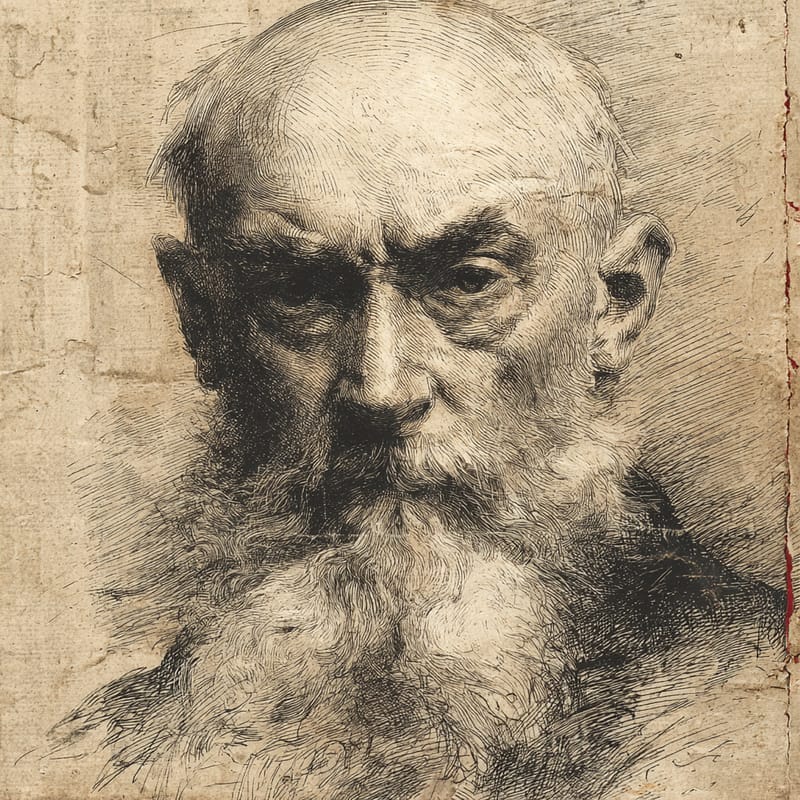
Martin Buber
Paths in utopia
Socialism of the small community.
Reformist Minarcho-SocialistOne of 729 ideologies · enter the Minarcho-Socialist hall →- Role
- Philosopher
- Era
- 1878–1965
- Region
- Austria / Israel
- Social band
- Reformist
- Placement
- −70 · −76 · +46
§ Where Martin Buber stands
3 axesIn Paths in Utopia (1946) Buber traced a tradition of communal socialism from Owen and Proudhon through Kropotkin and his friend Gustav Landauer, and praised the Jewish village communes of Palestine as an experiment that had not failed. He wanted ownership held cooperatively by small communities federated from below, not concentrated in a central planning state.
Buber distinguished the social principle of free association from the political principle of state power, and warned that socialism pursued through the state would swallow society. Paths in Utopia (1946) contrasted the centralised Soviet model with a federation of self-governing communities, and his politics always favoured dialogue, persuasion and voluntary association over coercion.
Buber's humanism rested on the dialogical ethic of I and Thou (1923), which asks people to meet one another as persons rather than objects. He applied it to politics by co-founding Ihud in 1942 to campaign for equal rights for Arabs and Jews in a binational state. His progressivism was rooted in religious tradition, especially Hasidism, rather than in secular radicalism.
How close are you to Martin Buber?
Three statements, one per axis. Answer them and we’ll drop you on the compass next to them.
§ The story
HistoricalMartin Buber (1878–1965) was an Austrian-born Jewish philosopher, religious thinker and Zionist. Born in Vienna and raised partly in Lemberg by his grandfather, the Midrash scholar Solomon Buber, he became a leading cultural Zionist, retold the tales of the Hasidim and founded the journal Der Jude in 1916. His book I and Thou (1923) made him one of the century's most influential philosophers of dialogue, and with Franz Rosenzweig he began a new German translation of the Hebrew Bible.
Buber taught at the University of Frankfurt until the Nazis' rise forced him out in 1933, and in 1938 he emigrated to Jerusalem to teach social philosophy at the Hebrew University. There he campaigned for Arab–Jewish reconciliation, co-founding the Ihud association in 1942 to press for a binational state, and in Paths in Utopia (1946) he championed a decentralised, cooperative socialism exemplified by the kibbutz. A moral voice in the new state of Israel, he opposed the death sentence passed on Adolf Eichmann.
Notable for
- 01'Paths in Utopia'
- 02Dialogical philosophy
- 03Kibbutz federalism
Key works & moments
- 1916Founds the journal Der Jude, a forum for cultural Zionism.
- 1923Publishes I and Thou, his philosophy of dialogue.
- 1925Begins translating the Hebrew Bible into German with Franz Rosenzweig.
- 1938Leaves Nazi Germany for Jerusalem and the Hebrew University.
- 1942Co-founds Ihud with Judah Magnes to campaign for a binational Arab–Jewish state.
- 1946Publishes Paths in Utopia, a case for decentralised communal socialism.
In their own words
“All real living is meeting.”
§ Minds closest to Martin Buber
All minds →


§ Also in the Minarcho-Socialist hall
Enter the hall →The closest minds above are this hall’s whole roster.
§ Common questions
4 answersWhat was Martin Buber's political ideology?
Martin Buber was a communitarian socialist and cultural Zionist: on the 99ideologies three-axis compass, a Reformist Minarcho-Socialist. Economically he sat well to the left (−70), favouring cooperative ownership by small federated communities such as the kibbutz. On governance he was strongly libertarian (−76), warning that state power swallows society and preferring voluntary association. Socially he was progressive (+46), a humanist who sought equal rights for Arabs and Jews, though rooted in religious tradition.
Was Martin Buber left-wing or right-wing?
Left-wing, in the libertarian and religious-socialist tradition. Buber wanted a socialism of cooperative communities in place of capitalism, and in the politics of Palestine and Israel he stood on the dovish left, pressing for Arab–Jewish reconciliation and a binational state. He rejected Marxist class war and the Soviet party-state, however, and his socialism drew on Jewish ethics and Hasidic piety, so he fits neither the communist left nor conventional social democracy.
Was Martin Buber a Zionist?
Yes, but of a distinctive kind. Buber was a cultural Zionist who saw the Jewish return to the land of Israel as a chance for spiritual and social renewal rather than simply the creation of a nation-state. From the 1920s he urged cooperation with the Arabs of Palestine, and in 1942 he co-founded Ihud to campaign for a binational state with equal rights for both peoples. After 1948 he remained in Israel, speaking up for the rights of its Arab citizens while supporting the kibbutz and Jewish–Arab dialogue.
Which minds are closest to Martin Buber?
On the 99ideologies three-axis compass, the minds closest to Martin Buber are G. D. H. Cole (98% alike), The Cooperative Commonwealth (archetype) (98% alike) and Gustav Landauer (96% alike). The furthest is Adam Sutler (0% alike).