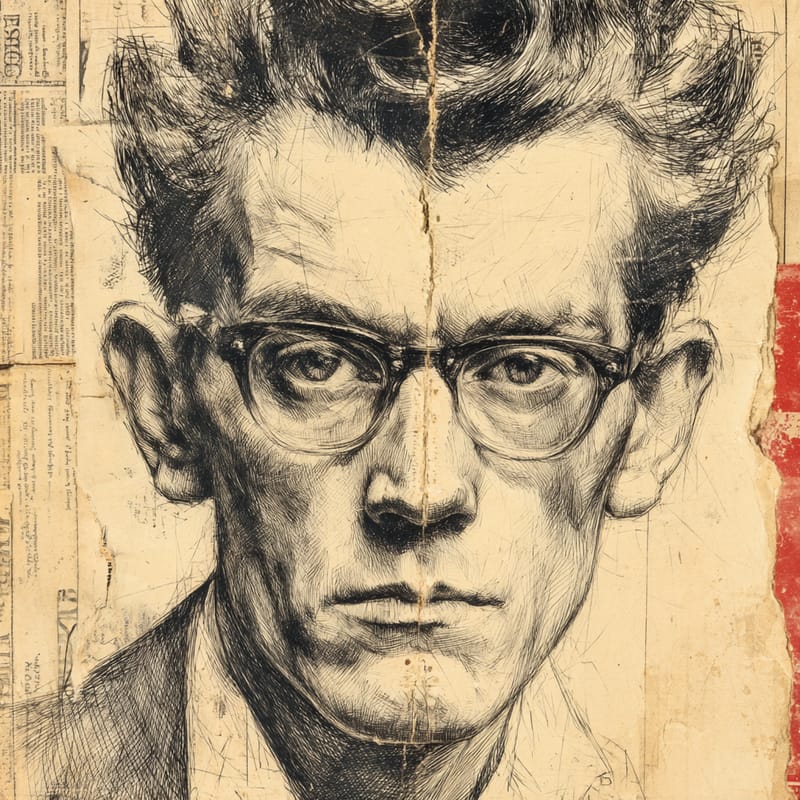
Raniero Panzieri
Inquiry from below
Studying the factory, with the workers.
Reformist AutonomistOne of 729 ideologies · enter the Autonomist hall →- Role
- Theorist & editor
- Era
- 1921–1964
- Region
- Italy
- Social band
- Reformist
- Placement
- −58 · −70 · +50
§ Where Raniero Panzieri stands
3 axesPanzieri argued that technology under capitalism is not neutral. His essay on the capitalist use of machinery, in the first issue of Quaderni Rossi (1961), showed how machines and factory organisation embody capital's command over labour, and Surplus Value and Planning (1964) argued that economic planning was capital's own tool, not a step towards socialism. He wanted workers' control, not merely state ownership.
Panzieri distrusted party orthodoxy and bureaucratic leadership. The Seven Theses on Workers' Control (1958), written amid the crisis of the Italian left after the Soviet invasion of Hungary in 1956, located socialist democracy in workplace councils rather than in the party apparatus, and Quaderni Rossi worked directly with factory militants outside the official channels of unions and parties.
Panzieri's progressivism lay in his open, anti-dogmatic method. He brought sociology into Marxism through workers' inquiry, set out in his 1964 talk Socialist Uses of Workers' Inquiry, and treated workers as co-researchers rather than as objects of party pedagogy, helping to open the Italian left to the New Left culture of the 1960s.
How close are you to Raniero Panzieri?
Three statements, one per axis. Answer them and we’ll drop you on the compass next to them.
§ The story
HistoricalRaniero Panzieri (1921–1964) was an Italian socialist intellectual and editor, the forerunner of operaismo. Born in Rome, he joined the Italian Socialist Party after the war, organised among Sicilian peasants during the land struggles of the early 1950s and rose to the party's central committee, helping edit its theoretical review Mondo Operaio. With Lucio Libertini he wrote the Seven Theses on Workers' Control (1958), a call for socialist democracy rooted in the workplace.
Sidelined as the Socialists moved towards government with the Christian Democrats, Panzieri left Rome for Turin, joined the Einaudi publishing house and in 1961 founded Quaderni Rossi, which studied the factory system at FIAT and Olivetti through inquiries carried out with workers themselves. The journal split in 1963–64 when Mario Tronti's group left to found Classe Operaia. Panzieri died suddenly in Turin in October 1964, aged 43, but his critique of technology and capitalist planning shaped the whole workerist and autonomist tradition.
Notable for
- 01Founded 'Quaderni Rossi'
- 02Pioneered 'workers' inquiry'
- 03Seeded operaismo
Key works & moments
- Early 1950sOrganises for the Socialist Party among Sicilian peasants during the land occupations.
- 1958Co-writes the Seven Theses on Workers' Control with Lucio Libertini in Mondo Operaio.
- 1959Moves to Turin and joins the publisher Einaudi.
- 1961Founds the journal Quaderni Rossi and publishes his critique of the capitalist use of machinery.
- 1963–64Quaderni Rossi splits as Mario Tronti's group leaves to found Classe Operaia.
- 1964Publishes Surplus Value and Planning; dies suddenly in Turin aged 43.
§ Minds closest to Raniero Panzieri
All minds →

§ Also in the Autonomist hall
Enter the hall →§ Common questions
4 answersWhat was Raniero Panzieri's political ideology?
Raniero Panzieri was a libertarian socialist and the founding figure of operaismo: on the 99ideologies three-axis compass, a Reformist Autonomist. Economically he sat left of centre (−58), arguing that capitalist technology and planning embody capital's command and calling for workers' control. On governance he was strongly libertarian (−70), distrusting party orthodoxy and bureaucratic leadership. Socially he was progressive (+50), an anti-dogmatic thinker who helped open the Italian left to the New Left.
Was Raniero Panzieri left-wing or right-wing?
Left-wing. Panzieri spent his life on the socialist left, first as a leader of the Italian Socialist Party and then as founder of Quaderni Rossi. He grew critical of his party's move into coalition with the Christian Democrats and of the Communist Party's faith in planning and technical progress, and argued for workers' control from below. That makes him a founder of Italy's New Left rather than a figure of either the reformist or the Soviet-aligned left.
What is a workers' inquiry?
A workers' inquiry is research into working conditions carried out with and by workers, aimed at understanding and strengthening their struggles. The idea goes back to the questionnaire Karl Marx published in 1880, asking French workers about their lives and jobs. Panzieri and the Quaderni Rossi group revived it in the early 1960s, studying FIAT and Olivetti through interviews and co-research with workers, and Panzieri set out its method in his 1964 talk Socialist Uses of Workers' Inquiry. It became a hallmark of operaismo.
Which minds are closest to Raniero Panzieri?
On the 99ideologies three-axis compass, the minds closest to Raniero Panzieri are Mario Tronti (98% alike), Harry Cleaver (97% alike) and Antonio Negri (95% alike). The furthest is Adam Sutler (0% alike).