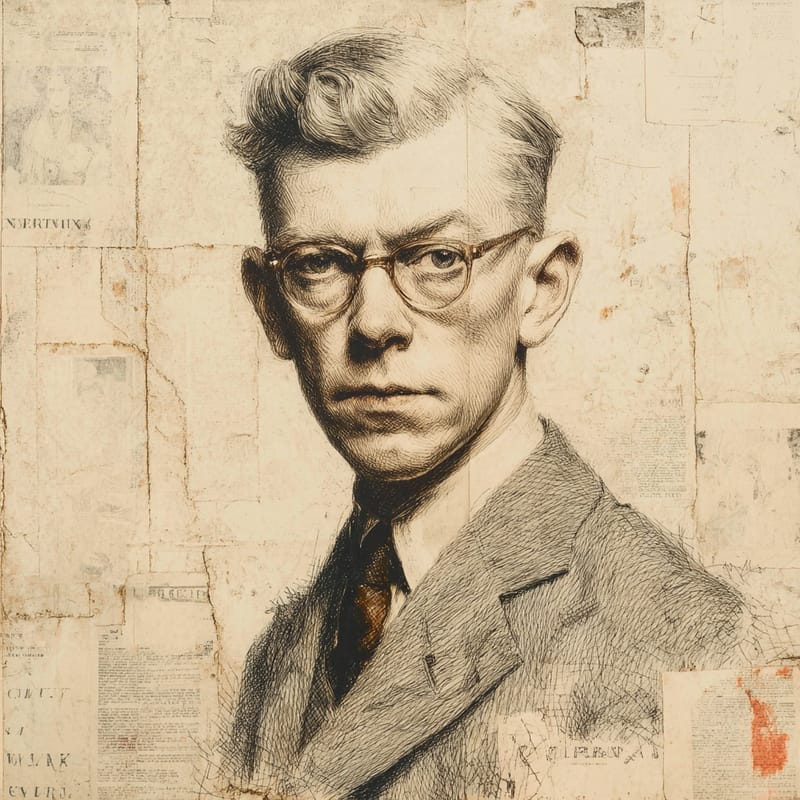
G. D. H. Cole
Guild socialism
Industry self-governed by its workers.
Reformist Minarcho-SocialistOne of 729 ideologies · enter the Minarcho-Socialist hall →- Role
- Theorist
- Era
- 1889–1959
- Region
- United Kingdom
- Social band
- Reformist
- Placement
- −72 · −72 · +48
§ Where G. D. H. Cole stands
3 axesCole wanted industry taken into common ownership but run by its workers rather than by the state. In Self-Government in Industry (1917) and Guild Socialism Restated (1920) he proposed national guilds, democratic associations of all the workers in an industry, which would manage production while consumer bodies represented users. In the 1930s he moved towards planning and nationalisation, which tempered his early radicalism.
Cole was a pluralist who distrusted the sovereign state. In Social Theory (1920) he argued for functional democracy, in which people are represented separately as producers, consumers and citizens through many self-governing associations, with the state reduced to a coordinating body among equals. He worked through democratic and parliamentary channels and never embraced revolutionary dictatorship.
Cole's progressivism was egalitarian and educational. He taught adult classes for the Workers' Educational Association, wrote popular working-class history such as The Common People (1938) with Raymond Postgate, and in The People's Front (1937) urged a broad alliance against fascism. He prized active, participatory citizenship over the paternalism of the Victorian reformers.
How close are you to G. D. H. Cole?
Three statements, one per axis. Answer them and we’ll drop you on the compass next to them.
§ The story
HistoricalGeorge Douglas Howard Cole (1889–1959) was an English political theorist, economist and historian. Educated at St Paul's School and Balliol College, Oxford, he joined the Fabian Society as a student, became the leading theorist of guild socialism in the 1910s and advised trade unions during the First World War. He later taught at Oxford, where in 1944 he became the first Chichele Professor of Social and Political Theory, holding the chair until 1957.
Cole's guild socialism, set out in Self-Government in Industry (1917) and Guild Socialism Restated (1920), offered a democratic alternative to both capitalism and state socialism and briefly inspired the building guilds of the early 1920s. After their collapse he worked inside the Labour movement, founding the New Fabian Research Bureau in 1931 and chairing the Fabian Society. A prolific writer, he produced the multi-volume A History of Socialist Thought (1953–60), biographies of William Cobbett and Robert Owen and, with his wife Margaret Cole, a long series of detective novels.
Notable for
- 01Guild-socialist theory
- 02'Self-Government in Industry'
- 03Fabian dissident
Key works & moments
- 1913Publishes The World of Labour, a study of trade unionism that launches his guild socialist case.
- 1915Helps found the National Guilds League after breaking with the Fabian leadership.
- 1917Publishes Self-Government in Industry.
- 1920Publishes Guild Socialism Restated and Social Theory.
- 1931Founds the New Fabian Research Bureau to rebuild Labour's policy thinking.
- 1944Becomes Oxford's first Chichele Professor of Social and Political Theory.
§ Minds closest to G. D. H. Cole
All minds →

§ Also in the Minarcho-Socialist hall
Enter the hall →The closest minds above are this hall’s whole roster.
§ Common questions
4 answersWhat was G. D. H. Cole's political ideology?
G. D. H. Cole was a guild socialist and pluralist democrat: on the 99ideologies three-axis compass, a Reformist Minarcho-Socialist. Economically he sat well to the left (−72), wanting industry in common ownership but run by self-governing guilds of workers. On governance he was strongly libertarian (−72), seeking to reduce the state to a coordinating body among many democratic associations. Socially he was progressive (+48), an egalitarian champion of adult education and active citizenship.
Was G. D. H. Cole left-wing or right-wing?
Left-wing. Cole was a lifelong socialist who wanted capitalism replaced by common ownership and workers' self-government, and he spent his career inside the Labour movement and the Fabian Society. His distinctive position lay on the libertarian side of the British left: he distrusted bureaucratic nationalisation and the all-powerful state, preferring democratic control by the people who did the work, which set him apart from Soviet communism and from Labour's more centralising planners.
What is guild socialism?
Guild socialism was a British movement of the 1910s and early 1920s that sought to replace capitalism with self-governing national guilds, democratic associations of all the workers in each industry, holding their industries in trust for the community. Developed by A. R. Orage, S. G. Hobson and above all G. D. H. Cole, it rejected both private ownership and state bureaucracy. The National Guilds League was founded in 1915, and building guilds briefly operated in the early 1920s before collapsing in the post-war slump.
Which minds are closest to G. D. H. Cole?
On the 99ideologies three-axis compass, the minds closest to G. D. H. Cole are The Cooperative Commonwealth (archetype) (99% alike), Martin Buber (98% alike) and Gustav Landauer (97% alike). The furthest is Adam Sutler (0% alike).