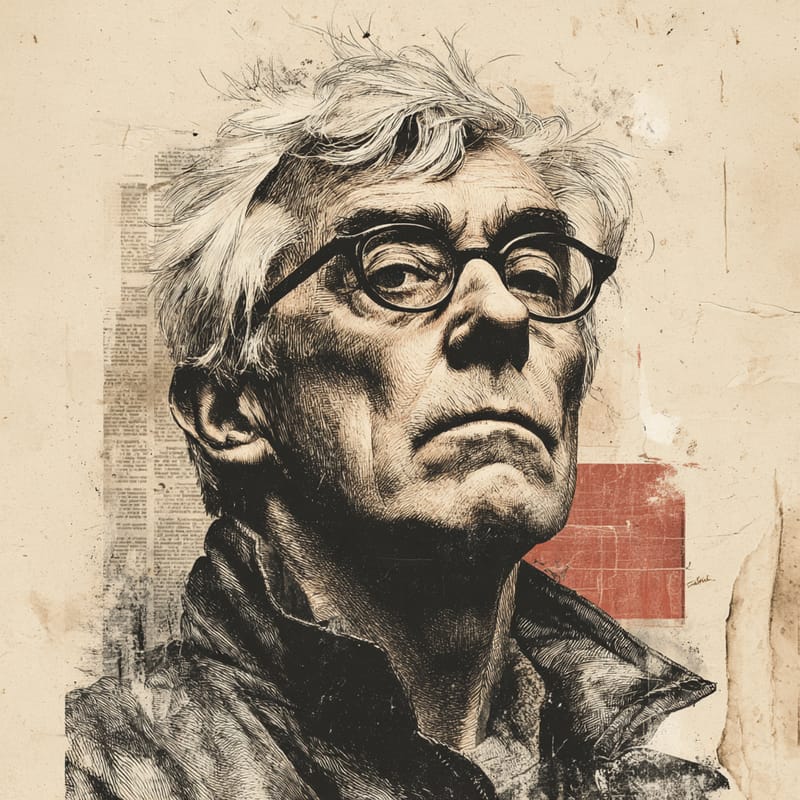
Mario Tronti
Workers and capital
Labour comes first, not capital.
Reformist AutonomistOne of 729 ideologies · enter the Autonomist hall →- Role
- Theorist
- Era
- 1931–2023
- Region
- Italy
- Social band
- Reformist
- Placement
- −58 · −72 · +54
§ Where Mario Tronti stands
3 axesTronti inverted the relation between labour and capital. In Workers and Capital (1966) he argued that capital is driven to innovate by working-class resistance, and his essay The Strategy of Refusal, collected there, made workers' refusal to cooperate with production their decisive weapon. He later turned from the factory to the party and the state as the place to contest capital, moderating his economic radicalism.
Classe Operaia (1964–67) insisted on workers' autonomy from the reformist leaderships of the party and the unions, and on the factory struggle as the real ground of politics. But Tronti never rejected the party itself: in L'autonomia del politico (1977) he argued that the working-class movement must take hold of political institutions, a shift that keeps him well short of anti-statism.
Tronti belonged to the New Left that broke with the Communist Party's culture of the skilled, disciplined worker. Operaismo found its new revolutionary subject in the mass worker of the northern assembly lines, often a young migrant from the south, and The Strategy of Refusal, collected in 1966, rejected the labour ethic that Catholic and communist Italy alike revered.
How close are you to Mario Tronti?
Three statements, one per axis. Answer them and we’ll drop you on the compass next to them.
§ The story
HistoricalMario Tronti (1931–2023) was an Italian Marxist philosopher and politician, the founding theorist of operaismo, or workerism. Born in Rome, he joined the Italian Communist Party as a young man, wrote for Raniero Panzieri's journal Quaderni Rossi from 1961 and in 1964 launched the journal Classe Operaia with Antonio Negri, Alberto Asor Rosa and others. His book Operai e capitale (Workers and Capital, 1966) became the founding text of the movement.
Tronti's Copernican revolution reversed the usual Marxist sequence, arguing that working-class struggle comes first and capitalist development responds to it. Yet he never left the communist tradition: from the late 1960s he worked again within the party, theorised the autonomy of the political in the 1970s, taught political philosophy at the University of Siena and sat in the Senate for the Democratic Party of the Left from 1992 to 1994 and for the Democratic Party from 2013 to 2018. He died in 2023.
Notable for
- 01Founded operaismo
- 02'Workers and Capital'
- 03The 'Copernican turn'
Key works & moments
- 1961Begins writing for Raniero Panzieri's journal Quaderni Rossi.
- 1964Launches Classe Operaia; his editorial Lenin in England proclaims the primacy of workers' struggle.
- 1966Publishes Operai e capitale (Workers and Capital), the founding text of operaismo.
- 1977Publishes L'autonomia del politico, turning towards the party and the state.
- 1992Elected to the Senate for the Democratic Party of the Left.
- 2013Returns to the Senate for the Democratic Party, serving until 2018.
In their own words
“We too have worked with a concept that puts capitalist development first, and workers second. This is a mistake.”
§ Minds closest to Mario Tronti
All minds →

§ Also in the Autonomist hall
Enter the hall →§ Common questions
4 answersWhat was Mario Tronti's political ideology?
Mario Tronti was the founding theorist of Italian workerism, or operaismo: on the 99ideologies three-axis compass, a Reformist Autonomist. Economically he sat left of centre (−58), placing workers' struggle, not capital, at the heart of economic development. On governance he was strongly libertarian (−72), insisting on workers' autonomy from party and union bureaucracy, though he later returned to party politics. Socially he was clearly progressive (+54), part of the New Left's break with the old labour ethic.
Was Mario Tronti left-wing or right-wing?
Left-wing throughout his life. Tronti began as a Communist Party intellectual, founded the workerist current that inspired Italy's revolutionary left of the 1960s and 1970s, and ended as a senator for centre-left parties. His path shows the range of the left rather than a move to the right: from the radical claim that workers' struggle drives history to the view, from the late 1970s, that the left must contest political power through its parties and institutions.
What is operaismo?
Operaismo, or workerism, is a current of Italian Marxism that emerged in the early 1960s around the journals Quaderni Rossi and Classe Operaia. Its founders, including Raniero Panzieri, Mario Tronti and Antonio Negri, studied the factory directly through workers' inquiry and argued that working-class struggle, not capitalist development, is the driving force of history. Tronti's Workers and Capital (1966) gave it its classic form. It shaped the revolutionary groups of the late 1960s and later the Autonomia movement and autonomist Marxism worldwide.
Which minds are closest to Mario Tronti?
On the 99ideologies three-axis compass, the minds closest to Mario Tronti are Harry Cleaver (98% alike), Raniero Panzieri (98% alike) and Antonio Negri (96% alike). The furthest is Adam Sutler (0% alike).