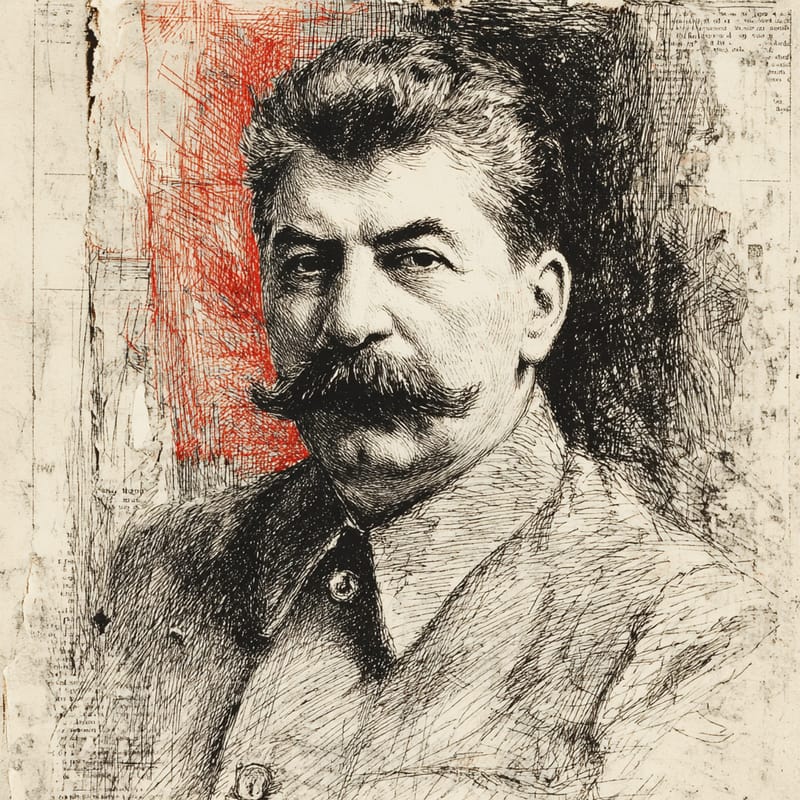
Joseph Stalin
Socialism in one country
Total state, five-year plans, terror.
Heterodox Stalinist-MarxistOne of 729 ideologies · enter the Stalinist-Marxist hall →- Role
- General Secretary
- Era
- 1878–1953
- Region
- Soviet Union
- Social band
- Heterodox
- Placement
- −98 · +98 · +30
§ Where Joseph Stalin stands
3 axesStalin ended Lenin's New Economic Policy and imposed near-total state ownership. The first Five-Year Plan, launched in 1928, set breakneck targets for heavy industry, and from 1929 his drive to liquidate the kulaks as a class forced peasants into collective farms, confiscated grain and deported better-off farmers, leaving almost no private economic activity beyond small household plots.
Stalin's rule was absolute. The NKVD's mass operations of 1937–38, launched by orders such as No. 00447, set regional quotas for executions and camp sentences, the Moscow show trials destroyed the old Bolshevik leadership, and the Gulag swallowed millions; his 1936 constitution promised civil rights on paper while a personality cult presented him as infallible.
Stalin's state was militantly atheist and modernising: churches were closed en masse and Moscow's Cathedral of Christ the Saviour was dynamited in 1931. Yet he also reversed early Soviet liberalism, recriminalising male homosexuality in 1934 and banning abortion in 1936, which is why his anti-traditional drive registers as only moderately progressive.
How close are you to Joseph Stalin?
Three statements, one per axis. Answer them and we’ll drop you on the compass next to them.
§ The story
HistoricalJoseph Stalin, born Ioseb Jughashvili (1878–1953), ruled the Soviet Union from the late 1920s until his death. The son of a cobbler in Gori, Georgia, he left an Orthodox seminary in Tiflis to become a Bolshevik organiser and fundraiser, including through bank robberies, and endured repeated arrest and Siberian exile. After the 1917 revolution he served as commissar for nationalities, and in 1922 he became general secretary of the Communist Party, a post he used to outmanoeuvre Trotsky, Zinoviev, Kamenev and Bukharin after Lenin's death.
Stalin forced the peasantry into collective farms and drove industrialisation through five-year plans, turning the Soviet Union into an industrial and military power at enormous human cost. The famine of 1932–33 killed millions, most of them in Ukraine and Kazakhstan, the Great Terror of 1937–38 alone saw roughly 680,000 people shot, and the Gulag held millions more. His government's 1939 pact with Hitler was followed by victory after the German invasion of 1941, and he imposed communist regimes across Eastern Europe. Khrushchev denounced his crimes and personality cult in 1956.
Notable for
- 01Forced collectivisation and the Five-Year Plans
- 02The Great Purge
- 03Soviet victory in WWII
Key works & moments
- 1922Becomes general secretary of the Communist Party, building a power base in its apparatus.
- 1928Launches the first Five-Year Plan; forced collectivisation of agriculture follows from 1929.
- 1932–33Collectivisation and grain requisitioning cause a famine that kills millions, above all in Ukraine and Kazakhstan.
- 1936–38The Great Terror: Moscow show trials and mass executions sweep through Soviet society.
- 1939His government signs the Nazi–Soviet pact, secretly dividing Eastern Europe with Hitler.
- 1945Leads the Soviet Union to victory over Germany and meets Allied leaders at Yalta and Potsdam.
In their own words
“We are fifty or a hundred years behind the advanced countries. We must make good this distance in ten years.”
§ Minds closest to Joseph Stalin
All minds →

§ Also in the Stalinist-Marxist hall
Enter the hall →§ Common questions
4 answersWhat was Joseph Stalin's political ideology?
Stalin was a Marxist-Leninist whose system came to be called Stalinism: on the 99ideologies three-axis compass, a Heterodox Stalinist-Marxist. Economically he sat at the far left (−98), replacing private enterprise with central planning and collective farms. On governance he was near the authoritarian maximum (+98), ruling through terror, the Gulag and a personality cult, and socially he leaned moderately progressive (+30): militantly atheist and modernising, but conservative on family, abortion and sexuality.
Was Joseph Stalin left-wing or right-wing?
Left-wing in economics and ideology, though his rule borrowed tools often associated with the right. Stalin led a communist party, abolished private ownership of industry and land, and justified everything in Marxist-Leninist terms, which puts him firmly on the far left. But he also promoted Russian nationalism, especially during the Second World War, rolled back early Soviet social liberalism and governed as a dictator, which is why many historians stress totalitarianism rather than left or right when describing his regime.
What is Stalinism?
Stalinism is the political and economic system Stalin built in the Soviet Union from the late 1920s. Its core features were a centrally planned, wholly state-owned economy; forced collectivisation of agriculture; the doctrine of socialism in one country, first set out in 1924; one-party rule enforced by secret-police terror and the Gulag; and a cult of the infallible leader. Nikita Khrushchev's 1956 secret speech, On the Cult of Personality and Its Consequences, condemned many of its crimes, and the label is often applied to similar regimes elsewhere.
Which minds are closest to Joseph Stalin?
On the 99ideologies three-axis compass, the minds closest to Joseph Stalin are Big Brother (99% alike), Lazar Kaganovich (97% alike) and Mao Zedong (96% alike). The furthest is Hans-Hermann Hoppe (0% alike).