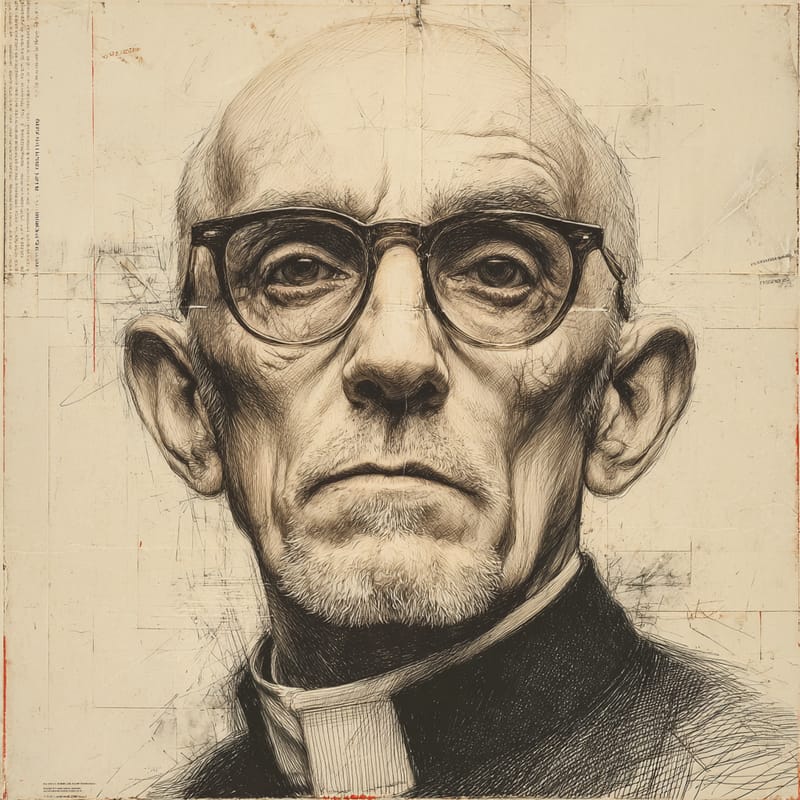
Luis Carrero Blanco
The regime's right hand
Continuity of the dictatorship.
Reactionary FrancoistOne of 729 ideologies · enter the Francoist hall →- Role
- Prime Minister
- Era
- 1904–1973
- Region
- Spain
- Social band
- Reactionary
- Placement
- +48 · +92 · −80
§ Where Luis Carrero Blanco stands
3 axesCarrero was the political patron of the technocrats, many linked to Opus Dei, who ended the Falange's autarky. He backed the 1959 Stabilisation Plan and promoted his protégé Laureano López Rodó, who ran the Development Plans from 1964 that opened Spain to foreign capital and tourism while the state still steered investment. Prosperity was offered in place of political freedom, a market-leaning but guided model.
Carrero devoted his career to perpetuating the dictatorship beyond its founder. He helped draft the 1947 Law of Succession, which declared Spain a kingdom with Franco as head of state for life, and worked to have Juan Carlos named successor in 1969. As prime minister from June 1973 he was expected to keep the system intact after Franco's death, with political parties still illegal.
Carrero was among the most traditionalist figures in the regime. A devout Catholic who attended Mass daily, he was an obsessive enemy of Freemasonry, which he blamed together with communism for Spain's misfortunes and attacked in polemics written under a pseudonym, and he saw the alliance of Church and state as the foundation of national unity.
How close are you to Luis Carrero Blanco?
Three statements, one per axis. Answer them and we’ll drop you on the compass next to them.
§ The story
HistoricalLuis Carrero Blanco (1904–1973) was Francisco Franco's closest political collaborator for three decades and, in 1973, his prime minister. Born in Santoña in Cantabria, he was a naval officer who served in the Moroccan war and spent the first months of the Civil War sheltering in a foreign embassy in Madrid before escaping to the Nationalist side. In 1941 Franco made him under-secretary of the presidency, the post from which he ran the machinery of government, and he became vice-president in 1967 and president of the government in June 1973.
Carrero was the regime's guarantor of continuity: a devout Catholic and fierce anti-communist who helped draft the 1947 Law of Succession, championed the technocrats who modernised the economy and steered the 1969 designation of Juan Carlos as Franco's heir. On 20 December 1973 the Basque separatist group ETA killed him with a bomb planted beneath a Madrid street, hurling his car over a building. His death removed the regime's chosen custodian and is widely seen as weakening hopes of Francoism without Franco.
Notable for
- 01Franco's right-hand man
- 02Chosen successor
- 03Assassinated by ETA
Key works & moments
- 1941Becomes under-secretary of the presidency, running the government machine for Franco.
- 1947Helps draft the Law of Succession, defining Spain as a kingdom with Franco head of state for life.
- 1959Backs the technocrats' Stabilisation Plan, which ends autarky and opens the economy.
- 1969Steers Juan Carlos's designation as Franco's successor and future king.
- 1973Becomes prime minister in June, the first head of government other than Franco since the war.
- 1973Killed on 20 December when an ETA bomb beneath a Madrid street blows up his car.
§ Minds closest to Luis Carrero Blanco
All minds →

§ Also in the Francoist hall
Enter the hall →The closest minds above are this hall’s whole roster.
§ Common questions
4 answersWhat was Luis Carrero Blanco's political ideology?
Luis Carrero Blanco was a Francoist of the Catholic right: on the 99ideologies three-axis compass, a Reactionary Francoist. Economically he sat right of centre (+48), sponsoring the technocrats who opened Spain's economy to markets and foreign capital. On governance he was near the authoritarian maximum (+92), working for three decades to entrench the dictatorship, and socially he was strongly traditionalist (−80), a devout Catholic and fierce enemy of communism and Freemasonry.
Was Carrero Blanco left-wing or right-wing?
Right-wing. Carrero was Franco's most loyal political lieutenant, a naval officer whose politics combined Catholic traditionalism, anti-communism and hostility to Freemasonry with a commitment to authoritarian continuity. His support for market-opening technocrats made him a modernising conservative in economics, but he resisted political parties, free unions and democratic reform, which places him squarely on the authoritarian right.
Why did ETA assassinate Carrero Blanco?
Because he was the dictatorship's designated custodian. ETA, the Basque separatist group, first planned to kidnap him and exchange him for prisoners, but switched to killing him after he became prime minister in June 1973. On 20 December explosives packed into a tunnel under Calle Claudio Coello in Madrid blew his car over a building as he returned from Mass. Many historians see his death as removing the figure best placed to keep Francoism intact after Franco, though its effect on the transition is still debated.
Which minds are closest to Luis Carrero Blanco?
On the 99ideologies three-axis compass, the minds closest to Luis Carrero Blanco are Camilo Alonso Vega (99% alike), José María Pemán (98% alike) and The National-Catholic State (archetype) (98% alike). The furthest is Emma Goldman (0% alike).