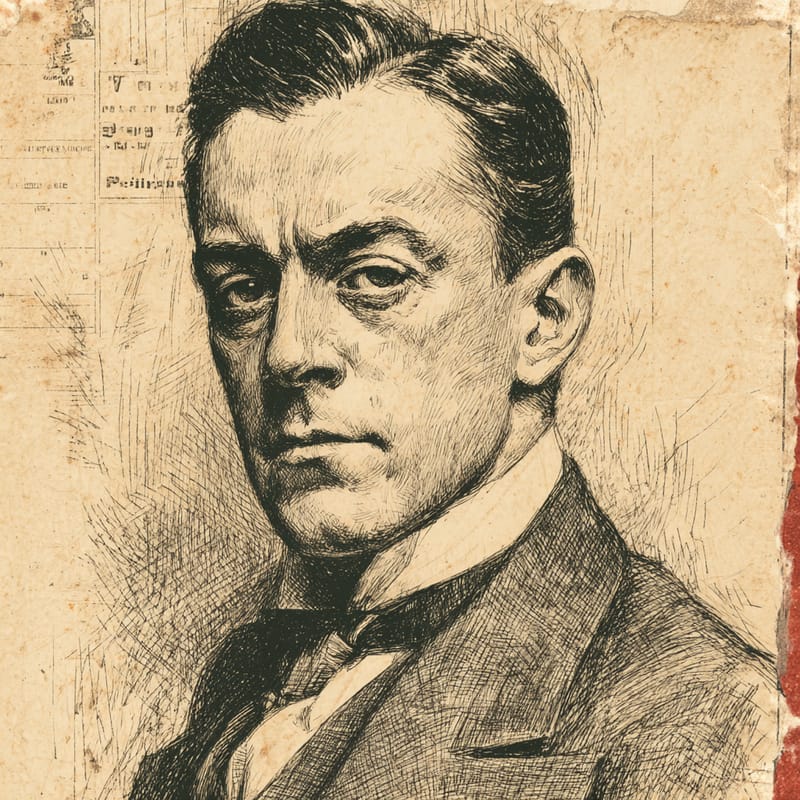
José María Pemán
The pen of the regime
Monarchist-Catholic legitimacy.
Reactionary FrancoistOne of 729 ideologies · enter the Francoist hall →- Role
- Writer & ideologue
- Era
- 1897–1981
- Region
- Spain
- Social band
- Reactionary
- Placement
- +46 · +88 · −80
§ Where José María Pemán stands
3 axesPemán wrote little on economics; his politics assumed the hierarchical, propertied Catholic society of his native Andalusia. He campaigned in the 1920s for Primo de Rivera's Patriotic Union, whose dictatorship settled labour disputes through corporatist joint committees, and backed the Nationalist order that reversed the Republic's land reform. His was an economics of order and property, placing him right of centre.
Pemán gave the dictatorships he served a cultured voice. He was a prominent figure in Primo de Rivera's single party, and in 1936 he chaired the Nationalist commission on culture and education in Burgos, which oversaw the purge of Republican schoolteachers. His speeches and verse justified the military rising as a national and religious crusade, though his ultimate loyalty was to the monarchy rather than to Franco.
Pemán's Catholicism and monarchism set him close to the traditionalist pole. El divino impaciente (1933) defended the Jesuits against the Republic's secular laws, his lyrics for the Marcha Real were widely sung as the national anthem under Franco, and his 1938 Poema de la Bestia y el Ángel framed the war as a struggle between Catholic Spain and atheist materialism.
How close are you to José María Pemán?
Three statements, one per axis. Answer them and we’ll drop you on the compass next to them.
§ The story
HistoricalJosé María Pemán y Pemartín (1897–1981) was a Spanish poet, playwright, journalist and orator from Cádiz, and the most celebrated literary voice of monarchist, Catholic Spain. A lawyer by training, he entered politics in the 1920s in the Patriotic Union, the single party of Miguel Primo de Rivera's dictatorship, and later wrote for the monarchist review Acción Española. His play El divino impaciente (1933), about the Jesuit missionary Francis Xavier, was a triumph widely read as a rebuke to the Republic, which had dissolved the Jesuits in 1932.
During the Civil War Pemán became the Nationalist cause's leading poet and speaker, chaired the commission that purged Republican teachers and wrote Poema de la Bestia y el Ángel (1938), which cast the war as a crusade of Christian Spain against an atheist beast. He twice served as director of the Royal Spanish Academy. A monarchist above all, he later counselled Don Juan de Borbón, the heir Franco passed over, and his wartime writings have kept him controversial since the return of democracy.
Notable for
- 01Regime ideologue and orator
- 02Monarchist-Catholic apologist
- 03Academician
Key works & moments
- 1920sWrites lyrics for the Marcha Real that are widely sung as Spain's anthem under Franco.
- 1933His play El divino impaciente, about Francis Xavier, answers the Republic's dissolution of the Jesuits.
- 1936Chairs the Nationalist commission on culture and education that purges Republican teachers.
- 1938Publishes Poema de la Bestia y el Ángel, casting the Civil War as a religious crusade.
- 1939Becomes director of the Royal Spanish Academy for the first time.
§ Minds closest to José María Pemán
All minds →

§ Also in the Francoist hall
Enter the hall →The closest minds above are this hall’s whole roster.
§ Common questions
4 answersWhat was José María Pemán's political ideology?
José María Pemán was a Catholic monarchist who lent his pen to Francoism: on the 99ideologies three-axis compass, a Reactionary Francoist. Economically he sat right of centre (+46), defending a traditional propertied order against the Republic's reforms. On governance he was strongly authoritarian (+88), serving Primo de Rivera's dictatorship and justifying Franco's rising, and socially he was strongly traditionalist (−80), devoted to Church, monarchy and the Catholic idea of Spain.
Was José María Pemán left-wing or right-wing?
Right-wing. Pemán belonged to the monarchist, Catholic right that opposed the Second Republic's secular and social reforms, and he became one of the Nationalist side's best-known propagandists in the Civil War. His later loyalty to the exiled Don Juan de Borbón put some distance between him and Franco, and his later journalism was milder in tone, but his ideas remained those of the traditionalist, authoritarian right.
Was José María Pemán a Francoist?
Yes during the Civil War and the early dictatorship, though he was a monarchist first. Pemán backed the 1936 rising, chaired the Nationalist commission that purged Republican teachers, wrote the war epic Poema de la Bestia y el Ángel and headed the Royal Spanish Academy under the new regime. But he saw Franco's rule as a bridge to a restored monarchy, and when Franco passed over Don Juan de Borbón he became one of the exiled heir's leading counsellors, siding with the dynasty's claims rather than Franco's own succession plans.
Which minds are closest to José María Pemán?
On the 99ideologies three-axis compass, the minds closest to José María Pemán are Luis Carrero Blanco (98% alike), The National-Catholic State (archetype) (98% alike) and Camilo Alonso Vega (98% alike). The furthest is Emma Goldman (0% alike).