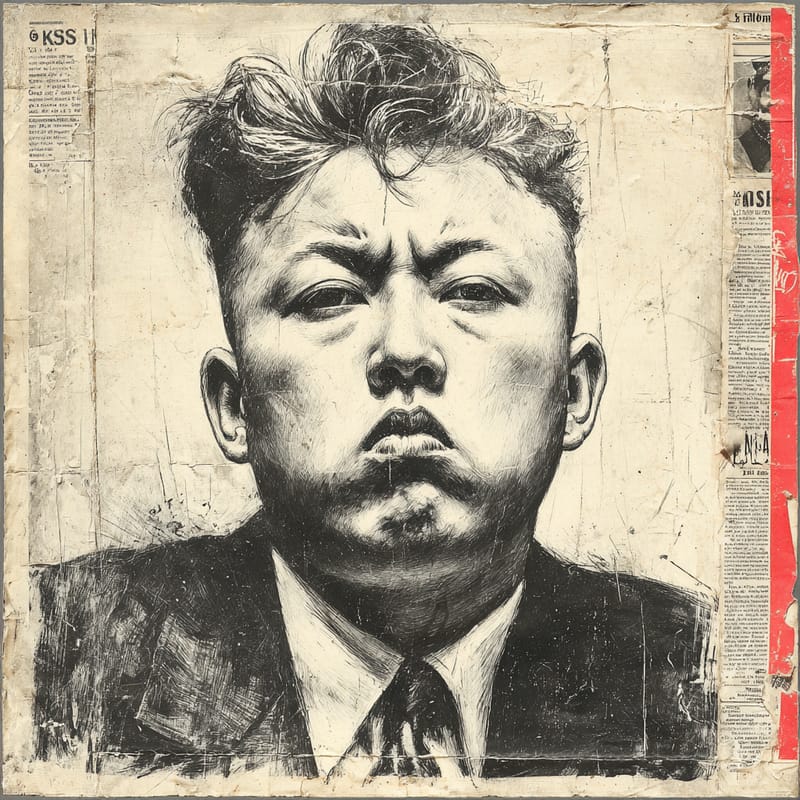
Kim Jong-un
The third generation
Byungjin — bombs and limited markets.
JuchistOne of 729 ideologies · enter the Juchist hall →- Role
- Supreme Leader
- Era
- b. 1984
- Region
- North Korea
- Social band
- Centre (no modifier)
- Placement
- −74 · +98 · 0
§ Where Kim Jong-un stands
3 axesKim has kept the commanding heights in state hands while tolerating far more market activity than his predecessors. The byungjin line adopted in March 2013 promised economic growth alongside nuclear weapons, his government accepted the private jangmadang markets and gave farms and enterprises more say over output, and in the early 2020s it moved to tighten state control over the grain trade.
Kim maintains absolute dynastic rule. In 2013 state media announced the execution of his uncle and former mentor Jang Song-thaek, he took the titles of party chairman in 2016 and general secretary in 2021, and a 2022 law on nuclear forces policy placed the arsenal under his sole command while permitting pre-emptive use.
Kim's social stance pairs a more modern public image with unrelenting control. He appears in public with his wife, Ri Sol-ju, and opened leisure projects such as the Masikryong ski resort at the end of 2013, yet the 2020 Reactionary Ideology and Culture Rejection Act imposes harsh penalties, including death in serious cases, for spreading South Korean films and music.
How close are you to Kim Jong-un?
Three statements, one per axis. Answer them and we’ll drop you on the compass next to them.
§ The story
LivingKim Jong-un (b. 1984) has ruled North Korea since December 2011, the third member of his family to lead the country. A younger son of Kim Jong-il, he was born in 1984 according to most accounts, was reportedly educated partly in Switzerland and attended Kim Il-sung Military University. Introduced to the public in 2010 as a four-star general and vice-chairman of the party's Central Military Commission, he was proclaimed his father's successor days after Kim Jong-il's death and named supreme commander before the end of 2011.
Kim has accelerated North Korea's nuclear and missile programmes, overseeing four of its six nuclear tests between 2013 and 2017 and its first launches of intercontinental ballistic missiles. In 2013 state media announced the execution of his uncle Jang Song-thaek for treason. A burst of diplomacy in 2018–19, including summits with South Korea's Moon Jae-in and three meetings with US President Donald Trump, ended without a denuclearisation deal. He later declared South Korea a hostile state, abandoning the goal of peaceful reunification, and in 2024 signed a mutual-defence treaty with Russia.
Notable for
- 01Third-generation dynastic rule
- 02Accelerated nuclear program
- 03Byungjin line
Key works & moments
- 2010Appears publicly as a four-star general and vice-chairman of the Central Military Commission.
- 2011Succeeds his father Kim Jong-il as supreme leader after his death in December.
- 2013Adopts the byungjin line; his uncle Jang Song-thaek is executed in December.
- 2017North Korea conducts its sixth and largest nuclear test and launches its first ICBMs.
- 2018Meets South Korea's Moon Jae-in at Panmunjom and Donald Trump in Singapore.
- 2024Signs a treaty with a mutual-defence clause during Vladimir Putin's visit to Pyongyang.
§ Minds closest to Kim Jong-un
All minds →

§ Also in the Juchist hall
Enter the hall →The closest minds above are this hall’s whole roster.
§ Common questions
4 answersWhat is Kim Jong-un's political ideology?
Kim Jong-un rules according to Kimilsungism-Kimjongilism, the official ideology built on his grandfather's Juche doctrine of self-reliance: on the 99ideologies three-axis compass, a Juchist. Economically he sits well to the left (−74), keeping a state-owned economy while tolerating private markets. On governance he is at the authoritarian extreme (+98), heading a hereditary one-party state with sole command of nuclear weapons, and socially he sits at the centre (0), pairing a more modern image with strict cultural control.
Is Kim Jong-un left-wing or right-wing?
Nominally left-wing, but his rule fits the left-right spectrum poorly. North Korea's ruling Workers' Party descends from the communist movement and the state owns the commanding heights of the economy, placing Kim on the left economically. Yet his authority rests on hereditary succession, ethnic nationalism and a leader cult rather than on Marxist class politics, so most analysts describe his regime as a dynastic totalitarian state rather than as a conventional left-wing government.
Is North Korea still communist under Kim Jong-un?
Only in a limited sense. North Korea remains a one-party state with a largely state-owned, planned economy, and the Workers' Party traces its roots to the communist movement. But references to communism were removed from the constitution in 2009, and since 2012 the party's guiding ideology has been Kimilsungism-Kimjongilism, centred on Juche and the Kim family. Under Kim Jong-un private markets have spread, even as the state has tried to keep them in check, so the system is better described as dynastic state socialism.
Which minds are closest to Kim Jong-un?
On the 99ideologies three-axis compass, the minds closest to Kim Jong-un are Kim Jong-il (99% alike), The Eternal Leader (archetype) (98% alike) and Kim Il-sung (97% alike). The furthest is Hans-Hermann Hoppe (0% alike).