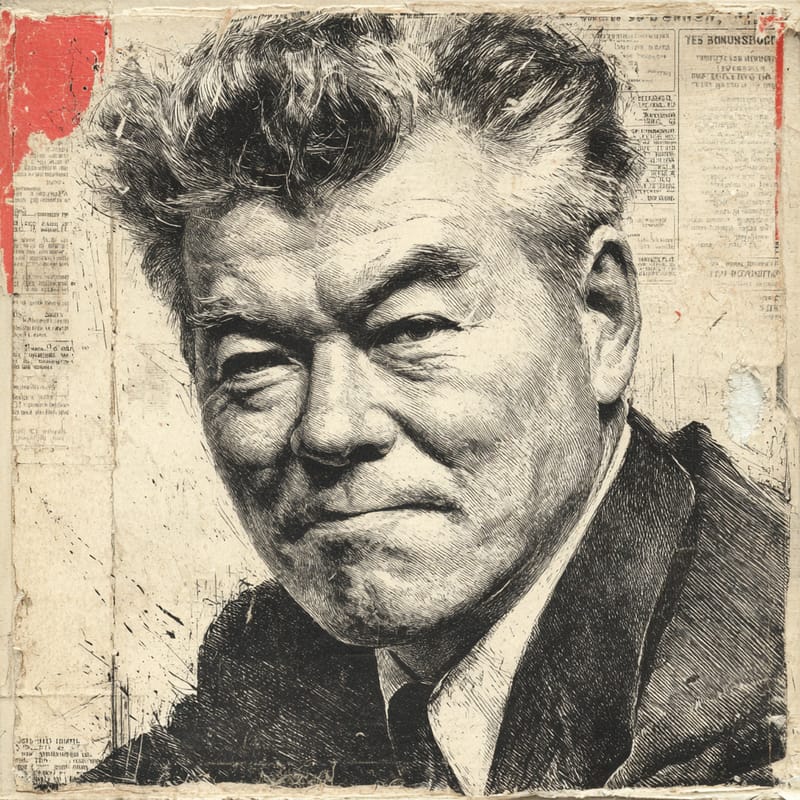
Kim Il-sung
The author of Juche
Self-reliance as state religion.
JuchistOne of 729 ideologies · enter the Juchist hall →- Role
- Eternal President
- Era
- 1912–1994
- Region
- North Korea
- Social band
- Centre (no modifier)
- Placement
- −78 · +98 · +5
§ Where Kim Il-sung stands
3 axesKim's state confiscated landlord holdings without compensation in the land reform of March 1946 and nationalised major industry the same year, then completed the collectivisation of agriculture by 1958. Mass-mobilisation drives such as the Chollima Movement launched in 1958 pushed output in a planned, autarkic economy, leaving little private activity beyond small household plots.
Kim crushed every rival faction, defeating the so-called August faction that challenged him at a party plenum in 1956 and purging pro-Soviet and pro-Chinese communists. The 1972 Socialist Constitution made him president, the Ten Principles of 1974 demanded absolute loyalty to the leader, and political prison camps punished dissent across whole families and generations.
Kim's rule fused revolutionary modernisation with national tradition. His state abolished the landlord class, decreed legal equality of the sexes in 1946 and suppressed religion, but it also recast Confucian loyalty and filial piety as devotion to the leader as father of the nation, while the songbun system ranked every family by inherited political loyalty. The two pulls leave him close to the centre.
How close are you to Kim Il-sung?
Three statements, one per axis. Answer them and we’ll drop you on the compass next to them.
§ The story
HistoricalKim Il-sung (1912–1994), born Kim Song-ju near Pyongyang, founded the Democratic People's Republic of Korea and ruled it from 1948 until his death, first as premier and, from 1972, as president. His family moved to Manchuria, where he joined the Chinese Communist Party and fought as a guerrilla against Japanese rule in the 1930s. Driven into the Soviet Union around 1940, he served in the Red Army and returned to Korea in 1945 with Soviet backing, becoming leader of the new northern state.
Kim launched the Korean War by invading the South in June 1950, a conflict that killed millions and ended in a 1953 armistice that left the peninsula divided. He then purged rival factions, built a Stalinist command economy and developed Juche, a doctrine of national self-reliance, into the official ideology of an intensely personal dictatorship. He arranged for his son Kim Jong-il to succeed him, creating communism's first hereditary dynasty, and four years after his death the 1998 constitution named him the country's Eternal President.
Notable for
- 01Founded the DPRK
- 02Authored Juche ideology
- 03Established a hereditary dynasty
Key works & moments
- 1937Leads a guerrilla raid on Pochonbo, a Japanese-held town on the Korean border.
- 1948Becomes premier of the newly founded Democratic People's Republic of Korea.
- 1950Invades the South, starting the Korean War; an armistice follows in July 1953.
- 1955Sets out Juche in a speech against dogmatism and formalism in ideological work.
- 1972A new socialist constitution names Juche the state's guiding idea and makes him president.
- 1994Dies on 8 July; the 1998 constitution later names him Eternal President.
§ Minds closest to Kim Il-sung
All minds →

§ Also in the Juchist hall
Enter the hall →The closest minds above are this hall’s whole roster.
§ Common questions
4 answersWhat was Kim Il-sung's political ideology?
Kim Il-sung was the founder of Juche, North Korea's doctrine of self-reliance, which grew out of Marxism-Leninism: on the 99ideologies three-axis compass, a Juchist. Economically he sat well to the left (−78), presiding over land reform, nationalisation and a planned, autarkic economy. On governance he was at the authoritarian extreme (+98), building a hereditary one-party state around his own cult, and socially he sat near the centre (+5), combining revolutionary modernisation with Confucian-style loyalty to the leader.
Was Kim Il-sung left-wing or right-wing?
Left-wing in origin and economics. Kim was a Chinese Communist Party guerrilla and a Soviet-backed communist who abolished private ownership of land and industry and built a planned economy, which places him on the far left. Over time, however, Juche replaced Marxist class politics with ethnic nationalism and a quasi-religious leader cult passed from father to son, features some scholars see as closer to the far right, so his regime defies a simple left-right label.
Did Kim Il-sung start the Korean War?
Yes. North Korean forces crossed the 38th parallel on 25 June 1950 on Kim's orders, in an invasion he had pressed Stalin to approve. Soviet archival documents released in the 1990s show that Stalin gave his consent in spring 1950 on condition that Mao Zedong agreed, and Mao did. Pyongyang has always claimed the South attacked first, but historians accept that the war began as a planned North Korean offensive, which drew in UN forces led by the United States and later Chinese troops.
Which minds are closest to Kim Il-sung?
On the 99ideologies three-axis compass, the minds closest to Kim Il-sung are The Eternal Leader (archetype) (99% alike), Kim Jong-il (98% alike) and Kim Jong-un (97% alike). The furthest is Hans-Hermann Hoppe (0% alike).